
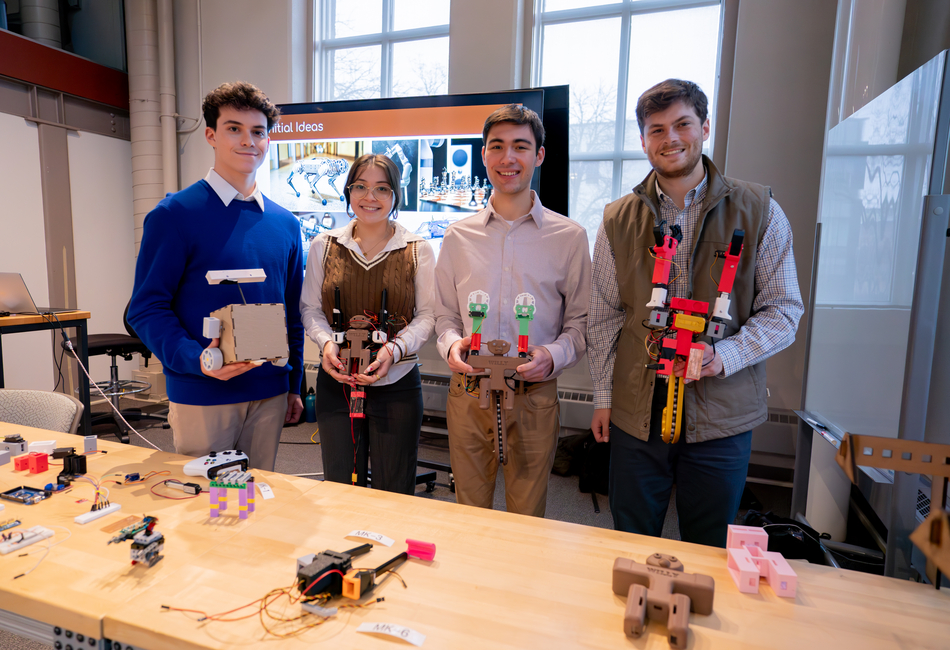
In 2025, Lehigh University celebrates the 30th anniversary of its Integrated Product Development (IPD) program: a pioneering initiative that forever changed the way the university approaches interdisciplinary education, real-world problem-solving, and entrepreneurial thinking. Launched in 1995 as a bold collaboration between Lehigh’s engineering and business colleges, IPD broke traditional academic boundaries by bringing together students from engineering, business, and design to work on sponsored product development challenges. Over the past three decades, IPD has not only served as the progenitor of Lehigh’s interdisciplinary capstone design programs, but also as the spark that ignited the university’s now-thriving entrepreneurship ecosystem.’
With the emergence of IPD, teams of students and faculty from engineering, business, and design arts collaborated year‑long on real, sponsored product development projects: from lunar dust‑shielding spacesuit joints for NASA, to surgical safety tools, to automotive spoilers.
This innovative program taught students not just design and prototyping, but also marketing, finance, ergonomics, and team leadership—preparing graduates to “hit the ground running” in industry or to launch their own ventures.
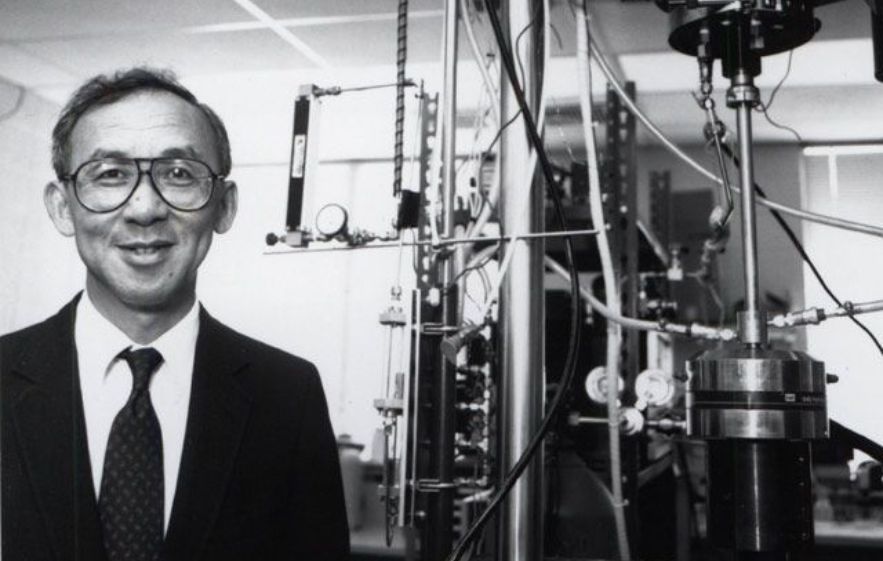
Professor Robert P. Wei (1931-2015), an expert in fracture mechanics, took the lead in creating IPD in the early 1990s. Wei and several other mechanical engineering professors decided the engineering college needed to promote hands-on learning and group projects.
“We recognized that students today were more computer-literate than before, but less mechanically literate,” Wei said at the time, citing advances in technology. “In the old days, you could open the hood of a car and see the spark plugs, the carburetor and the engine. You could tweak things. Now, if you open the hood, you can barely find the oil dipstick.”
“Bob started the IPD program with an industry workshop that resulted in an on-campus effort to improve engineering design in the undergraduate mechanical engineering curriculum,” recalled John Ochs, professor of mechanical engineering and mechanics, who directed the IPD program from its inception through to his retirement in 2018. “I recall Bob saying that he knew that the IPD program was important to the department, the college, the university, the region and the country.”
Acting on Wei’s recommendations, the engineering college launched the Freshman Design class, in which engineering students take apart and reassemble electromechanical devices and go on to design and make their own products.
In 1995, the mechanical engineering department established the yearlong IPD class, in which teams of students from engineering, business and the arts work with an industrial sponsor to design and make products and develop marketing plans for them.
Led by Ochs and Todd Watkins, currently the Arthur F. Searing Professor of Economics at Lehigh, IPD earned national recognition within just a few years: winning awards from the American Society of Mechanical Engineers, coverage in The New York Times, invitations to national competitions, and national awards via the NCIIA (now VentureWell)

Institutionalizing interdisciplinary thinking
As IPD’s reputation grew, Lehigh institutionalized the program. By 1996, the IPD capstone course was cross‑listed through engineering and business, supported by external sponsors, and hosted in a renovated campus building—later known as the Wilbur Powerhouse—to serve as a hub for prototyping, teamwork, and design innovation.
Soon, roughly 120 juniors and seniors participated annually across disciplines, working alongside faculty from engineering, business, and design arts.
In 1997, Ochs and colleagues initiated the Integrated Learning Experience (ILE) faculty working group, which spawned nearly fifty pilot interdisciplinary courses across Lehigh’s colleges.
Within a decade, two‑thirds of undergraduates had engaged in IPD‑like inquiry projects—showing that the IPD model had effectively seeded a campus‑wide interdisciplinary culture.
Growing an entrepreneurship ecosystem
IPD’s emphasis on commercialization and real‑world innovation naturally led toward broader entrepreneurship initiatives at Lehigh. In 2002 Lehigh opened Wilbur Powerhouse, renewing its physical infrastructure to house IPD alongside complementary programs: Integrated Business and Engineering (IBE) and the design‑arts initiative.
In 2003, the Lehigh Entrepreneurs Network (LEN) was launched with a $50,000 grant from the Kauffman Foundation. The network was envisioned explicitly to support IPD students by linking alumni, faculty, and entrepreneurs campus‑wide
That same year, Lehigh formally established an entrepreneurship minor, strengthening academic infrastructure and signaling institutional commitment to student entrepreneurship
Lehigh also introduced the Integrated Business and Engineering (IBE) Honors Program in the late 1990s. IBE featured its own two‑semester capstone design course, where business and engineering students worked on real‑world corporate sponsorships, blending design, finance, and strategy in highly structured teams.
Building on two decades of success with IPD, Lehigh introduced in 2010 a Master of Engineering in Technical Entrepreneurship, a one‑year professional graduate curriculum based on the IPD blueprint. This program requires students to “learn by launching”—conceiving a technology‑based product and bringing it to market within a year, with product development and venture launch as graduation requirements.

Starting in 2012, IPD was rebranded as the Technical Entrepreneurship Capstone Projects program to align with Lehigh’s burgeoning graduate‑level TE programs. Today, undergraduates in this program work in multi‑disciplinary teams of six or seven, collaborating with industry mentors and sponsors to develop prototypes and business plans, mirroring IPD’s original ethos.
Institutional expansion
The intellectual and structural momentum generated by IPD paved the way for the establishment in 2010 of the Dexter F. Baker Institute for Entrepreneurship, Creativity, and Innovation, funded by a major gift from alumnus and retired Air Products CEO Dexter Baker (1937-2012.)
The Baker Institute became the umbrella for IPD (now the undergrad capstone), IBE, the entrepreneurship minor, the technical entrepreneurship master’s program, and dozens of other entrepreneurship‑related initiatives—open to students across all colleges.
By 2013, the entrepreneurship ecosystem supported by the Baker Institute encompassed roughly 3,400 students in courses, 55 ventures in development, and dozens of academic and co-curricular programs such as pitch competitions, venture challenges, and themed startup tracks
In 2019, Professor Sabrina Jedlicka, who now serves as Lehigh’s Deputy Provost of Graduate Education, took the lead on the effort to grow IPD into a campuswide, interdisciplinary capstone design program.
“Capstone design should be a joyous experience,” she said in a 2019 interview for Lehigh’s Resolve magazine. “I vividly remember the team realizing, I learned this concept as a sophomore, and this skill last semester, and it turns out these things actually are related! They do apply to solving engineering problems! The capstone represents that moment in your academic career when you get to integrate the concepts from your coursework; during the capstone experience, students should see how the physical, the analytical, the technical, and the other skills they have gained fit together.”
According to Jedlicka, growing the IPD program to include projects that appeal to a broader base of students—and finding new ways to incorporate students from other majors across campus—is a natural evolution of Lehigh's heritage in easing the boundaries between the classroom and real world problems.
“Communicating across disciplines is critical to addressing the world’s challenges, so we need to train our students to think beyond these disciplinary silos,” says Jedlicka. “The best way to prepare them is to give them projects with no easy solutions; projects that require a team approach. We want them to work together, applying their unique skillsets and perspectives to problems they would encounter in the workforce.”
Reflecting on IPD’s Legacy
Looking back, it is clear that IPD was not merely a capstone class—but a transformative educational model that catalyzed Lehigh’s entrepreneurship revolution. Originally focused on product design, IPD systematically taught students to think entrepreneurially across disciplines. Its organizers—particularly Ochs and Watkins—extended that DNA throughout the university via ILE, IBE, the entrepreneurship minor, the graduate TE program, the Baker Institute.
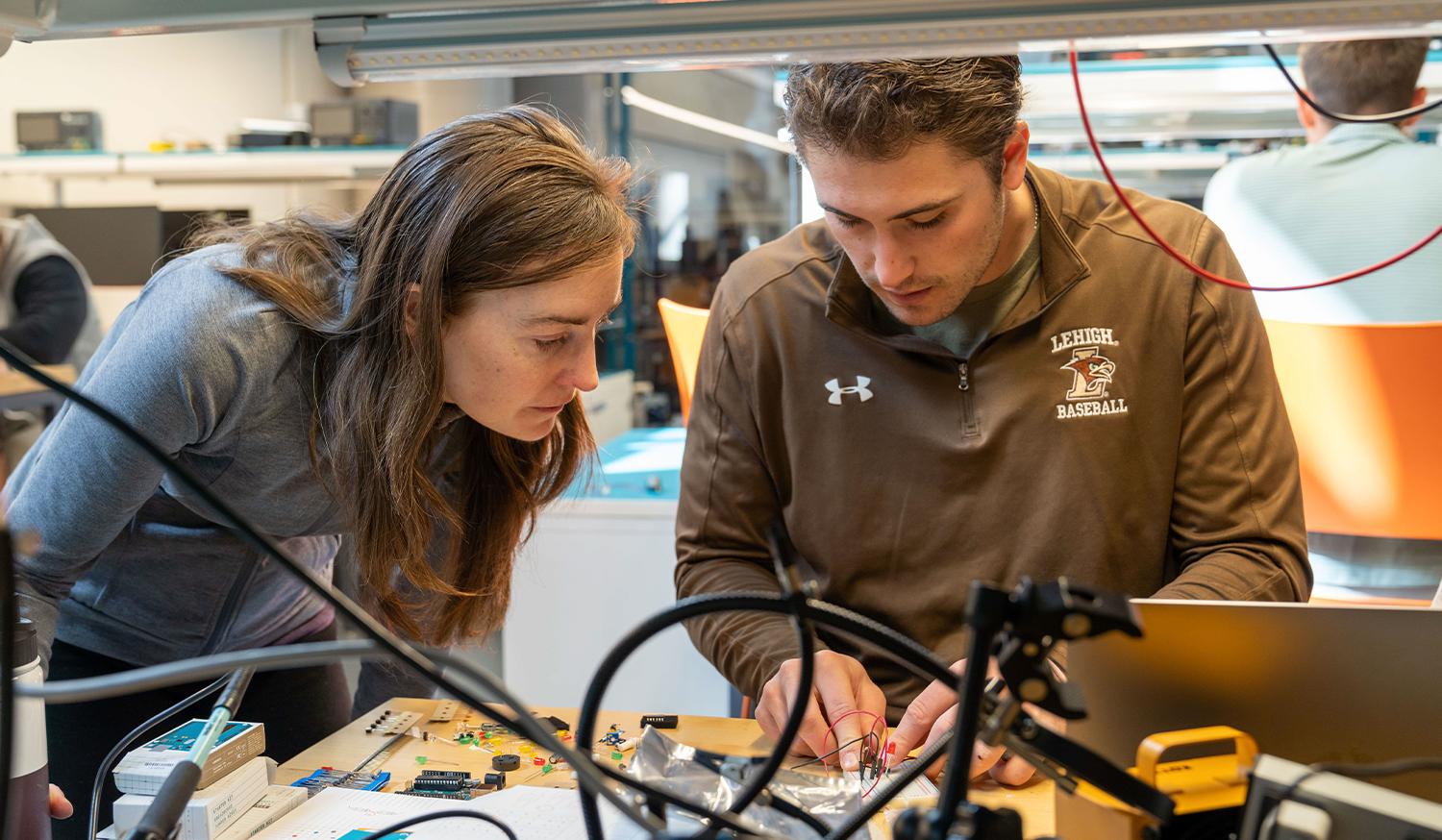
IPD spurred startups such as EcoTech Marine (founded by IPD alumni) that returned to campus to sponsor new teams, closing the loop between innovation and enterprise. TE has spawned a number of successful startups, including Goblies, a type of throwable paintball invented by Lehigh University graduate Briana Gardell, and Zaffrus, graduate Ali Almasi’s company that focuses on importing and selling saffron.
Even as IPD evolved and graduate offerings matured, the underlying mission has remained: to teach students how to innovate and commercialize—and to prepare them to build sustainable companies.
From its inception in 1994, Lehigh’s IPD program evolved into the foundation for Lehigh’s modern interdisciplinary capstone design ethos—and, perhaps more importantly, as the spark igniting a full university-scale entrepreneurship infrastructure. By embedding real-world, cross-disciplinary, inquiry‑based design into required curricula, IPD went beyond technical education to foster entrepreneurial mindsets. Its success prompted the creation of the Baker Institute, an entrepreneurship minor, integrated programs like IBE, graduate degrees in technical entrepreneurship, and a rich ecosystem of venture-oriented activities.
In short, IPD was never just a course—it was a catalyst. Its founding vision continues to animate Lehigh’s commitment to experiential, interdisciplinary design and innovation education, making it one of the nation’s most entrepreneurial undergraduate institutions by the mid‑2020s.