By Christine Fennessy
The conditions inside a rotating detonation engine (RDE) are extreme: Combustion travels faster than the speed of sound, temperatures can approach the melting point of the metals containing it, and materials must withstand intense pressure and chemical interactions.
For first-year mechanical engineering PhD student Nathaniel Dudko ’25, that complexity is precisely the appeal.
“There are so many variables and tradeoffs you have to consider in designing an RDE,” he says. “A material might work from a thermal perspective but then degrade from the pressure or chemical interactions. I like the extreme nature of this particular problem.”
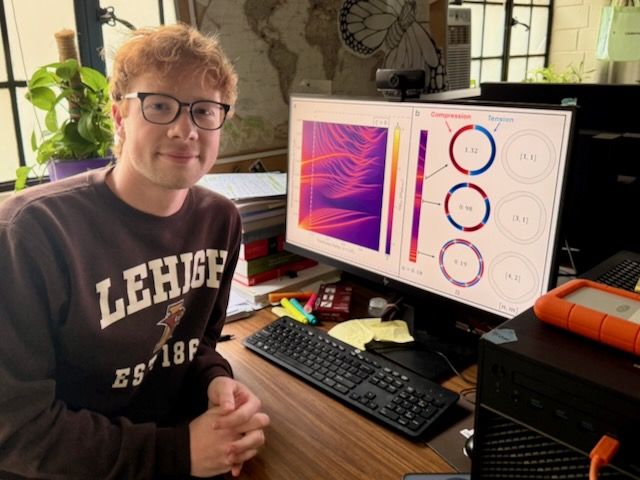
Dudko is part of a Lehigh research team developing modeling and simulation tools to guide the design of rotating detonation engines, an emerging propulsion technology with potential applications in aerospace. The project, led at Lehigh by Natasha Vermaak, associate professor of mechanical engineering and mechanics, is a collaboration with researchers at Carnegie Mellon University and the University of California, Irvine.
Unlike traditional rocket engines, RDEs generate power by sustaining a circular detonation wave in an annular, or ring-shaped, chamber. The fuel-air mixture burns at thousands of meters per second, potentially enabling more compact, efficient engines with higher thrust-to-weight ratios.
“But it’s a very extreme environment because the wave is moving at such high speed and the temperatures are at the melting point of the metals that contain it,” Dudko says. “So we’re looking at how we can design a material and structure for that environment.”
A path toward research
Dudko hadn’t planned on pursuing a PhD when he arrived at Lehigh.
A mechanical engineering major interested in aerospace, he gained experience in Vermaak’s Thermostructural Lab and completed internships at the Air Force Research Laboratory (AFRL), where he worked on composites and antennas for spacecraft, and Los Alamos National Laboratory, where he assisted a team studying shape memory alloys for hypersonic vehicles.
“I really enjoyed the work culture and the environment in the labs, and the problems were so complex and interesting,” he says. “I think I’d like to lead my own lab eventually, and I knew getting a PhD could help me do that.”
When Dudko began considering graduate school, he turned to Vermaak to talk through his options. She told him about the RDE project her team was preparing to undertake.
“My main interest is in aerospace, and RDEs are potentially a new kind of rocket engine,” he says. “So it was a good fit for me.”
Recognition and opportunity
Now, Dudko’s path toward a research career has received national recognition. He was selected for a three-year National Defense Science and Engineering Graduate (NDSEG) Fellowship, a highly competitive program supporting graduate students in disciplines relevant to the mission of the U.S. Department of Defense.
The fellowship covers full tuition and required fees and provides an annual stipend of $43,200, along with travel and health care benefits. For Dudko, however, one of its biggest draws is the opportunity to work with a research mentor within AFRL.
“I’ve had great mentors here at Lehigh and at both my internships as an undergrad,” he says. “I know how effective they can be in moving your work forward and broadening your professional circle. The mentorship aspect of this award is what I’m looking forward to the most.”
Dudko credits the research experiences he had as an undergraduate—both on campus and through internships—with helping him figure out what he wanted from graduate school. He now encourages prospective and incoming Lehigh students to explore faculty labs, discover what kinds of problems interest them, and connect with professors. He also points to engineering clubs as another way to build skills and community; Dudko joined the Lehigh University Space Initiative on the first day of his first year.
He remembers arriving at Lehigh from a high school with a stronger focus on music and the arts than on STEM and worrying that he would be starting from scratch as an engineer.
“I tell new students all the time, ‘Even if you have no engineering experience, you will succeed,’” he says. “Lehigh will do an amazing job getting you where you need to be.”
For Dudko, the fellowship is recognition of how far he's come since his first days at Lehigh.
“I’ve spent my internships with very smart students from other universities, but from what I’ve seen, the average Lehigh student has so much more hands-on experience, and that sets them apart,” he says. “It’s not only helped me in my career, but it’s helped me become a more well-rounded person overall.”