
By Editorial Services
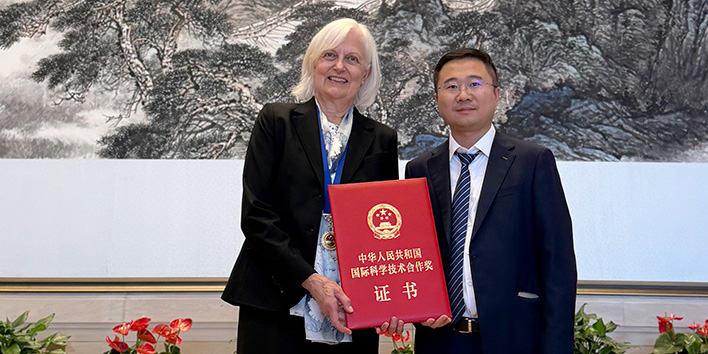
Elsa Reichmanis, Professor and Carl Robert Anderson Chair in the Department of Chemical and Biomolecular Engineering at Lehigh University, has received China’s International Cooperation Award in Science & Technology, a recognition that honors individuals whose work has strengthened scientific collaboration, education, and international exchange.
For Reichmanis, the award reflects decades spent building relationships across the global scientific community—not through large international research programs, but by mentoring students, advising academic leaders, participating in scientific exchanges, and helping create opportunities for researchers to connect across borders.
“There is value in building communication networks broadly,” Reichmanis says. “It’s a benefit to fundamental science because bringing in different perspectives can stimulate different ways of thinking about problems. That can then stimulate identifying new directions in science, building knowledge that benefits everybody globally.”
Science as a Common Language
Beginning with visits to China as part of an American Chemical Society delegation more than 20 years ago, Reichmanis has participated in international symposia, served on advisory committees, and helped foster connections among researchers and educators. She describes those efforts as using science as a common language—one that creates opportunities for meaningful dialogue and long-term professional relationships.
“Science can develop a path to communication,” she says. “And with communication, it’s a step toward building trust.”
Expanding Perspectives Beyond Borders
Throughout her career, Reichmanis, who also directs Lehigh’s Institute for Functional Materials and Devices (I-FMD), has championed collaboration as a driver of scientific discovery. She believes that researchers working across disciplines, institutions, and national boundaries are often able to tackle questions that would be difficult to address alone.
“One individual working with someone else expands what they’re able to think about and what they're able to accomplish,” she says. “Through that collaboration, you get to do more—and maybe do something that's more significant.”
Investing in the People Behind Scientific Progress
While Reichmanis says she does not seek recognition, she views the award as an affirmation of the importance of investing in the people and professional relationships that underpin scientific progress.
“The broader science base benefits everyone,” she says. “That’s how fundamental science moves forward.”