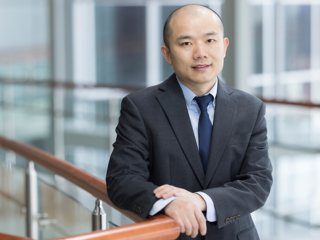
Jifu Tan, PhD Mechanical Engineering ’15: Teaching as he was taught
A Lehigh PhD now guides his own students in the same spirit he was mentored, even using his former professor’s textbook in his own classroom.
Finding Lehigh
Jifu Tan’s path to Lehigh began with a change of plans. He had originally enrolled in the PhD program at the University of Texas at Arlington in 2009, but he moved to Lehigh the following year with his advisor.
As an undergraduate, Tan wasn’t especially passionate about his major. He wanted to work with “high technology,” and began thinking more carefully about what he enjoyed: math, mechanics, and programming.
That self-assessment led him toward numerical methods for solving equations that describe physical phenomena and toward a professor whose research aligned with those interests.
A small campus, a close community
Tan found Lehigh’s compact campus and close-knit research community particularly appealing. His lab included Chinese, American, Turkish, Iranian, and Indian students across several graduating classes, creating a diverse community that extended well beyond the classroom.
There was plenty of time for fun, too. When his advisor left for the evening, labmates would form two-person teams for video games in adjoining lab rooms, trading good-natured trash talk through the shared wall. Tan played basketball at least twice a week and took advantage of Lehigh After Dark, which gave students opportunities to stay active and socialize through late-night recreation.
That balance helped make the demands of doctoral study sustainable, Tan says: a small-town setting, a supportive lab community and friends with whom he could unwind.
A class that still pays off
Some of Tan’s most valuable lessons at Lehigh came from pushing himself beyond the minimum requirements. He chose the more challenging graduate section of a parallel computing course, even though the undergraduate version would have satisfied his requirement. The workload was intense, with projects that sometimes kept him up past 3 a.m.
The investment paid off. The CPU- and GPU-based computing techniques he learned in the course in 2011 and 2012 are still central to his research in biological fluid mechanics, where he relies on large-scale computing.
He also remembers a fluid mechanics professor at Lehigh who wrote his own textbook and eventually made it available free online. Tan still has his copy—and today, teaching fluid mechanics himself at Binghamton, he uses that same textbook in his own classroom.
How Lehigh prepared him for a career in science
After completing his PhD, Tan was offered postdoctoral positions at both Duke University and the University of Pennsylvania; he chose Penn, staying closer to the network he’d built at Lehigh. He became an assistant professor and later was promoted to an associate professor at a university in Illinois before joining the mechanical engineering faculty at The State University of New York at Binghamton, a public ivy, where he’s now an assistant professor.
Three other faculty members in his department are also Lehigh PhDs who Tan didn’t personally know before he arrived. To him, that’s a telling detail: a research university hired him and his colleagues on the strength of Lehigh’s training and reputation alone, not personal connections. Lehigh’s Rossin Doctoral Fellows program gave him some of the concrete skills behind that reputation: Practical training in academic writing, networking, and teaching that he still draws on today.
But what left the deepest mark, Tan says, was less a specific skill than a model: how Lehigh’s professors taught, how they treated and mentored their students, and who they were as people. That model of teaching and mentorship is what he says he’s carried most directly into his own research and his own classroom.
His advice: Take ownership of the decision
Tan is direct about what does and doesn’t work when it comes to studying abroad. If the motivation comes primarily from a parent, he says, the challenges of the experience can become a source of regret rather than growth.
He also believes students benefit from reaching out to professors directly and early, rather than waiting. And he’s skeptical of the idea that a university’s name alone determines a student’s success.
A student who is motivated enough to earn an opportunity, he says, is likely to make the most of the resources available to them wherever they study.
Nearly two decades after leaving China, Tan sees his Lehigh experience as more than a credential. It gave him habits that have continued to shape his career: curiosity, self-direction and a willingness to take the harder path.
Now, in his own classroom and lab at Binghamton, he is passing that same model of teaching and mentorship on to his own students.
Jifu Tan,理海大学机械工程博士(2015届):用他被教导的方式去教书
从理海大学走出来的这位博士,如今在宾汉姆顿大学的讲台上延续着当年的学术薪火。不仅是那份治学精神,甚至在一门他教授的课上,使用着当年理海大学教授亲手写下的教材。
与理海结缘
Jifu Tan通往理海的路,源于一次意外的转折。2009年,他原本打算在德州大学阿灵顿分校跟随导师开展学习工作,但第二年导师转去了理海,他的申请和求学之旅也随之转向。
申请之际,Tan对自己的本科专业并没有太大热情。他想做的是“高科技”,而不是和自己当时理解的土木工程里的钢筋水泥打交道,于是他开始认真思考自己真正喜欢、擅长的东西:数学、力学和编程。
这次自我审视和深思把他引向了利用数值方法求解描述物理现象的方程这一方向,也引向了一位研究方向与此契合的教授,让他最终与理海结缘。
精致的校园,紧密的社区
Tan特别喜欢理海紧凑的校园和紧密的科研社区。他的实验室里汇聚了来自中国、美国、土耳其、伊朗和印度等不同国家、不同年级的学生。这个多元化的群体不仅在课内碰撞火花,其深厚的情谊更延伸到了课堂之外。
紧张的科研之余,他们的业余生活也丰富多彩。实验不太忙、导师不在的晚上,同学们就会两两组队,隔着墙开黑打游戏,互相损对方几句。Tan每周至少打两次篮球,也参加“Lehigh After Dark”(理海夜生活)的项目,通过各类校内的深夜文体活动保持身心活跃、融入社交圈。
Tan说,这种生活与科研的平衡,支持他完成了高强度博士学业:这里有宁静的小镇环境、充满支持的实验室氛围,以及一群可以放松相处的朋友。
一门至今仍在受益的课
Tan在理海最有价值的一些收获,得益于他不断跳出舒适圈、自我加压。当时,他主动选择了一门难度更高的高级研究生阶段“并行计算”课程,尽管原本更基础的课程就已经足够满足他的毕业学分要求。这门课的任务异常繁重,为了完成里面的各种项目,他有时甚至要死磕到凌晨三点多。
事实证明,当年的付出收获了长远的效益。他在2011年和2012年这门课上学到的CPU和GPU计算技术,至今仍是他生物流体力学研究的核心利器——这项研究需要依赖大规模计算。
他还清晰地记得理海大学的一位流体力学教授。那位教授当年亲自撰写了教材,并最终将其免费发布在网络上供大家使用。Tan 至今仍保存着那本教材。如今,在宾汉姆顿大学同样教授流体力学课程的他,也将这本教材带进了自己的课堂,延续着当年的学术薪火。
理海如何为他的科研生涯做好准备
博士毕业后,Tan同时拿到了杜克大学和宾夕法尼亚大学的博士后邀约;他选择了宾夕法尼亚大学,以便离他在理海建立的人脉更近一些。此后,入职伊利诺伊州的一所大学,他在那里一路从助理教授做到副教授。之后,他转任至“公立常春藤”之一的纽约州立大学宾汉姆顿分校机械工程系,现任助理教授。
巧的是,该系另有三位教授同样顶着理海博士的光环——但在来这之前,Tan 跟他们谁都不认识。Tan 认为,这一事实非常有说服力:这证明了一所R1研究型大学在引才时,完全是基于理海大学的育人质量与卓越声誉,而非通过私人关系,就聘用了他和他的同事。理海的Rossin博士学者项目(Rossin Doctoral Fellows)也为他赢得这份声誉打下了扎实的实践基础——当时在学术写作、社交拓展和教学方面接受的系统训练,让他至今受益匪浅。
但 Tan 坦言,留给他最深烙印的,与其说是某项具体的技能,不如说是一种为人师表的典范:那是理海大学教授们授课的方式、对待和指导学生时的态度,以及他们展现出的人格魅力。他说,这种教学与传承的模式,正是他如今最直接注入到自身科研与教学实践中的财富。
他的建议:把决定权握在自己手中
在留学这件事上,什么行得通、什么走不通Tan的态度十分坦率。他说,如果出国读书主要靠父母推着走,那留学一路上吃的所有苦,最后大概率只能变成委屈和遗憾,根本谈不上成长。
此外,他认为学生应当尽早、主动地去联系教授,而不是一味被动等待,这样才能大受裨益。对于“唯名校论”的成功观,他也持保留态度,不认为一所大学的名气能单独决定一个学生的成败。
Tan 强调,一个具备充足动力去争取机会的学生,无论在何处求学,都更可能充分利用身边的资源。
在离开中国近二十年后的今天,Tan 认为自己在理海大学的经历绝不仅仅是一纸文凭。它赋予了那些至今仍在塑造他学术生涯的宝贵习惯:对未知的好奇心、自主掌控的方向感,以及甘愿选择更艰难道路的勇气。
如今,在宾汉姆顿大学属于他自己的课堂与实验室里,他正将这种为人师表的典范传递给他的学生。