By Christine Fennessy
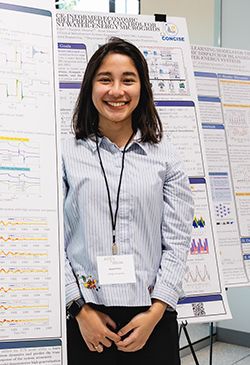
Artificial intelligence is driving unprecedented demand for data centers, but the enormous swings in electricity required to train AI models can strain the electric grid. Addressing that challenge was the focus of a year-long fellowship Saskia Putri PhD’26 completed while she was a doctoral student at Lehigh University.
The fellowship paired Putri with researchers at Siemens through Lehigh’s Pasteur Partners PhD (P3) Program, which connects doctoral students with industry and other external partners to pursue use-inspired research alongside academic and industry mentors. For Putri, the experience not only advanced research on more resilient and sustainable power systems for AI data centers but also helped shape her career path. She now works as a contractor within the Research and Pre-Development division at Siemens Foundational Technology, designing power systems for existing AI data centers.
The collaboration grew out of a Lehigh-Siemens partnership involving Lehigh’s Center for Advancing Community Electrification Solutions (ACES). Led by Farrah Moazeni, assistant professor of civil and environmental engineering and Putri’s advisor, and co-led by Javad Khazaei, associate professor of electrical and computer engineering, the project brought together Lehigh’s expertise in power systems and microgrids with Siemens’ experience in automation and energy systems.
Designing more resilient power systems for AI data centers
During the fellowship, Putri developed and validated a simulation model of a next-generation data center power system that integrates renewable energy, hybrid energy storage, and advanced controls to manage the rapid fluctuations in electricity demand created by AI workloads. She and the research team also evaluated how different grid conditions affect data center operations and developed automated energy-management strategies to improve stability.
One focus was determining how multiple energy sources could work together within a single facility. The team also explored alternative backup technologies, including linear generators, which can require less space and respond more quickly than conventional generators.
The larger goal, Putri says, is to help data center operators anticipate their energy needs before new facilities are built and design power systems that can respond to changing conditions.
“The architecture might be different for different facilities, but they could still use the general control management system that we proposed in this fellowship,” says Putri. “We’re very excited about that.”
Two Lehigh students have joined the fellowship and will build on Putri’s work, expanding the models with more detailed simulations of individual energy sources and developing power-scheduling tools that account for additional operational constraints.
Connecting doctoral research with industry
For Putri, the fellowship offered something beyond the technical research: a firsthand look at how ideas move through an industrial research and product-development environment.
“I was encouraged to think beyond whether a method was technically novel and instead focus on whether it solved a meaningful user problem,” she says. “In academia, I was used to emphasizing scientific contributions, but through discussions with a Siemens researcher, I learned to also consider scalability, usability, and business impact. That perspective helped me understand how industry research balances innovation with practical value.”
The experience also deepened Putri’s understanding of how data centers can meet their enormous energy demands more sustainably.
“Hyperscale data centers are building energy systems that include renewables and energy storage, and they’re designing their own power systems before they connect to the actual grid to minimize the potential for disruption to the grid,” says Putri. “I believe we’ll see these centers being powered in a more sustainable way.”
Before the fellowship, Putri was unsure whether she wanted to pursue academia or industry after completing her PhD. The fellowship gave her direct exposure to industrial research and product development—and helped clarify that decision.
“I really enjoyed seeing the research go from the lab to testing to an end product that will be used by the client,” she says. “That experience played an important role in my decision to pursue opportunities in industry.”
“Working with Saskia has demonstrated the value of the Siemens–Lehigh collaboration,” says Abhishek Banerjee, senior research scientist on the Research and Pre-Development team and Putri’s supervisor. “Through her Siemens-supported PhD research, Saskia connected academic expertise with industry-relevant challenges and contributed meaningfully to our technical discussions. Supporting researchers at this stage of their careers helps develop exceptional talent while fostering the exchange of ideas between academia and industry and building a strong foundation for future collaboration.”
Putri says the fellowship also gave her access to mentors whose technical expertise and industry experience helped shape her research and professional development.
She encourages other doctoral students to pursue similar opportunities, especially if they are still deciding where they want their careers to lead.
“I received so much guidance, and it all led to the position that I’m in now,” she says. “I’m so grateful this collaboration with Lehigh and Siemens is continuing because this is a very important research area.”