
Duration: 12:42 | Published: July 5, 2022
Episode Summary
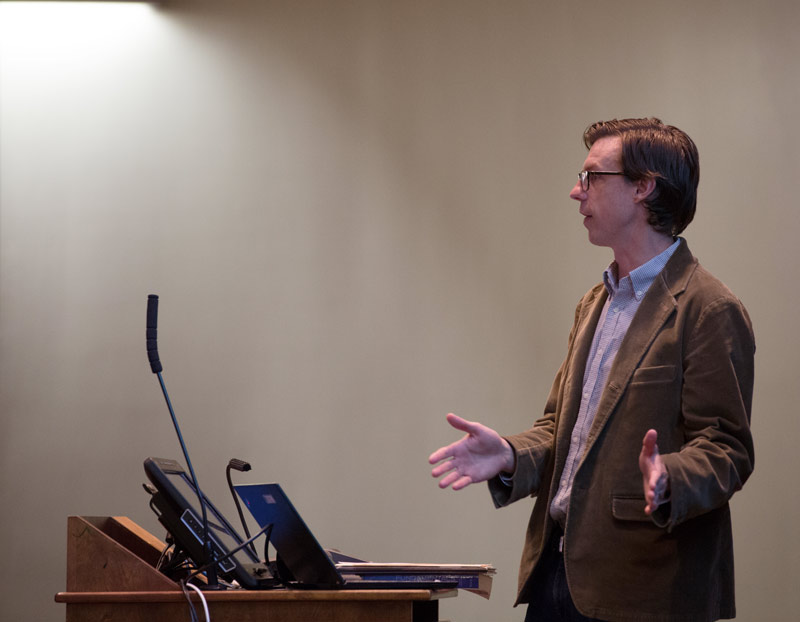
Nicholas Strandwitz has always been curious about how things work. As a kid, he loved taking apart electronics to see what was inside, and that curiosity eventually led him to materials science and engineering—a field focused not on designing entire systems, but on understanding and improving the materials they’re made from.
Today, Nick’s research centers on atomic layer deposition, a manufacturing technique that allows engineers to build ultra-thin films with atomic-scale precision. Those nearly invisible films are essential to modern technologies, from the transistors inside computers and smartphones to more efficient solar cells and next-generation medical devices. His lab is developing new materials that could reduce energy loss in electronics, improve renewable energy technologies and enable future advances such as quantum computing.
Along the way, Nick offers an accessible introduction to the field of materials science, explaining why it sits at the intersection of engineering, physics, chemistry and biology. He also shares why creating materials that have never existed before is one of the most rewarding parts of his work.
“Breakthroughs in materials don’t just improve existing technologies,” he says, “they make entirely new ones possible.”
Key Moments
- 1:19 — Taking things apart as a kid
- 2:02 — Discovering materials science through undergraduate research
- 2:41 — What is materials science?
- 4:42 — The “magic” of atomic layer deposition
- 5:29 — Why these invisible films power modern electronics
- 6:27 — Making better solar cells and computer chips
- 8:57 — Medical applications and light sails for space travel
- 10:03 — Why electronics keep getting smaller
- 10:58 — The hidden “magic” inside our devices
- 11:20 — Why creating new materials is so exciting
Featured Quotes
"Materials science…focuses on the actual material, the stuff that our systems are made of rather than the entire system." — Nicholas Strandwitz
"We’re laying down an atom at a time…we can build up a film with atomic-scale precision." — Nicholas Strandwitz
"Realizing that these new materials can enable new technologies…that’s probably the most exciting thing." — Nicholas Strandwitz
Full Transcript
Transcript is auto-generated and lightly edited for clarity.
Welcome to Rossin Connection, a podcast about all things Lehigh engineering. Coming to you from the P.C. Rossin College of Engineering and Applied Science at Lehigh University. It's a show for students, alumni, faculty and staff, current, former and future. And for anyone interested in the many creative ways the engineers are solving the world's problems. I'm your host and producer, Christine Fennessy. Our guest today is Nick Strandwitz. Nick is an associate professor of material science and engineering. In this episode, he explains what he calls the magic of atomic layer deposition, a thin film growth technique that among many other things, helps our computers and smartphones do what they do and do it fast. He also talks about why this discipline of engineering is particularly satisfying. Thanks for joining us. It was probably a given that Nick Strandwitz would become an engineer. He was the kind of kid that liked seeing things from the inside out.
I was definitely a tinker. I love to take stuff apart and just try to figure out how things worked and maybe try to fix things.
Things like a broken stereo receiver.
I pulled the like metal cover off of it and looked at all of the components inside and where the power came in and where audio signals came out and tried to kind of understand how everything was connected in there.
Sometimes when he put it back together, the stuff worked. But with that broken receiver,
Yeah, I didn't, I definitely didn't know what I was doing in that particular case.
High school kind of sealed the deal for him. He was really good at math and physics, but when he went to Penn State for engineering, he didn't know what kind of engineer he wanted to be until he started doing research as an undergrad.
And I had a research experience where I worked in a clean room and I made basically a gas detector device and I thought about the material that was actually detecting the gas and how it worked. And I found that to be really interesting.
At the time, he didn't really know much about material science, but he found that experience in the lab fascinating.
So I realized that if I want to go learn more about this type of thing, you know, material science was a great area because that would allow me to focus on the specific material that would go into like our engineering systems and things like that.
Now it's probably helpful to just give a quick explainer on material science.
That's a great question because a lot of incoming students, uh, first year engineering students don't know what material science engineering is. And I, I didn't know either.
He says material science is the connection of engineering to physics, chemistry, and biology.
It focuses on the actual material, the stuff that our systems are made of rather than the entire system.
Take for example, he says a jet engine, a mechanical engineer might be concerned with the rotations per minute of the system, the overall components and how everything fits together.
Whereas the material scientist or materials engineer would be focused more on the actual turbine blade and understanding it has to go through certain forces and and experience these extreme temperatures for it to function properly. And so what is the best material for that? Because you can't of course just take a piece of aluminum and do that, it will just melt and then that will not work very well.
He says another example is in solar energy. An electrical engineer might think about among other things, the circuit on a solar cell, its connection to your house and to a battery.
Whereas the material scientist would focus on the actual solar cell material itself. So how is, and most of them are made of silicon. How is that silicon processed? How many impurities or defects are in that? And what types of films do we put on the surface to make it work better?
Nick did his graduate work at UC Santa Barbara, then a postdoc fellowship at Caltech in Pasadena, California. He liked doing research and says he was captivated by the idea of being able to direct his own lab. Growing up in Erie, Pennsylvania, he was well aware of Lehigh. So when a faculty position opened up here, he went for it.
I knew about Lehigh. I knew that you could do great teaching and great research at Lehigh and that we have great facilities here. So that was about almost 10 years ago now that I came out here
Today. Nick's primary research area is centered on a thin film growth technique called atomic layer deposition.
And it's kind of exactly what it sounds like. You're kind of laying down a single atom or so, or two atoms maybe at a time onto a surface. So that surface could be a piece of glass or a piece of silicon for a solar cell or something like that. And so we're laying down an atom at a time and that way we can build up a film with a kind of atomic scale precision. So we can think of like atoms as our bricks and where we're laying down a layer of bricks each time. And we can choose different bricks and we can choose exactly how many bricks we put down. That way we have a lot of control, particularly on the nanometer scale.
To put that scale in perspective, these thin films are often measured in micrometers. And one micrometer is one-millionth of a meter.
The human hair is some tens of micrometers across. So we're talking thinner than that. Much thinner than that.
Most of us rarely, if ever think about these films, but they're critical in the operation of things we use every day. Like our computers and our phones. He says there are several billion transistors in these devices and the films on those transistors are all grown using atomic layer deposition.
And that film is about two and a half nanometers thick and it needs to be exactly that thick. If it's thicker than that, your chip will not be able to switch as fast. If it's thinner than that, electrons can actually go through it. And it's supposed to be an insulator electrical insulator. So if electrons can go through it, your chip heats up or it ceases to function.
And in case you didn't know, a nanometer is one-billionth of a meter. For reference, a human hair is approximately 80,000 to a hundred thousand nanometers wide. Nick says his lab works on further developing the technique of atomic layer deposition.
We've been supported by a few industry partners and Department of Energy and National Science Foundation to try to make, for example, better solar cells or better films for uh, chip manufacturing that can make chips more efficient or more powerful
For the solar cell project. He and his team are working with a department of energy to investigate ways to get electrical contacts to behave better when they're in contact with silicon. And by behave better, he means minimizing the losses that can occur at that junction.
Kind of the key thing for a solar cell that you have on your rooftop, if it can convert, let's say 5% of the sunlight energy into electricity, okay, but what if it can convert 20% or 21%? And so the area that we kind of implement these, especially if you're thinking about your own rooftop, is pretty much limited. So the higher the efficiency, the more energy you can capture. And if it's you're already spending thousands of dollars to put up supports and all of these other systems to integrate that solar cell, the more electricity you can capture in that system, the better.
Nick and his team have a similar goal for the work they're doing on computer chips. They're developing a film that will minimize electrical losses and allow transistors to work faster.
So our computers have upwards of 10 ish billion transistors in them and all transistor, it could be reduced to kind of the analogy of a switch, an electronic switch that is on or off. And these things switching on and off is what allows us to do calculations and then talk over Zoom and write a Word document.
Or do basically anything on a computer. He says all these little switches are turning on and off very fast.
So imagine, you know, if you have 10 billion switches and you can reduce the energy use by a few percent, that can go a long way to, well, one, saving energy, but two, having your chip heat up less and you can pack more of these transistors in there without having it heat up so much. So you can look at a lot of the newer high-end computers. They have these really fancy cooling modules on them because all of that computation takes a lot of energy. Doesn't need to take nearly as much as it currently does. So that's kind of one of the other areas of focus for us.
But these films aren't just for solar cells and integrated circuits. He says that one potential application for this area of research is in healthcare.
We work on some ultra hard ultra inert coatings based on metal nitrides, like titanium nitride that we grow that can be used in stents and in vivo in in the body.
He says one of the more exotic potential uses for these films is in the creation of light sails. Light sails are giant, super thin membranes that work like the sail on a boat, but instead of wind, they're propelled by light and they could be used to move spacecraft
Because we can only send up so much fuel and the fuel is extremely heavy. So if you could just send up something extremely light that has one of these sails, and so then you would sail using light either from the sun, you could, you can use that. But also we could also shoot it with a laser from earth or from a satellite to kind of push on it. Basically to accelerate it through space where it doesn't have to hold its fuel. It just kind of gets pushed on, uh, by the light just like you would with uh, wind. But of course you can't use wind up there in space.
But the biggest area of application he says is electronics, particularly as they get smaller.
If we think about electronics and what we've seen kind of over the past maybe whatever, 30 or 40 years in particular with transistors going from let's say hundreds of nanometers in size, that's our little switch that we have to now, current transistors have features sizes that are on the order of five-ish nanometers. So when you do that, you can pack a lot more of them in there. And that's why we have so many on there and that's why they work as well as they do. So the kind of, uh, perpetual minimization of electronics is definitely not going away. And so we need better tools to build materials with kind of atomic scale like one atom at a time type precision. He
Says that precision will advance current technologies and help spawn new ones like quantum computing. It's the kind of work that makes him look differently at the things around him, even if he can never actually see that work.
I can't go look at those films. Even if I had an integrated circuit that I pulled outta my computer and broke it in half, I can't see anything. You know, which is kind of, it's like the magic that's buried in there
And contributing to that magic is the ultimate draw of this field because in material science you get the opportunity to create something that's never been made before.
So I think that is kind of inspiring. 'cause then you, like, if you make a new material, let's say I can make a new semiconductor that can be 10 times as thin as silicon and maybe 50% more efficient at converting solar energy into electricity. You know, so making new materials can enable things like that or, or something like a computer that maybe can function at like 10 times what our best computers do now or a hundred times and use maybe one 10th the electricity. Uh, so realizing that these new materials can enable new technologies, I think that's probably the most exciting thing.
That's it for today's show. I'd like to thank Nick for taking the time to talk at a very busy end of the semester. For more information about all the academic programs at the P.C. Rossin College of Engineering and Applied Science, and to find our show, head to engineering.lehigh.edu. Music in this episode is by Blue Dot Sessions. You can send us story suggestions or feedback on X at Rossin podcast. I'm your host and producer, Christine Fennessy. See you next time.
About the Guest
Nicholas Strandwitz is an associate professor in the Department of Materials Science and Engineering at Lehigh University. His research focuses on atomic layer deposition and other advanced thin-film manufacturing techniques that improve the performance of electronics, solar cells and energy technologies. His work combines materials science, nanotechnology and engineering to create materials that enable the next generation of devices.
Episode Details
Related Episodes
- Episode 23: How Fish Are Inspiring the Next Generation of Underwater Robots and Renewable Energy
- Episode 26: Beyond Silicon: The Search for Next-Generation Semiconductors
- Episode 27: Powering a More Reliable Electric Grid with Javad Khazaei