
Duration: 44:49 | Published: October 8, 2020
Episode Summary
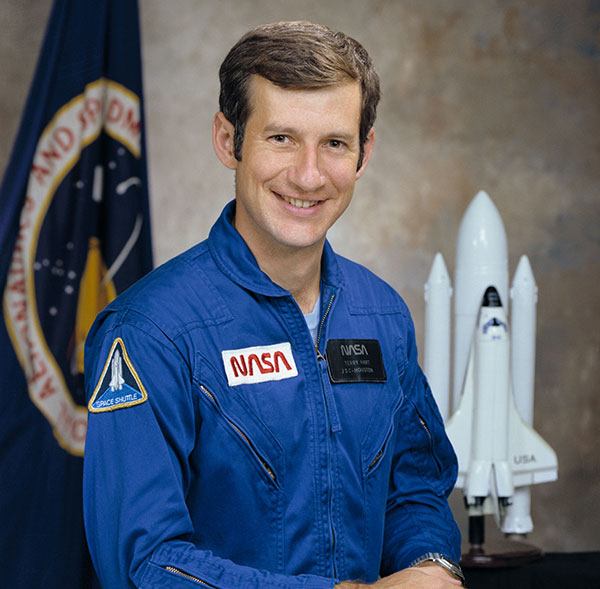
Part 2 of our conversation with Terry Hart ’68, ’’88H begins in 1978, just after Terry was selected from 8,000 applicants to be one of 35 astronauts known as Group 8, the first to include African Americans, Asian Americans, and women.
“We had a saying at NASA, that we wanted to ‘maintain an even strain,’” he says, referring to the excitement that builds among astronauts leading up to a mission. “So we would often, under those pressures, say, ok, we’re going to step back for a while, maybe not do any simulations for another day or two to maintain that proper stress level as you get closer to launch.”
It’s just one of many moments in Terry’s life that can pull double duty as a teachable moment. In this, the second part of our interview with Terry—a teaching full professor in mechanical engineering and mechanics, former fighter pilot, inventor, telecommunications executive, and astronaut—he provides a firsthand account of astronaut training, what it feels like to launch aboard the space shuttle, life in orbit, and the engineering that made one of NASA’s earliest satellite repair missions possible.
We learn about the years of preparation that preceded the eight-day mission, as he describes how astronauts and mission controllers repeatedly rehearsed both routine operations and unexpected failures until every member of the team could respond instinctively.
He walks listeners through the shuttle launch, the physical sensation of accelerating into orbit, the surprising silence of space and the challenge of adapting to weightlessness, and recounts how an unexpected equipment failure forced the crew to abandon their carefully rehearsed plan and improvise a new approach with engineers and mission controllers on the ground.
The experience became one of his most enduring lessons in engineering: preparation isn’t about memorizing procedures but about developing the knowledge, teamwork, and confidence to solve problems that no one anticipated.
He describes life after NASA and how teaching has become his most treasured occupation.
>> Miss the first part? Listen to part one of our conversation with Terry Hart
Key Moments
- 2:12 — How NASA trains astronauts
- 3:22 — Preparing for the historic Solar Maximum satellite mission
- 6:01 — The Long Duration Exposure Facility experiment
- 11:16 — Simulating weightlessness on Earth
- 12:48 — What a space shuttle launch really feels like
- 18:24 — The blackness of space and the surprise of weightlessness
- 20:04 — Motion sickness in orbit
- 23:36 — The failed satellite capture and the successful recovery
- 26:53 — How NASA’s training philosophy shaped Terry’s teaching
- 28:16 — Leaving NASA
Featured Quotes
"We trained for two years." — Terry Hart
"You always have to expect the unexpected." — Terry Hart
"The value of your training is that you learn how to work with the team." — Terry Hart
Full Transcript
Transcript is auto-generated and lightly edited for clarity.
Welcome to Rossin Connection, a podcast about all things Lehigh engineering. Coming to you from the P.C. Rossin College of Engineering and Applied Science at Lehigh University. It's a show for students, alumni, faculty and staff, current, former, and future. And for anyone interested in the many creative ways the engineers are solving the world's problems. I'm your host and producer, Christine Fennessy. Today's episode is part two of my interview with Mechanical Engineering professor of practice and astronaut Terry Hart. We're devoting two episodes to Terry because he's had a really interesting life as an engineer, a fighter pilot, an inventor, an astronaut, and as a Lehigh professor. And when you've led that kind of life, you've racked up some pretty great stories. In this episode, we learn about Terry's 1984 space mission about what it's like to prepare for something for two years, and why weightlessness felt pretty miserable at first and why his mission was historic and almost didn't happen.
He also talks about his life after NASA about the future of space exploration and how he felt about being named to deliver the commencement address for the 2020 class. The pandemic, of course, changed graduation, and so Terry hasn't delivered that speech. Not yet anyway, but he's got it ready to go, and he does share a little of it here. Today's conversation begins in 1978, after Terry was selected out of 8,000 applicants to become one of just 35 astronauts. They were known as Group 8, and it was the first astronaut group to include African Americans, Asian Americans, and women. I started by asking Terry to describe what astronaut training is like. He often says that in six years at NASA, he never took an actual test.
Yes. When you, when you start, uh, there's some classroom work, so you get some lectures. Uh, the astronauts come from a broad variety of backgrounds. Some are pilots, you know, test pilots, uh, others are medical doctors, a lot of scientists from every field you can imagine. So everybody has to kind of be brought up to the same level. The pilots have to learn the science and the scientists have to learn about flying, all that kind of thing. So, uh, that takes some classroom work, uh, that goes on for about a year. And then in the afternoons you might be flying airplanes or in the simulators where the simulators, now you start learning like the hydraulic system on the space shuttle. So there's a special simulator for that. And you have a trainer that sits there with you and you kind of walk through the, the aspects of that. And that builds over the year until, are you ready to be assigned to a flight crew and then you participate in a full up simulation? Usually? Well, it doesn't have to be, but often with mission control on, uh, online as well.
Okay. Okay. Well, all right. So in now for your shuttle flight in April of 1984, you and your crew had several tasks, and can you describe what they were and what your role was in them? Yeah.
We had, we had actually one of the most exciting missions of the early part of the program. Uh, we were do to do the first, uh, rendezvous of the space shuttle program with a satellite that had been disabled called Solar Maximum. It was launched by NASA four years earlier, and it was spinning outta control, uh, because of a failure in the attitude control system. So we trained for two years actually, um, to do the rendezvous. That was my part actually with my commander, Bob Crippen. You know, we did the first rendezvous with the space shuttle program, and then to do the space walks. Our other two crew mates, uh, George Nelson and Jim van Hoften trained, uh, underwater in a, uh, large swimming pool at nasa, you know, where they would learn how to actually repair the, the satellite. And part of that was my job too, uh, using the mechanical arm to, uh, capture the satellite.
So, so, okay. So you trained for two years to do this specific, this one specific task with the rendezvous?
Yes. The, the rendezvous sequence goes on for three days, actually from the time you launch and establish an orbit in space to the time you actually hook up with the, uh, in this case, the, uh, the solar maximum satellite. So we would, uh, rehearse and train for all the different maneuvers that had to be done in the course of those three days to, uh, get up real close to the satellite. Uh, and then once we were close, then I could grab it with the, uh, spa shuttle mechanical arm.
Okay. What is it like to do two years of rehearsal for something like that? I mean, were you dreaming about this maneuver at, at the end?
Yeah, sure. I mean, it's, it is the, the tension and the, and the excitement builds, of course, during that two year period, but it's more than just training, because when we start, we don't know how to do the mission quite yet. So we work with the engineers and the, and the controllers and mission control to figure out how to do the nominal mission, but even more importantly, how to do the off nominal cases where something breaks, uh, something goes wrong with the space shuttle or on the ground with one of the tracking radars, and then you, you fine tune all those backup procedures, uh, and you practice those in a simulator and you get surprised. I mean, there's a, there's an engineer in the back of the mission control called Sim Soup, the simulation supervisor. And he or she injects failures into the mission so that the mission control team and the crew on board have to react and, uh, exercise all these different backup procedures that we had planned.
And so part of your mission was this spacecraft repair, but you were also releasing the long duration exposure facility. Can you explain what that was?
Sure, yeah. That was an interesting satellite spacecraft that was designed by NASA Langley, and it was like a big cylinder, about 14 feet in diameter and about 32 feet long. So it took up almost the entire space shuttle Cargo Bay weighed, uh, 35,000 pounds and on it were, uh, a number of experiments, uh, 85 different experiments from 150 scientists all around the world with different kind of materials. And they were wanted to test to see how things weather in space and some other experiments would gather cosmic rays or micro meteorites, that kind of thing. Uh, and then six years later, another shuttle mission brought it back to Earth and they could see the results of the experiments. And, and that went a long way to helping them plan how to build the space station because, you know, things, weather and space, and you don't want to have to do too many maintenance emissions to maintain the Space Station. So it was a pretty cool, um, experiment to be on.
Yeah, yeah, definitely. And just to go back to your, the, the rendezvous element of your mission, when you were training, did you have to also train in each other's capacities in case something happened where you would have to do the spacewalk? It it was that part of your training as well?
Yes, that's, that's a good point because, uh, there were five of us on the mission. So there's always at least two people that know how to do everything in case someone's not feeling well or whatever. And really just to be able to check on each other. We sort of watch what each other's doing. So if you understand the job yourself, like for Rendezvous, for example, my commander, Bob Crippen was actually executing the maneuvers, you know, in the space shuttle, but I was helping him load those into the computer and do the calculations, and then just to, you know, observe that everything was going well and the mechanical arm, that, that was, uh, just the opposite. Then, uh, I was trained as the primary operator for the mechanical arm, but my commander, Bob Crippen, was the backup on that.
Okay. And did you also have to work underwater? Did you have to do that aspect of it as well? A
Little bit. I, I was a mission specialist like the other two that did the space walk, uh, George Nelson and Jim van Hoften. And so I would do familiarization training with them again, they would basically do the space walk, but they were often using the mechanical arm, so they would give me instructions to how to move them around on the end of the mechanical arm. So again, to better understand how to do that, I would actually do their job sometimes in the swimming pool, uh, and learn how to repair the satellite so I could better visualize when they asked me to do something and what it is, uh, they were trying to do.
Okay. And so just to go back to my, my thought about dreaming about this, because I, I can't imagine when you're doing something over and over and there's that much pressure on it, how that must sort of affect your, um, you know, your subconscious.
Yeah, it's just a lot of excitement. 'cause it was a two year training period in those last six months leading up to the launch. You're their prime crew, so, so all their training and resources are prioritized for you. And so it's a very exciting, uh, uh, period as the excitement builds up, you know, toward the launch. Uh, so yeah, dreams, yeah, I, I guess I would, uh, dream about the mission, but we had a saying, uh, NASA that we wanted to maintain an even strain. And, and that phrase has its origins all the way back in the early space program because of this excitement that builds up. You, you need to kind of take a deep breath sometimes and, and maintain your perspectives on things. So we would, uh, often, uh, under those pressure we say, okay, let's take a deep breath now, and we're gonna, uh, step back for a while, maybe not do any simulations for another day or two and, and look at the procedures or do do something a little different to kind of maintain that proper stress level so that you don't become, uh, overly excited, uh, as you get close to launch y.
Yeah, that makes sense. And how long were those days in those last six months before the, before the launch?
Yeah, the days are, the days are pretty long. Uh, it's actually a little bit longer for the people in mission control. Uh, the, when I was at Capcom, you know, I got that experience where you really, uh, only get a handful of hours off a day. You're, you're in and out of mission control. You, you're on shift or planning your next shift. The, the crews in space, they try to not schedule more than 16 hours of activities a day. So you have eight hours, which is kind of booked as sleep, but most astronauts only sleep like four to six hours. That seems to be adequate because once you are asleep and weightlessness, it's very restful. Uh, there's no tossing or turning or anything, so there's a little free time during that eight hours to look out the window and, you know, watch the world go by and take photographs, that kind of thing, uh, before you go to sleep.
Oh, I see, I see. So I, I was asking about the hours leading up to the launch, but you're talking about when you're actually up in space, your days were 16 hours. Yeah. Okay. Okay.
Yeah, it is actually kind of the same thing in a way, because when you're in those couple months, right before the launch, you're just reliving the mission over and over again in these simulations, the simulations will go on for three or four days at a time. So you, you do go home at night to sleep, but, but the other 16 hours you're in the simulator, or if you're a capcom, you're in mission control, rehearsing the mission. So it's almost like being on a mission, uh, during those days.
And how do you simulate weightlessness on earth?
Well, that's a tough one. So the only way to really practice the tasks that you have to do is to go in the swimming pool. So you have to put the spacesuit on to do that. And it's pretty realistic. It's actually, we, we learned over time, if you could do a task with the spacesuit on under water, and you design the tools and figure out the procedures for doing a particular task, like repairing the satellite, if you could do it in the pool, you could do it, uh, easier in space or training system was a little harder, (laughs), uh, because, uh, weight, this is actually a little bit easier once you get used to it.
And did that prove true with your crewmate that did the spacewalk, did he say that it was easier to do it in space?
Yes, absolutely. The training environment's, uh, difficult because it's hard to totally simulate weightlessness. So what we end up with under the pool is actually a little bit tougher than, uh, than the actual task. And, um, almost every space walker comes back and says, you know, our, our training is good because it's actually harder than the real task.
Got it, got it. Okay. Alright. So now I know that you have described the launch thousands of times, probably by now, (laughs), but you know, you talk about the launch in terms of the Gs on your chest and this organ pipe resonance and mach noise. And I was just wondering if you could take me through the launch, but help me understand, when you talk about GS on your chest and mock noise, like what does a g feel like to someone who's never felt that? And is there, uh, something analogous to mach noise that I could perhaps understand a little bit better the experience of the launch?
Sure. Well, you know, when, when you're sitting in a chair and you're kind of relaxing, uh, that's one gravity of course, one g. And, uh, the direction is, you know, from your head down. So, you know, we're used to that. And, uh, that's our normal daily activity. When you climb into the space shuttle or any launch vehicle to get ready to launch, you're pretty much on your back. So now the G-Force is onto your chest and there's a little bit of more pressure in your head from being in that position. So that's, yeah, not uncomfortable for most people. Your, your feet are up a little higher, uh, as you're resting in the, uh, seat there at launch. And then, uh, so you're there for about an hour and a half or so, typically before lift off, but it's not, you know, too uncomfortable and then the engines light up and boom, you're off and going.
So we go from, from that one g that you were feeling on your chest to about three Gs, which is about like two more people your size laying on top of your chest. (laughs), you could imagine that. Uh, so it, it's, uh, I wouldn't say it's hard to breathe, but you have to consciously try to breathe because of the pressure, you know, on, on your chest. And then on top of that, there's a little bit of vibration. The shuttle was pretty much a pussycat that way. Uh, I think the hardest launch vehicle for the American astronauts was the titan. I think that vehicle got up to about four Gs of acceleration with more vibration. Uh, the shuttle was limited to three Gs, and the vibration was really not too bad. It was only in the first two minutes. Uh, so you can still read displays and and so forth, but if you wanna throw a switch, uh, while you're under three Gs, you have to kind of practice that a little bit because they're, uh, when you go to reach up, your arm weighs three times heavier than you're used to it, so, uh huh Yeah.
So it's not something you can train on on the earth, you just have to kind of go through the experience and recognize that you're gonna have to take special care, uh, when you go to reach for something under those kind of G loads.
Interesting, interesting. And so, and when you're talking about things like organ pipe resonance and, and the mach noise, what are you talking about there? Yeah,
The, the term organ pipe comes from, um, the musical instrument. Of course, the space shuttle, solid rockets were big hollow tubes, basically. And the frequency of resonance of that hollow tube, as all the rocket gases, you know, were being produced and come out, well, it was around 11 hertz, 11 cycles per second. And, and that's a little too low to hear. Uh, so, but you feel it, and you can feel it in the, it's kinda like a woo, if, if it was a sound, it would be like a very, very low frequency sign. But it's a, instead it's a oscillation and the GForce on your body, so you, you feel it. And it feels pretty good actually. (laughs), you know, you're going somewhere, you know, you three Gs and all of a sudden there's this whawhawha behind it that's, uh, pushing you on. And that, that continues for about two minutes. In the case of the space shuttle, after two minutes, the salt rockets would be, uh, uh, depleted. There were fuel, and they would separate away, uh, there. And, and then at that point, it was kind of an interesting, uh, uh, change that I could describe here in a minute, if you like.
Oh, yeah, definitely.
Yeah. I think the whole mission was the thing that surprised me the most. 'cause you talk to people that have flown, there were several space shuttle flights before I went, so I had, you know, people to talk to about the shuttle, but also the Apollo astronauts had flown on the Saturn. So you get used to the, after two minutes, you're used to those three Gs, and then all of a sudden those rockets go away. And the shuttle with its big tank there was still pretty heavy. And the, and the liquid rockets and the tail, uh, of the shuttle there only have so much thrust. So we went from three Gs down to about one and a quarter Gs. But the sensation was that we were almost like being weightless, and it felt like we were going back down again into the ocean or something, (laughs). It was the strangest feeling.
And then of course, as the tank got lighter and lighter as the shuttle, you know, burned off fuel, then the, the G loads would build back up to about three Gs at about six and a half minutes. And then, and then the main engines, which actually throttle back so as not to exceed three Gs, which was the structural design limit of the shuttle. So that ride was kind of like a, a lot of push. Then all of a sudden you, you feel pretty light in the seat, then the push builds up, and then of course, when you reach orbital velocity, the engines would shut down, and then you'd be weightless, you'd be right to zero G. Oh,
Wow. And what, what do you mean by mach noise? What is that?
Okay, so in that first two minutes, when you go through the altitude, the most airliners fly at like 30 or 40,000 feet. The space shuttle, it's about, it's like a minute after launch, the space shuttle is going supersonic. So it forms shock waves on it. Uh, sometimes you can see those, if it's, if the air's humid, you can actually see it on the launch films and, and the, they would make a buffeting sound, you know, they're very aerodynamic, noisy kind of sound. But then, you know, by the two minute period where a solid rockets would come off from the ground, it doesn't look like the shuttle's all that high, but really it's right on the edge of space right there. So there's almost no air left above you. So things get very quiet, which is very eerie because you have all this thrust and your, your thrust is building back up, acceleration is building back up to three Gs, yet it's perfectly quiet. You can hear the fans on the computers running (laughs). Uh, you know, it's kind of, uh, strange, uh, to have all that power, but no noise once you're in a vacuum.
Y Yeah, definitely. And, and you had mentioned that, you know, in other talks that you had given that these were things that you didn't expect the sudden, like lessening of the pressure going from three Gs to 1.25, and then everything getting so, so quiet. And then there was another thing that you said you, you weren't quite ready for was, uh, the total blackness of space
That did surprise me. Um, it, it's ironic, but uh, when you're in space, you don't really see the stars. And the reason is the, the sun is so bright coming directly, you know, from the sun without going through the atmosphere. It's so bright, and the, it reflects off the earth with a lot of brightness. And the shuttles tiles are white. So we look out the window that, again, there's a lot of light coming off the tiles, so your eyes stop way down. The pupils of your eyes are, are real tiny, uh, because the light's so bright. So when you look into the blackness of space, uh, your eyes aren't sensitive enough to see the stars. You can see the moon, but not the stars. So it's a blackness that you feel like you could reach out and touch. It's almost surreal. And, and that you would look at the shuttles tiles out the window, they'd be gleaming bright white, and right next to the bright white is this total blackness like black, like you've never seen (laughs). And it, it's, uh, the, the contrast is just so dramatic, uh, that I wasn't, no one had told me to expect that. Yeah, because I guess every astronaut that goes up for the first time has something that, that surprised them, that they didn't hear from someone, um, that went before them.
And when you had that sensation of, you know, the vehicle going down from three Gs, did you think first split second that maybe something was wrong because the sensation was so unexpected?
Yeah, I was right in the middle seat, so I could watch the engines, I could see all the engine gauges. So I kept on checking the edges about every five seconds because this didn't seem like they were in full power, but of course they were. Yeah.
Okay. All right. And now you've said that weightlessness is fun, but it was the biggest challenge. And, and I think that you said that you were actually motion sick and that had never happened before in training. Is that, is that right?
Yeah, I was actually one of the, I had one of the worst experiences, I guess, of, uh, it turns out about, uh, two thirds of the astronauts that go up don't feel totally fine the first day, one third go up and they're fine. So you, Bob Crippen, our commander was one of those, and he flew on the very first space shuttle as the pilot, you know, and, and he was fine. But, but you don't know because there's no correlation to any kind of motion sickness problems on earth. In fact, you, one of the, um, Sky Lab astronauts who was very sick for a couple days aws Bill Poe, and he was a Air Force, Thunderbird (laughs). So he had done every, yeah. And I was a fighter pilot. I never had any kind of sense of motion sickness. But within, within 10 minutes after the engine shut down and we were weightless, I knew I was in trouble. My, uh, my body just wasn't reacting right. And I wasn't moving around too much, but, but just all of a sudden I could tell, you know, I was gonna be sick. And that, but it fortunate never lasts more than a day or so. I was still a little washed out the second day. Um, but every, everybody's fine by the third day. And, and so we, we generally don't plan space walks or anything like that until the third day.
Okay. Okay. And so this is a gross question, but do people throw up in space and what happens when that happens? Well,
You, we use towels and, and so forth to try to avoid it getting around, uh, uh, obnoxiously, (laughs). Uh, but yeah, it happens. But we're all prepared for it. And they think it's, uh, it's, you know, roughly two thirds of the people that go have some problem. But again, I was kind of on the extreme side of that (laughs) of that curve. Oh yeah. Oh man.
Yeah. Were you able to, to, to do your job in those first 24 hours? Or were you
Just kind of, um, barely, yeah, barely (laughs). All I had to do the first day was to un un birth the mechanical arm and check it out. And I did that with Bob Crippen watching me very closely. 'cause he (laughs) he knew, he knew I was, uh, struggling, you know? Wow.
That must be a terrible feeling. I mean, it's terrible. Anyway. Yeah. But being in space,
I told the doctors when I got back that I think what I, 'cause I had, again, I had no sense of motion sickness on the ground, uh, airplanes, boats, you know, I've done everything. Uh, never had any trouble. But what, when I went to, to try to sleep that first night, I did fall asleep, but just for a few minutes, and then I ha I, I woke up with a nightmare that I was falling, and, and I was (laughs) because you, your weightless you, you're literally, you're falling, right? And I, so I think what triggered my bad reaction was a almost kind of a brain stem, uh, fear of falling that we all have. Um, I think it, I, I didn't have any, um, conscious sense of fear. You know, I was elated, you know, we were in space, I was there, you know, uh, and then all of a sudden, you know, my GI tract was clearly not cooperating.
And I think whatever brainstem reaction I had was maybe more powerful than most people would expect to have from a fear of falling. Uh, because I, I woke up in a start and I kind of, uh, tried to grab something 'cause I thought I was falling. And then, then when I finally fell asleep, I was better the next day. But yeah, so I told the doctors that when I got back, and they all kind of looked at me like, (laughs), well, maybe, I don't know. They, you know, they, they're still trying to figure it out, but they, um, it's a different animal than motion sickness on, on earth.
(laughs). So bizarre. Yes. Okay. Well, now could you tell the story of the rendezvous, because that wasn't without problems and, you know, it was a little high stress and questionable whether it would happen. Right. And so can you tell the story of what happened in your role in, you know, ultimately making it happen?
We, we train for every possible failure that we can think might happen, and then we find ways to work around 'em, you know, so you can still get the mission done, uh, even though things don't work right. But this one, we, we didn't anticipate (laughs), so we did the, the rendezvous went fine. So the end of the, or middle of the third day, we're closing in on the satellite, and I got the arm ready, I'm gonna grab it. But the plan was initially for, uh, George Nelson once we stopped about 200 feet in front of the satellite for George Nelson to fly over using the backpack, the man maneuvering unit. So he is untethered, uh, and he flies over to the solar max, which is rotating slowly. And right under one of the solar panels, there's a, um, a pin, uh, one and a half inch diameter steel pin that he's gonna dock himself to.
And then he'll use his thrusters to stop the rotation. And then once he stopped the rotation, then I would grab it with the mechanical arm, and that was the plan. So when he went to dock to the satellite on that little pin, instead of docking, the docking adapter malfunctioned, and he bounced off the satellite. So he tried that three times, and each time he hit the satellite, it started spinning and tumbling in a different way. So now we had a mess on our hands, because I was prepared as a backup to grab the satellite without him being out there. I could match the rotation and grab it, but now I was tumbling. And so I, I tried a couple times to grab it, but we were running outta fuel and it was kind of a mess. So we, we backed away for a day, you know, about, uh, 10 miles behind the satellite and parked ourselves back there. And then the ground took over and got this, the satellite back in a slow spin again without the tumbling. And then we came in on the next day without the space walkers out there. Yeah, I just grabbed it with the mechanical arm. Then I was able to match rotation rates with it, grab it with a mechanical arm, and birthed it. Now we were back on normal plan once we had it in the payload bay, then the, the next day, then the crew could go out and do their spacewalk to start to repair 'em.
Wow, okay. And is there anything that you, I'm sure that you share that story often with your students. Is there anything that you pull out of that as a, as a teachable moment as it were for your students?
Uh, sure. I mean, you always have to expect the unexpected, which was what happened here. And it's, it's not unusual and space missions particularly that, that something will happen, that no one anticipated the value of your training. Uh, you say, okay, well you didn't train for that specific thing, but, but the value of your training was that you learned how to work with the mission control people. And, and beyond that, the people in Goddard that were controlling the satellite that got a back under control and spun it up, uh, you know, all that team of people, that big pyramid of people, you know how to talk to them and you know how to work in real time with them because you've trained on all these other failure modes that could have happened. So when you're ready to go, you can handle something that you hadn't thought about before, because that training is so good for the entire team to be able to work together.
Yeah. Did have you ever in your life since applied that rigor of training to anything else? Like, even, even maybe just on like a, like a lesser level, obviously, but with the same sort of ethos behind it, I guess? Yeah,
I think, uh, anytime you try to do something new, uh, and you think about how NASA trains people, that's a good lesson to have learned that you can't do the same intensity, of course, um, six month of training for, or it was two years of training really for a mission. But I, I think in terms of the way I train my students, you know, at Lehigh I train them for success. In other words, I want them to be confident when they graduate, you know? So I don't beat 'em up too much. (laughs), they're, they're mostly seniors, you know, I get ready to graduate. So I, I try to train 'em for success. I give them problems that they feel good about that they can do. So my students, then they take my exam, they're hopefully learning something and preparing themselves for something they would see in their first job in industry.
And was that the way NASA trained the astronauts as well, in a very positive reinforcement sort of way? So to always kind of keep morale up?
Yes. Yeah, very much so. I mean, six years never a negative word, really, in six years. Yeah. We tend to be hard on ourselves. Well, you're dealing with a bunch of people that came through that selection process. They're all overachievers, you know? So it is not a problem motivating people. So if anything, you know, sometimes astronauts are a little too hard on themselves in certain situations, and you kind of say, okay, we made a mistake, you know, so, uh, let's, you know, move on. But the mode of teaching that I like to do anyways is that positive, uh, reinforcement.
Yeah. Yeah. No, that makes sense. Okay. So now you had a second space flight lined up at nasa, but after six years, you, you left to return to Bell Labs, correct?
Yeah, so it was a very hard decision to make. 'cause it was a good mission that I, uh, ended up not going on. It was a joint mission with the Germans processing materials in a laboratory inside the space shuttle. So most of the training was done in Munich. And, uh, you know, with the, the other astronauts didn't know I had turned that mission down. I didn't, in fact, I didn't tell 'em until a couple years ago at a reunion. I mentioned it at that time. 'cause whoever was, you know, selected instead, and all I, I didn't want them to think I bailed out on 'em and not, didn't fly the mission, but it was, it was a tough decision. 'cause uh, right at that time, 1984, the government was breaking up the bell system. So the place I worked, uh, bell Laboratories was being split up and divided, uh, between different parts of, uh, at and t and the, and all the other companies that were coming out of the Bell system.
So they told me if I wanted to have a career there, I, I've been gone for six years that I really needed to come back then, you know. So I kind of thought about it for about three weeks, and then I, you know, went in and told George Abey or who selects all the crews, you know, for the missions that I would like to go back to. And he, he was very understanding. He said, um, totally support that, you know, you did a great job on this mission. And, um, we appreciate that. So that, that was a, a nice way to, to leave.
Yeah. And you know, I just think for a lot of people who might have a hard time understanding why you might wanna trade space for an earthbound engineering career, what for you was the ultimate draw when it came to engineering? Why was that career path so important to you that after three weeks you decided your career as an astronaut was over?
It? It is a hard decision and, uh, uh, many, many astronauts have had to make that decision. Uh, I'd say about half will stay for their entire career. To me, I, I was always interested in something new with technology and, and may surprise you, but when you're an astronaut, you're kind of limited in what you can do. I mean, you're in operations, you know, so you have to be focused on that. But the, all the engineering's being done by the people that are designing the next mission and the next thing to go, and, and that part of me, that engineering part of me was not something I could enjoy. Uh, your engineering knowledge helps you in operations, but if you wanna be, um, designing things and building new things, then the astronaut's job is not the one to be in. So I, so I decided to go back and I ended up, uh, the head of engineering for at and t's satellite division, you know, which was a wonderful job to go back to. Oh,
Okay. Alright. And so, but a year after you left NASA, your pilot, Francis Richard Scobee was one of seven crew members Yeah. Who was killed aboard the Challenger. Were you watching that launch?
I, I was, I was at work at, uh, Bell Labs actually that morning. So it was pretty, um, pretty difficult. Um, and the school teacher, you know, was killed as part of that too. It was a very tough time. And we all went down to Houston, of course, to, uh, for the service and president, uh, Reagan came down and delivered a wonderful address to everybody. So, but it was a, a tough time for the whole, the whole nation. Um, but especially, uh, uh, I, you know, lost, you know, five, five friends all one, all one morning, you know, um, the seven astronauts I knew five, uh, very well. And as you, uh, Dick Scobee was, um, my pilot on my mission, you know,
H how did that affect your view of the space program? Well,
We, we, um, or at least I expected to have a loss. It's hard. The, the best, very best launch vehicle rocket we've ever built is up around 98% reliability. And sure enough, you know, we lost two space shuttles. So I, I wasn't surprised that we would have a loss. What I was surprised is that the nature of the loss, in fact, it was true of the second one when we lost Columbia, both cases NASA understood the problem. In the case of the Challenger, it was the seals in the solid rockets, uh, when they got cold, they weren't fitting right then in the case of the Columbia, it was ice coming off the tank. So both those problems were pretty well understood, but they thought they, and they had fixes coming along and all that kind of thing. They just, uh, underestimated that it could get outta control and cause a loss of a vehicle on a crew.
So that, that was pretty hard to take. 'cause I always had, you know, such high regard for NASA and their, their engineering judgment. Uh, but here, the pressure to fly more frequently was building than people that were making those decisions. It was starting to erode their judgment, their better judgment, uh, to try to fly faster. So that's particularly hard to take, you know, if something just blew up and for some unknown reason that they weren't watching that, that would've been a little easier to accept. But, but here with a known problem, it was, it was pretty hard to accept it.
Yeah. Oh, I can't imagine. And in, in terms of the future for space exploration, you've said that your number one priority would be an asteroid recovery mission. And that questions a mission like that would answer, would be perhaps more interesting than landing on the moon again. And so why do you say that, and what do you think we could learn from a mission like that?
Well, actually, as the scientists that are speaking out, you know, we've gone through a, a couple reversals here, which is a little unfortunate. The, the Bush administration had been focused on the replacement for the shuttle being a large rocket called Aries, and then going back to the moon. Then in 2008, when Obama became president in 2009, the scientists kind of prevailed upon him that going back to the moon was not worth all the cost because the science was so limited on the moon, you always learn something. But we had learned so much about the moon on Apollo that the scientists wanted to, to take the next step and get an asteroid. And an asteroid being the prim modal material, the solar system, it was a lot more scientific interest. So they, they reversed the program. Then under Obama, they're still building the same, uh, rocket. But now the mission changed to, to one of capturing an asteroid.
Okay. So, so that is actually underway that, that particular goal.
Well, no, (laughs), they're still building the rocket. In fact, next, next year we're gonna test the rocket. It's called Space Launch System. And it's about, it uses a lot of space shuttle technology, the solid rockets and so forth. But it's as big as a Saturn 5. It's a huge rocket. So what we're going to go do with it is still a little unknown. The scientists still wanna do the asteroid, but then when Trump came in, then he's decided to change the mission again and go back to the moon again. He wanted to be during his first term, and NASA said, well, we can't do that (laughs). It's not, you know, possible. So, so it's still kind of up in the air a little bit. I'm not, nothing's funded except building the, the first four rockets. I think they're gonna build the first four. And then the command module is called Orion.
And it's a lot like the Apollo module, except it is a little bit bigger. So it holds four astronauts. So all that's being prepared, and they've actually test flown the command module too, the capsule. So they can do, uh, either mission. Now, when they decide which one, they'll fund it after these four test flights, they could do a, like a five month mission to an asteroid to bring it back. Or they could do a remote mission and bring it back and then send crews to a parking spot between the earth and the moon where they could park the asteroid. So there's a lot of different scenarios, but we'll have to hopefully, um, listen to the scientists and choose the one that's gonna be the most scientifically interesting for the program.
I think the key phrase there is listen to the scientists, um, (laughs). Um, okay. So, uh, transitioning to Lehigh and what was the impetus to teach and why did you choose Lehigh?
Well, Alma Mater (laughs),
You have several (laughs).
I always loved the Lehigh Valley and, and all. And I, uh, I felt like I, I wanted to teach. I'm a techno nerd, you know, I really enjoyed technology and I always liked, I I, back in pilot training, I did it a lot. You know, I, I would help my fellow students in pilot training understand some of the engineering principles that the Air Force was teaching us. You know, I, I enjoyed explaining it to 'em and trying to put it in terms that they could learn it without having a technical training that I had, you know, so explaining things. In other words, I enjoyed that. So I, I thought, well, you know, I'm gonna try to retire from industry early enough, young enough that I can make this transition. 'cause every course you teach, every new course you teach is kinda like writing a book, you know? So you really have to buckle down and, and study and prepare and, 'cause you have to learn it well enough yourself to explain it to someone else. So, yeah, so I made that transition like 15 years ago now, (laughs), I guess. And, uh, yeah, it took a year or two to get comfortable in the classroom. And then I loved it. You know, I just wanted to teach more courses. So I've built out, so I, I teach three in the fall and, uh, four courses in the spring.
And has there been anything surprising about teaching that you've discovered over the years?
Um, I'm constantly surprised by how bright some of my students are. (laughs). I mean, it's, it's really remarkable. And I, I try to think, well, why is that? Why, why are they, uh, there's so much quicker at absorbing things? And I, I think a lot of it's, you know, kind of grown up with the internet. You know, when, when we had a question back in the sixties, if you wanted to research something, you'd have to trudge on in the library and, and start digging up all these books that were written a hundred years ago and, and try to, uh, put the whole thing together. And you now they need to go click, click, click. And, and they got it all in front of 'em. And all the, uh, manuscripts from the different societies, engineering societies are available. So they, they learn really quick. And, uh, so it's so much fun and challenging to teach someone that's that quick, uh, 'cause they, they'll, they'll always be asking me questions that I have to think hard, hard about (laughs), you know? Uh, and, uh, so it's fun. I enjoy it.
Oh, that's great. And so where do your aerospace students tend to end up when they graduate? What are a few examples?
Uh, all over the industry. I mean, some don't, some take the aerospace minor, but they don't work in aerospace industry per se. They may work in a different engineering, uh, field, but certainly a lot at nasa. Probably have maybe, uh, I want to guess around 20 former students working at different NASA locations. Uh, several SpaceX, a handful at, uh, JPL and Jet Propulsion, uh, laboratory, uh, and, uh, Lockheed and Boeing a lot, of course, you know, so it's, it's fun and, and yeah, some will stay in touch with me. It's always good to get a note every once in a while to hear about the exciting projects that they're working on. And, and it also gives me the opportunity to put my current students in touch with former students that are in these different jobs where they can find out what's really going on, uh, in those companies in terms of future programs and hiring and that kind of thing.
Oh, yeah, that's, that's great. Are there any favorite stories that you have about students who've gotten back in touch with you about what they've gone on to do?
The, the most exciting one, I think was, I, I won't mention his name, but he's, he's outta SpaceX. Oh, he's, he's moved on now, but he was at SpaceX when they were doing these booster flyback backs. I dunno if you saw any of those, but the, you know, the, they launched the Falcon Rocket, and then the boosters would fly back and, and land on the pad and Florida (laughs), and one of 'em, uh, down range, the main, the main boosters too far down range to when it finally ran out of fuel to get back to Florida, so it would land on the, on the floating platform out in the, in the Atlantic Ocean. So he, uh, when the, they first tried that, it failed and it crashed, you know, uh, which is normal. It is a real tough thing to do. And then the second one failed, and, or sorry, the second one succeeded, and it landed. And, and my phone went off about 10 minutes later, (laughs). And he called, he said, we did it. I said, I saw, I saw you did it (laughs).
Oh my God, that's amazing.
Yeah, yeah, yeah.
Well, so, so when you were named back in February to deliver the commencement address for the 2020 class, you called it the honor of my life to be selected to do that. And so this is coming from the guy who was selected out of 8,000 applicants (laughs) to be an astronaut for nasa. So why was that distinction so meaningful to you?
Yeah, it, it really, um, really was the honor of my life. But lehigh's, I mean, it truly is my alma mater, my, my adopted mother. So I, I think in terms of my life really beginning at Lehigh, and that part of my education was so important to everything I did in the rest of my, my career. So, you know, here, you know, flash forward 50 years later, (laughs) after graduating to be, uh, selected to come back and be the speaker for our graduating class was, uh, truly an honor. So I hope I have the, uh, since the speech is all written and ready to go, uh, I hope I have a chance to, to give it here in the future.
And for those students who will listen to this, what do you want them to know?
Well, I tell a lot of stories about NASA. There are kind of stories, uh, that show the importance of teamwork. Uh, sure, you need a lot of people that are well trained, and they, they have to understand their technology and the jobs they're doing, but they have to work together, you know, as a team to make anything Im important happen. And, and more and more, our society, our life becomes increasingly complex with every generation. There's, um, always a, a room for individual contributors. But, but more and more you need interdisciplinary focus, uh, with people with all different kinds of skills coming together to accomplish, uh, something that no one person could, uh, possibly do.
Yeah, I can't think of a much more important message than, uh, teamwork right now. Yeah. In this era.
Yeah, for
Sure. Can I ask you just one pandemic question? Sure. Uh, so what do you think a pandemic means for space exploration?
Well, I never, uh, thought about that connection. One, one of the, the quotes I liked the best is, uh, when Bill Anders, one of the Apollo eight astronauts, was, uh, circling the moon on Christmas Eve in, uh, 1968, that first mission to the moon before they, before the lander was ready, they were orbiting that, that Christmas Eve. And they saw the earth rise, you know, over the horizon of the moon. And, uh, they hadn't thought about that. They hadn't planned it, or he grabbed a camera real quick and he snapped that picture of the earth rise. And the quote that went with that from him was, uh, we came to explore the moon and we discovered the earth. And I think that sums up pretty much what I think the future of the space program is, is that we look back upon ourselves at the earth and we see how perishable our atmosphere is, how thin it is. And you look down, you don't see political boundaries at all. You know, you just see all these continents and it gives you a sense of, uh, boy, we need to take good care of this place, and we need to take good care of each other. And, uh, I think that's the maybe 200 years from now, when historians look back upon the space program, they'll say, yeah, that's the best thing that came out of the space program, was that sense of unity, that people need to live better here on earth.
That's it for today's show. I'd like to thank Terry Hart for being so generous with his time. And I have to say, I had so many more questions, like, honestly, what did he think of The Martian? So anyways, maybe we'll have him on again someday for a part three. I do wanna mention that Terry didn't just operate the mechanical arm during his 1984 space mission. He also operated a 70 pound IMAX camera. You can watch that footage in the 1985 documentary, The Dream is Alive, and as he said, Terry teaches three courses in the fall and four courses in the spring. He also teaches the Ground School segment of the FAA's Pilot training course. The two credit class has no prerequisites, and it's open to students from all of Lehigh's colleges. For more information about all the academic programs at the P.C. Rossin College of Engineering and Applied Science, and to find our show, head to engineering.lehigh.edu. Music in this episode is by Blue Dot Sessions. You can send us story suggestions or feedback on X at Rossin podcast. Thanks for listening and stay safe.
About the Guest
Terry Hart is a teaching full professor in the Department of Mechanical Engineering and Mechanics at Lehigh University and a former NASA astronaut. A Lehigh mechanical engineering alum, he also earned graduate degrees from MIT and Rutgers University before beginning a distinguished career that included engineering at Bell Laboratories, service as a U.S. Air Force fighter pilot, and selection to NASA’s Astronaut Group 8. In 1984, he flew aboard the Space Shuttle Challenger on STS-41C, helping complete the first successful repair of a satellite in orbit. He also operated the IMAX camera for the feature The Dream is Alive (1985). Today, Terry shares lessons from engineering, aviation, and human spaceflight with the next generation of engineers at Lehigh University.
Episode Details
Related Episodes
- Episode 12: From Engineer to Astronaut: Terry Hart's Journey to NASA (Part 1)
- Episode 15: From Engineering Student to Robotics Entrepreneur
- Episode 17: Coffee, Cosmetics, and the Hidden Engineering of Everyday Products
- Episode 32: Engineering for Global Impact with Eric Obeysekare
“We had a saying at NASA, that we wanted to ‘maintain an even strain,’” says Terry Hart, referring to the excitement that builds among astronauts leading up to a mission. “So we would often, under those pressures, say, ok, we’re going to step back for a while, maybe not do any simulations for another day or two to maintain that proper stress level as you get closer to launch.”
It’s just one of many moments in Hart’s life that can pull double duty as a teachable moment. In part 2 of our interview with Hart, a professor of practice in mechanical engineering and mechanics, and former fighter pilot, inventor, telecommunications executive, and astronaut, he takes us through his experiences as an astronaut to his current position as someone who is “constantly surprised by how bright some of my students are.”
Back in February, Hart was named to be the commencement speaker for the 2020 class. He had his speech—and his stories—ready to go, but the pandemic disrupted graduation. In these two episodes, listeners have a unique opportunity to hear some of what Hart planned (and still plans!) to say, and why being asked to speak to graduates was even more of an honor than being selected to become an astronaut.
>> Miss the first part? Listen to part one of our conversation with Terry Hart