
What to expect from each intro course
Both ENGR 005 and ENGR 095 fulfill your “ENGR 005” requirement, but the two options offer different formats and experiences.
ENGR 005 is the standard course taken by most students. It’s a 2-credit experience that introduces core topics like design, teamwork, problem-solving, communication, ethics, and professionalism. In ENGR 005 you’ll take part in two 5-week modules of your choosing, each based in a different engineering major, which will allow you to explore them as potential majors. The course meets once a week for a 75-minute lecture on Friday and an additional once a week 3-hour lab session, either on Monday or Wednesday afternoon.
ENGR 095 is a new 3-credit pilot course you can take in place of ENGR 005, with a more integrated, interdisciplinary approach that will help you understand how various engineering majors work together to solve problems and design solutions. This course includes the ENGR 005 Friday lectures and broadens the hands-on component to two 7-week, problem-based modules that connect engineering with other foundational subjects. The course meets once a week for a 75-minute lecture on Friday and twice a week—Monday and Wednesday afternoons—for 3-hour lab sessions. ENGR 095 is intended for students who want a more collaborative experience and are excited to help shape a new kind of learning environment.
This fall, the two ENGR 095 module topics are:
- Design and Make (bringing together mechanical and electrical engineering with calculus and physics—and more). Rapid prototyping and manufacturing is a key enabler for engineering, entrepreneurship, and design thinking. This is a project-based experience where you’ll use digital fabrication and microcontrollers to solve real design challenges. As you prototype and iterate in teams, you’ll gain practical skills in breadboarding, mechanical design, and hands-on fabrication using tools like 3D printers and laser cutters. You’ll also engage deeply with foundational engineering principles and apply key concepts from calculus and physics—such as force, motion, energy transfer, and systems thinking—through direct, intuitive experimentation. The final project is a culmination and synthesis of everything you’ve learned, with a central focus on mastering the engineering design process from concept to creation.
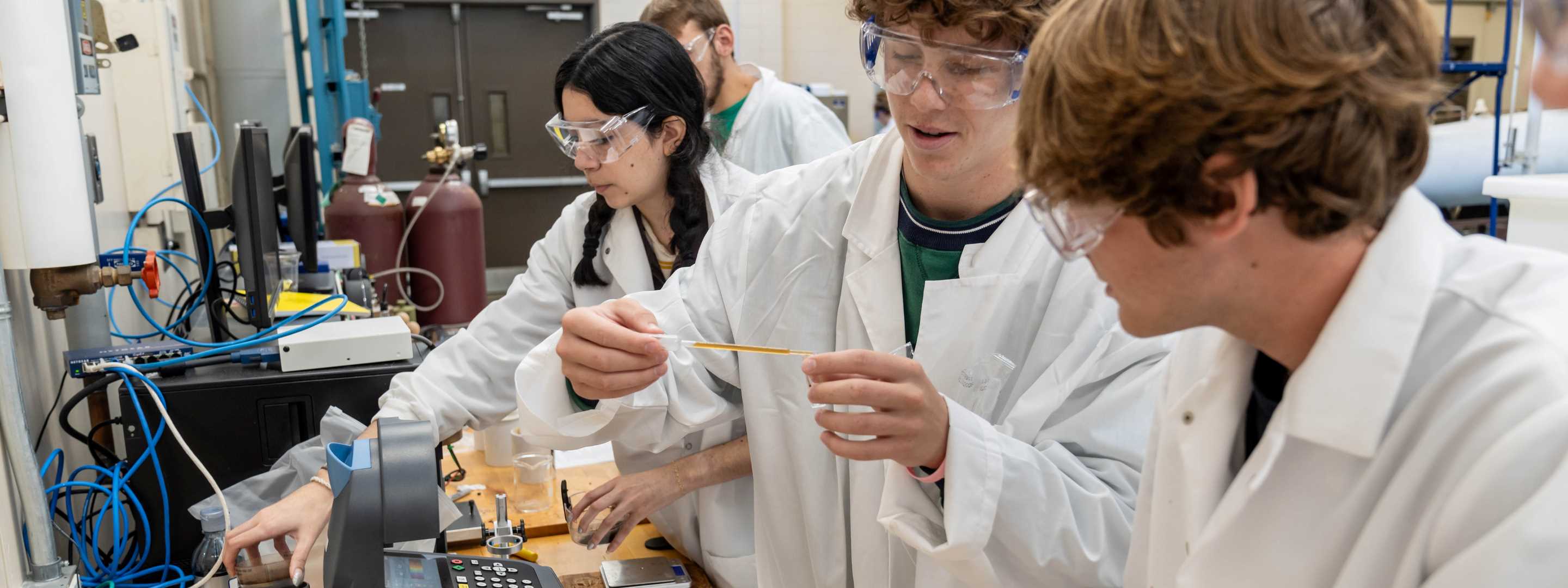
- Energy Storage (combining disciplines including chemical and electrical engineering and materials science with calculus, chemistry, and physics). Energy demands are rising at an unprecedented pace across society, from emerging AI technologies requiring large computing data centers, to increased cooling needs and electric vehicles, just to name a few. Engineers from every discipline must develop a deep understanding of energy demands, production, and storage. Energy storage systems can buffer energy supply and demand, ensuring continuous operation even when primary energy sources are unavailable or variable—such as with solar or wind power. In this module, you will have the opportunity to build a working energy storage electrochemical cell, design and build a potentiostat for testing and control of the cell, code the control and analysis software, perform materials characterization experiments, and explore the environmental impacts of electrochemical energy storage.
Seats are limited for this opportunity, and you can apply to be part of the ENGR 095 cohort at this link. Applications are due by July 7th and we will notify students selected for ENGR 095 by July 11th. For students who are not selected for this Fall’s ENGR 095 cohort, we do plan to offer a similar course this Spring.