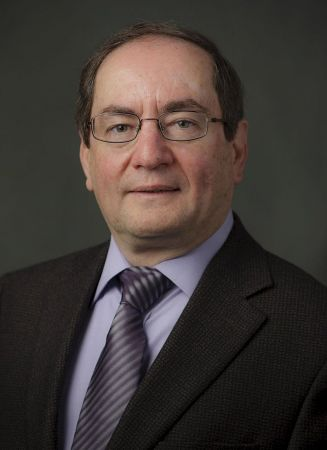
Israel E. Wachs, the G. Whitney Snyder Distinguished Professor of Chemical and Biomolecular Engineering at Lehigh University, has been elected to the National Academy of Engineering (NAE), one of the highest professional honors in the field of engineering. Wachs was recognized "for establishing fundamental structure–activity/selectivity rules governing molecular engineering of mixed oxide catalysts" that guide the rational design of solid catalysts (materials that accelerate and control chemical reactions) for air pollution remediation, sustainable energy, fuels, chemicals, plastics, and pharmaceuticals.
Membership in the NAE honors individuals who have made outstanding contributions to engineering research, practice, or education, as well as those who have pioneered new and emerging technological fields. Those elected are among the world’s most accomplished engineers and are often called upon to provide independent expertise on critical national and global challenges.
Wachs' election also underscores the national visibility of research conducted at Lehigh, which was designated an R1 institution—indicating the highest level of research activity according to the Carnegie Classification of Institutions of Higher Education®—in 2025.
"Professor Wachs' election to the National Academy of Engineering recognizes his decades of pioneering fundamental contributions to chemical engineering," says Stephen P. DeWeerth, the Lew and Sherry Hay Dean of the P.C. Rossin College of Engineering and Applied Science. "His work has reshaped key areas of catalysis science, bridged fundamental understanding with practical applications, and helped define the modern field of operando molecular spectroscopy. His research has impacted a global community of scientists and engineers and has provided industry with fundamental tools to design more efficient and sustainable processes."
For almost four decades, Wachs has earned international recognition for his research spanning both the fundamental and applied dimensions of solid-based catalysis. He is widely known for pioneering work in operando molecular spectroscopy, a methodology he helped establish that enables catalysts to be characterized under actual reaction conditions while simultaneously monitoring reaction products in real time, which has allowed establishing fundamental structure-activity/selectivity relationships for mixed oxide catalysts.
This "working" view of the surface chemistry of solid catalysts has allowed Wachs and his collaborators to identify catalytic active sites and surface reaction pathways on solid surfaces, the locations where the catalytic reactions take place, and the participating surface reaction intermediates, establishing structure-activity/selectivity relationships that guide the rational design of advanced catalysts. This fundamental research has wide-ranging applications, from the sustainable manufacture of value-added fuels, chemicals, and pharmaceuticals to environmental catalysis.
"I am deeply honored and humbled to be elected to the National Academy of Engineering," says Wachs, who will be formally inducted during the 2026 NAE Annual Meeting. "This recognition reflects not just my own efforts, but the sustained contributions of my students, postdoctoral researchers, visiting scientists, colleagues, and collaborators over many years. My career has been driven by a passion for advancing fundamental understanding in surface chemistry and catalysis and applying that knowledge to real challenges—from cleaner industrial processes to technologies that benefit society. I’m grateful for the strong support of the Lehigh community over the years and excited to continue pushing the boundaries of research and innovation."
A prolific inventor and researcher, Wachs holds more than three dozen U.S. patents, plus an additional 70 international patents, some of which have been licensed for industrial use. One invention, recognized by the U.S. Environmental Protection Agency (EPA) with a Clean Air Excellence Award, converts paper-mill pollutants into value-added chemical intermediates employed in the manufacture of resins for wood products (particleboard and plywood), insulation, and brakes, among other applications.
His scholarly impact is equally substantial: Wachs has published more than 400 highly cited technical articles, with a career publication citation count exceeding 53,000 and an h-index of 132 (the number of publications cited 132 times or more). As an educator and mentor, he has advised 50 PhD students (40 as dissertation advisor and 10 as co-advisor), 20 postdoctoral researchers, 15 MS students, dozens of undergraduate students, and 25 visiting scholars. He has guided numerous researchers who now are professors in academia (national and international), conduct research at national labs, and hold positions in global corporations such as Albemarle, AstraZeneca, Bristol-Myers-Squib, CB & I (formerly Lummus), Chevron, Cummins, Dow, DuPont, Johnson-Matthey, Linde, Lyondell Basel, Toyota, and Universal Oil Products (UOP).
Wachs' election to the NAE follows a long list of prestigious national and international honors. He is a Fellow of both the National Academy of Inventors (NAI) and the American Chemical Society (ACS). His career honors include the R.H. Wilhelm Award in Chemical Reaction Engineering (American Institute of Chemical Engineers), the George A. Olah Award in Hydrocarbon and Petroleum Chemistry (ACS), the Humboldt Research Award for Lifetime Achievements (Alexander von Humboldt Foundation, Germany), and two Fulbright Senior Scholar Fellowships (in Argentina and Israel). Additionally, he has been a visiting professor at the California Institute of Technology, Princeton University, and Harvard University, as well as at international universities in Argentina, France, Israel, Japan, Spain, and The Netherlands.
At Lehigh, Wachs directs the Operando Molecular Spectroscopy and Catalysis Research Laboratory. Recent projects in his group include converting toxic gaseous NOx emissions from power plants to benign N2 and H2O; transforming abundant CO2 and H2O captured directly from air to fuels and chemicals with renewable electrons from windmills and solar collectors; transforming sustainable biomass-derived ethanol to butyl rubber for green automotive tires and biomass to green fuel; converting sustainable biomass-derived methanol and ethanol to green acrolein (a major chemical intermediate in production of polyesters and animal feed); and transforming abundant natural gas to value-added fuels (e.g., aviation) and chemicals (key chemical building block small olefin molecules that are experiencing a global shortage).
Early in his career, Wachs achieved what he once described as a “lifetime discovery” by using Raman spectroscopy to resolve the long-debated molecular structures of supported metal oxide catalysts—providing the first clear view of how such catalysts function at the molecular level.
"Professor Wachs' goal has always been to understand the dynamic nature of surface catalytic active sites under relevant reaction conditions," says Steven McIntosh, Zisman Family Professor of Chemical and Biomolecular Engineering and ChBE department chair. "By bringing molecular-level understanding to industrial-scale problems, he has truly changed our approach to catalyst design for critical energy, environmental, chemical, and sustainability applications."
Wachs' election to the NAE represents a defining milestone in a career that has consistently advanced the scientific foundations of catalysis science while translating those insights into real-world impact.
Wachs earned his bachelor's (BE) degree from The City College of the City University of New York and his master (MS) and doctoral (PhD) degrees from Stanford University. Before joining the Lehigh faculty in 1987, Wachs spent several years engaged in industrial research at the Corporate Research Laboratory of Exxon Research & Engineering Co., an experience that helped shape his enduring focus on bridging fundamental science and industrial applications.