
The building-block chemicals behind everyday products—like shampoo bottles, food containers, and kitchen spatulas—are largely derived from oil. Researchers are now working to replace those fossil-fuel-based inputs with materials sourced from renewable biological systems, a shift with implications for health, economic resilience, and national security.
These bio-sourced molecules begin as renewable feedstocks such as plants and algae.
“Through a series of chemical steps, these molecules can be transformed into platform chemicals that industry uses to make a wide range of products,” says Steven McIntosh, Zisman Family Professor and Chair of the Department of Chemical and Biomolecular Engineering at Lehigh University.
But many of those reaction pathways remain poorly understood. In a paper recently published in Nature Catalysis, McIntosh and his collaborators report findings that advance understanding of how these transformations occur and how they might be made more efficient. The study’s co-authors include Bohyeon Kim, a PhD student advised by McIntosh, as well as Cardiff University (Wales) researchers Dr. Graham Hutchings, Dr. Samuel Pattisson, and PhD student James Spragg.
Gold-palladium interaction reveals new catalytic behavior
At the center of the work is a newly observed interaction between two common catalyst metals: gold and palladium.
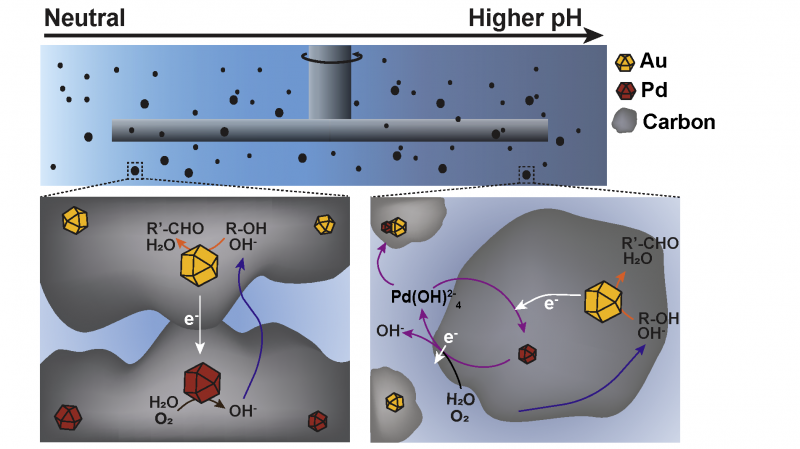
Building on earlier work, the team examined how gold and palladium interact when used together as catalyst particles. They found that the two metals couple through an electrochemical mechanism, altering each other’s behavior in ways that change how reactions proceed.
“Every reaction consists of two half-reactions, oxidation and reduction,” says McIntosh. “In conventional catalytic reactions, both occur on the same catalytic particle. But in our design we couple separate gold and palladium nanoparticles, forcing those reactions separate, and making the overall system more efficient.”
In effect, the pairing creates a nanoscale electrochemical reactor, increasing reactivity so that more molecules can react per second at a given temperature.
Separating reactions improves efficiency in catalyst systems
“If you want to scale a chemical process to produce platform chemicals, it has to be as efficient as possible,” he says. “That means maximizing reaction rates while minimizing energy input and the use of expensive catalysts.”
The team also showed that this coupling stabilizes the palladium. Under typical reaction conditions, palladium would dissolve. In the presence of gold, however, it remains in a metallic state.
“Through this electrochemical crosstalk between the metals, we’re not only increasing reaction rates, but also stabilizing the system,” he says. “That allows the catalysts to operate under conditions they normally couldn’t, and it’s the first time this has been shown.”
The researchers also found that this stability breaks down under highly alkaline conditions. While gold continues to drive the oxidation reaction, palladium begins cycling between dissolved and metallic states, a process called homogeneous and heterogeneous coupling.
“This cycling becomes part of the reaction itself,” he says. “We’ve effectively enabled an entirely new reaction mechanism that hasn’t been previously observed.”
New mechanism expands possibilities for catalyst design
Ultimately, the work points toward the development of more effective catalysts, and, in time, more practical approaches for producing bio-based chemicals at scale. For now, the findings offer something more foundational: a new framework that could reshape how catalysis researchers think about these reactions.
“We’re driven by innovation in basic science,” says McIntosh. “This is one of the most fundamental projects I’ve worked on, providing a foundation for further innovation in this space and future application”
Together, the findings suggest that even well-studied catalytic systems may behave in fundamentally different ways than previously understood, which opens the door to new strategies for designing more efficient chemical processes.
—Story by Christine Fennessy