
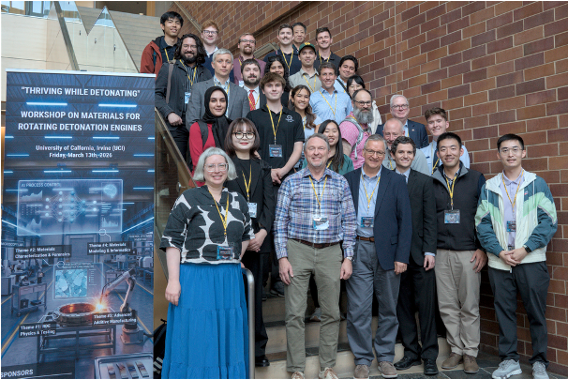
Recently, MechE Prof. Natasha Vermaak led her team including Profs. L. Valdevit, D. Mumm, X. Shi, at UC Irvine and Prof. M. Taheri-Mousavi at Carnegie Mellon University to host a workshop by invitation only for over 35 leaders in industry, government labs, and academia working at the cutting edge of materials technologies for rotating detonation engines (RDEs) (Figure 1).
The rotating detonation engine is a renowned propulsion concept that generates power by sustaining a circulating detonation wave in an annular chamber traveling at thousands of meters per second. Despite the efficiency potential of RDEs, the lack of proven materials solutions that can withstand the extreme thermomechanical loads produced by detonations remains a key barrier to deployment.
Representatives from Boeing, Relativity Space, ATI, NAWCAD, NAVAIR, Los Alamos National Lab, leading universities in this domain and US Air Force Research Laboratory, among others, joined the conversations about key research opportunities in RDE testing platforms, relevant materials characterization, advanced manufacturing, as well as materials informatics and modeling capabilities.
Vermaak’s NSF DMREF team is using an integrated approach that combines experiments, simulations and AI/machine learning (Fig. 2) to build a deeper understanding of how changes in the composition and microstructure of advanced structural alloys influence damage and failure mechanisms in the RDE environment. Learn more here.