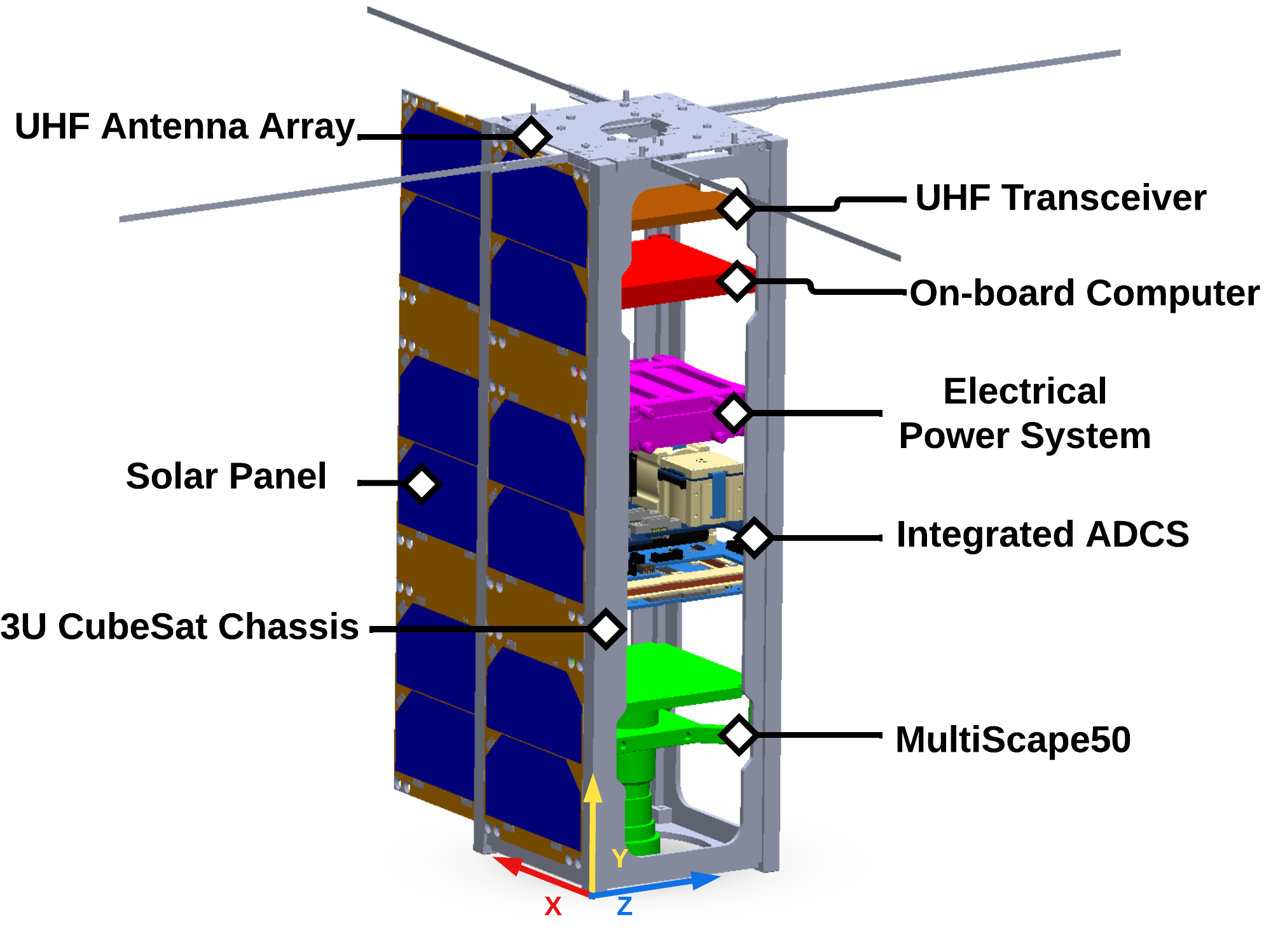
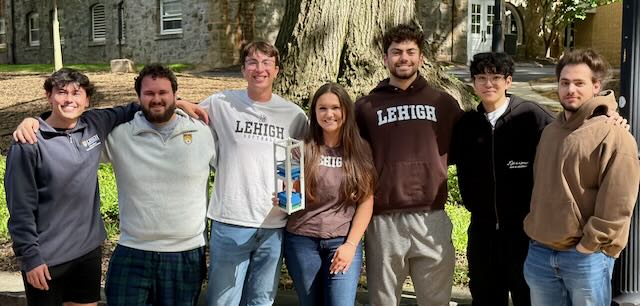
Lehigh University students developing a CubeSat designed to track ocean plastic from low Earth orbit have been selected to participate in the University Nanosatellite Program (UNP), a federally funded, Air Force–managed initiative that mentors university teams in satellite design and operations.
The selection brings $45,000 in funding to the Lehigh University Space Initiative (LUSI) and its CubeSat team, along with an additional $20,000 to support three student interns participating in a six-week summer mentorship program at Kirtland Air Force Base in New Mexico. Since the UNP began in 1999, just 55 universities have been selected to participate.
Monitoring Ocean Plastic Pollution from Low Earth Orbit
Hannah Peik ’27, outgoing president of LUSI and head of the club’s CubeSat team, says the opportunity almost didn’t happen.
A CubeSat is a nanosatellite measuring just 10cm x 10cm x 10cm. University clubs like LUSI submit design and mission proposals with the ultimate goal of building a satellite capable of launching aboard a NASA rocket. LUSI had already applied to NASA’s CubeSat Launch Initiative (CSLI), received positive feedback, and revised its proposal for a satellite that could transmit data on the location and density of ocean plastic patches from low Earth orbit.
Then funding disruptions to NASA’s CSLI program in 2025 left the team uncertain about its next steps.
“That really put us in limbo, so I spent winter break trying to find other launch opportunities," says Peik, who is in the fourth of a five-year dual-degree program in mechanical engineering and astrophysics.
Her search eventually led her to the UNP, but the deadline to apply was less than three weeks away.
“I had to jump on it pretty quickly to get our advisor, Professor Terry Hart ’68, and Lehigh onboard and put together the proposal, but we made it,” she says.
“The passion and dedication of our LUSI students has made all of this possible,” says Hart, a teaching full professor of mechanical engineering and mechanics and former NASA astronaut who leads Lehigh's new master’s program in Aerospace and Space Systems Engineering (MS-AERO). “They’ve embraced an enormous challenge and created opportunities that will benefit future students as well.”
Strategic Partnerships in Satellite Research and Development
Working with fellow CubeSat team leaders, Peik helped draft a proposal outlining the OSPREY (Ocean Satellite for Plastic Research and Environmental Yield) satellite’s mission, the team’s research goals, and how the group would utilize UNP funding.
“We outlined several projects already underway that will support our mission,” she says. “For example, we’ve started building a ground station on the Mountaintop campus that will allow us to downlink unclassified information from satellites within range, as well as uplink data to our own satellite. We’re also developing and testing prototypes of our CubeSat.”
The proposal also highlighted LUSI’s collaboration with Penn State University as part of the Pennsylvania Space Grant Consortium, which supports aerospace-related research and workforce development opportunities for students and faculty across the state.
“We wanted to show that once we have the ground station up and running, that we plan to open it up to the broader community, both across Lehigh and the state,” Peik says. “Researchers from a range of disciplines will be able to access data from any unclassified satellite within range of the facility. I think it helped our application that we showed how accepting Lehigh into the program could benefit other schools and teams as well.”
Professional Mentorship and Real-World Aerospace Training
This summer, the interns—two from Lehigh and one from Penn State—will travel first to the Kennedy Space Center for orientation before continuing to Albuquerque, where they’ll receive mentorship from government and industry experts aimed at refining the team’s CubeSat design and preparing the students for potential careers in aerospace engineering.
“I’m really looking forward to it,” says Adam Klinge ’28, a materials science major who serves as payload lead on LUSI’s CubeSat team and is one of the approximately 24 students participating in the program. “We’re going to be learning how a mission should be structured. We’ll learn new software and modeling techniques. And for a CubeSat to actually launch, it has to pass multiple levels of approval, so we’ll be learning how to prepare for those processes. They call it an internship, but they’re going to teach us so much.”
Aidan Donnelly ’28, an electrical engineering major and the CubeSat team’s power systems lead, says the experience will give students firsthand insight into the aerospace industry.
“It’s a training program that’s going to help us build our own satellites, and we’re going to be learning from the people who do this for a living,” he says. “It’s an amazing opportunity.”
As LUSI approaches its fifth year as a student organization, Peik says the club’s momentum reflects growing student interest in aerospace engineering and space research at Lehigh. Its members are so passionate, she says, that they easily convince first-year recruits to sign up on the first day of class—and stay until graduation.
“Everyone has put so much work and effort into this club,” says Peik, whose tenure as president is wrapping up, but who will continue working on the CubeSat until her own graduation. “We love space and the idea of contributing to it. We’ve helped Lehigh reach the point where it has a credible space program, and that’s exciting to see.”
—Story by Christine Fennessy