By Christine Fennessy
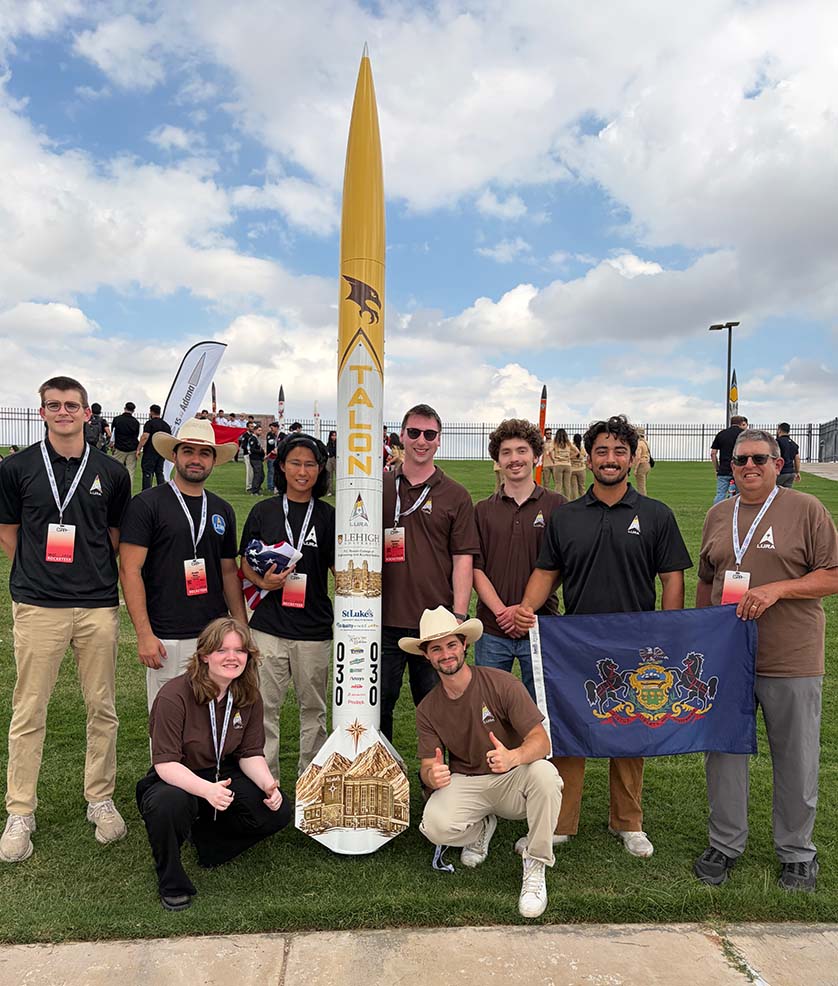
Just two years after its founding, the Lehigh University Rocketry Association (LURA) earned a place on one of collegiate rocketry’s biggest stages. In June, the student team competed in the 2026 International Rocket Engineering Competition (IREC) in Midland, Texas—the world’s largest student rocketry competition—and returned with a Space Dynamics Laboratory (SDL) Payload Challenge Honorable Mention recognizing the technical excellence of its robotic payload.
Teams undergo a months-long application and review process, and only a fraction of the hundreds that apply are accepted. This year’s competition featured 143 teams from 20 countries, nearly all of which faced challenging outdoor conditions.
“The weather was terrible all week,” says Keegan Gagnon ’26, a master’s student in aerospace and space systems engineering who founded LURA as an undergraduate and is the group’s outgoing president. “It was really windy, there were sandstorms, and the wind shear was especially strong. So as the rockets ascended, the wind would hit them from one direction, and as they flew higher, the wind hit them from the opposite direction.”

Preparing for the International Rocket Engineering Competition
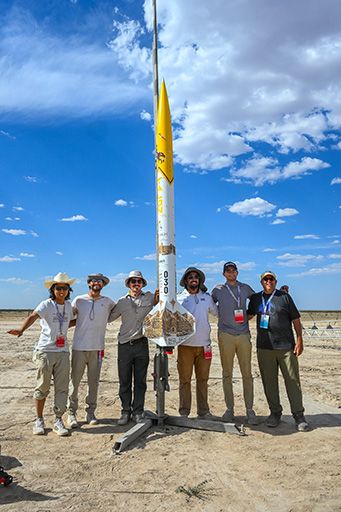
LURA entered Talon, its 15-foot, eight-inch-diameter rocket, in the 10K COTS category, where teams aim to reach 10,000 feet using commercially available motors. Before launching, every rocket must pass a safety inspection.
While many teams arrive with last-minute work still to complete, Talon was ready. Judges inspected everything from the motor and fins to the avionics, awarding LURA’s rocket one of the competition’s highest inspection scores.
“We did extremely well on our inspections and got nearly a perfect score on our build and design quality,” says Gagnon.
Weather challenges test the Lehigh rocketry team
They hoped to launch early the next day during a rare weather window. But then a rocket exploded (it happens), and by the time the fire was extinguished and the remnants collected, the weather had turned again. It was 6 p.m. when they and 15 other groups were called to the launch pad.
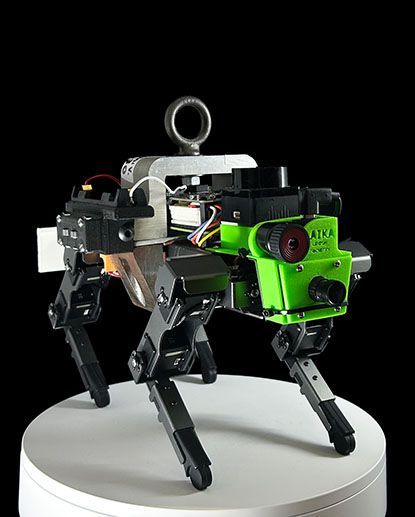
They set Talon up and armed it—turning on the avionics and the payload (a robotic dog named LAIKA). They were 15th in line to launch. Not ideal.
“It was sitting on the pad for 55 or 56 minutes, and the batteries were running the entire time,” says Gagnon. “That’s a fairly long time, but we had planned for that.”
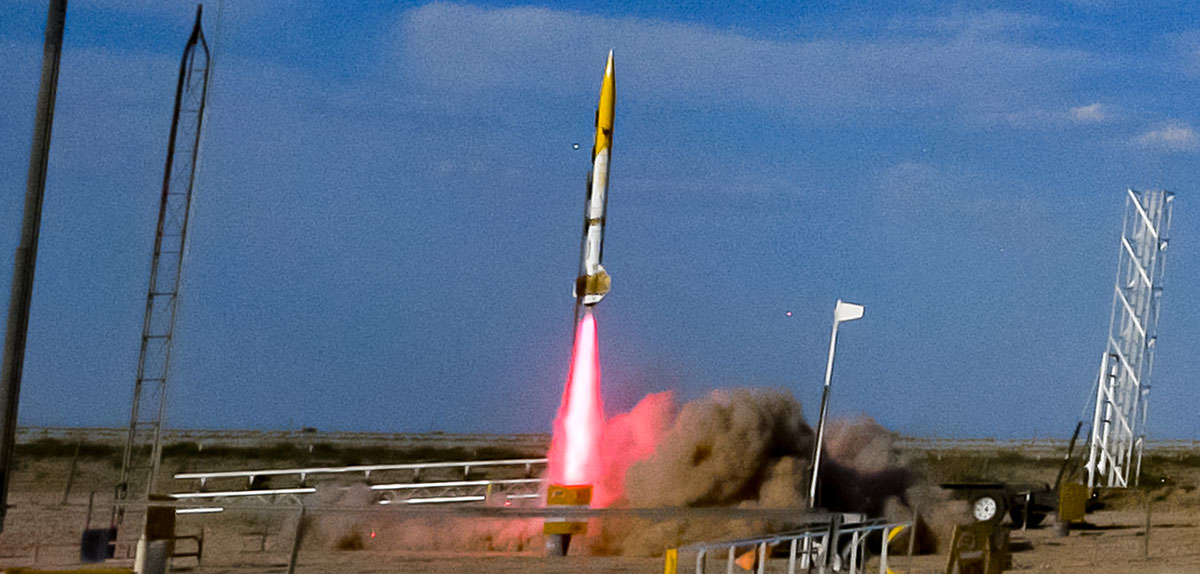
What they couldn’t control, of course, was the weather. The wind had picked up again and they could see several of their competitors’ rockets getting pushed around in the sky. When it was finally their turn, Talon lifted off.
Things looked good until strong winds pushed the rocket slightly off course. At apogee—the highest point of the flight—the drogue parachute, payload, and main parachute all deployed simultaneously. Normally, only the smaller drogue deploys to control the initial descent, with the payload and main parachute releasing at about 1500 feet.
“We think the wind shear pulled out the rest of the parachutes,” he says. “Which was fine because the rocket came down safely, it was just hanging out for a much longer time at a high altitude. But we didn’t lose points for that.”
What they did lose points for was apogee accuracy. They had predicted Talon would hit 9,558 feet. It went 8,561 feet.
“We definitely lost that thousand feet because of the wind,” he says. “It pushed Talon so that it was flying at an angle instead of straight up.”
Because of the late launch, the team couldn’t recover Talon or its payload until the next day, leaving both exposed to strong desert winds overnight. Using GPS, they found both, but the rocket’s nose cone was missing.
The team believes the premature parachute deployment tangled the nose cone tether and tore it free. Unless they could find it, they stood to lose significant points in the flight performance category.
Once again, they ran up against Mother Nature. “There was another sandstorm, and really windy, bad weather, so we had to come back the next day to look for it,” says Gagnon.
Without GPS to guide them to the missing nose cone, the students drove more than two hours back to the site and estimated where the nose cone should have landed based on the rocket’s apogee. But another storm halted recovery efforts once again.
They finally located the piece—completely intact—after it had been in the desert for three days.
“Which is pretty surprising since it had fallen on its own from 10,000 feet,” says Gagnon.
Since the nose piece could be reattached, Talon was considered to be structurally sound and the team received full points for that portion of the flight performance category.
Robotic payload earns Space Dynamics Laboratory award
The team also scored well in the payload category. Designed to simulate a sophisticated autonomous payload, LAIKA, the robotic dog, collected engineering data after landing and was intended to demonstrate technologies relevant to future aerospace missions. Although its optical camera malfunctioned, it did return thermal images of its surroundings.
The robot’s design ultimately impressed judges most. While competition rules require only a payload weighing at least two kilograms—and many teams use something as simple as a metal block—LURA developed a sophisticated robotic system.
It earned high marks for technical merit and received a SDL Payload Challenge Honorable Mention for Technical Relevance, recognizing both its complexity and its similarity to technologies under development at Space Dynamics Laboratory.
For a club in its relative infancy, competing at one of the world’s premier collegiate rocketry competitions, successfully launching and recovering its vehicle, and earning an award for its innovative payload marked a remarkable milestone.
"I'm so proud of these students and all they have accomplished over the past two years," says LURA’s faculty advisor, Terry Hart ’68, teaching full professor of mechanical engineering and mechanics, former NASA astronaut, and founding director of Lehigh’s master’s program in Aerospace and Space Systems Engineering (MS-AERO).
For Gagnon, who now works as an engineer at Northrop Grumman, the achievement was especially gratifying. He plans to continue serving as a mentor to LURA.
“The goal was to just get to the competition, but we showed up with one of the biggest and coolest-looking rockets, and everyone loved our payload,” says Gagnon. “We had so much attention, the judges loved us, and our team carried itself so well.”