
Duration: 27:35 | Published: November 9, 2022
Episode Summary
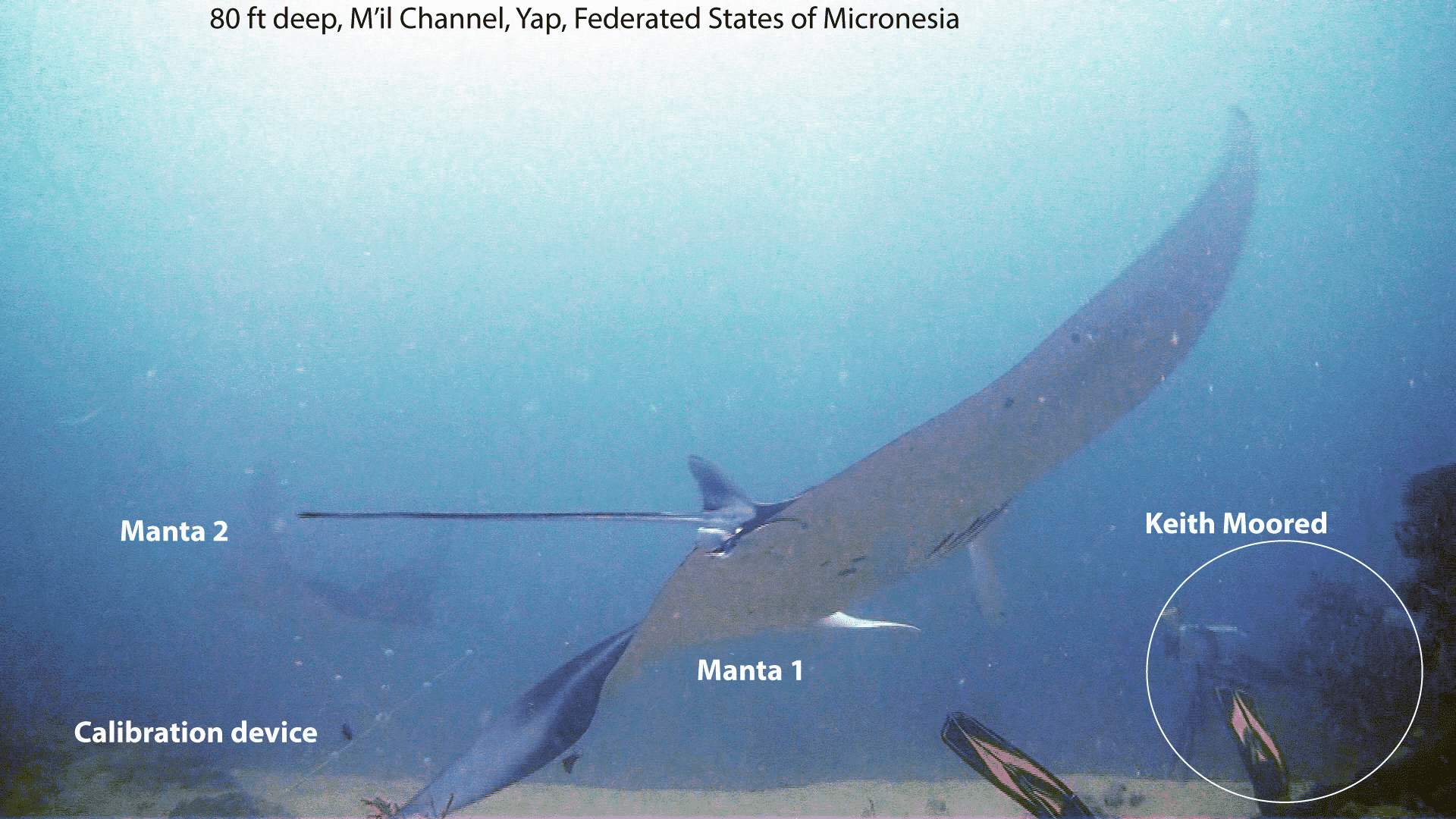
Diving with manta rays isn’t the typical research experience of an engineering graduate student. But Keith Moored was one of the lucky ones (see photo at right). He got the opportunity to go to Micronesia as part of his PhD research into bio-inspired robotics.
“To see these manta rays up close, it really was just a dream,” he says.
As a professor in mechanical engineering and mechanics, Keith and his team now study the fluid mechanics of fish swimming. “We try to understand what features of fish swimming relate to high efficiency, high speed locomotion, and what that’s doing in terms of the fluid mechanics, in terms of how water flows around these fins.”
His research focuses on bio-inspired locomotion, an area of mechanical engineering that examines how the fluid mechanics of fish swimming can be applied to solve real-world engineering challenges. His lab investigates everything from the hydrodynamics of fish schooling to underwater robots that swim more efficiently, quietly, and with better maneuverability than traditional vehicles. Those same principles are also being used to design renewable energy systems that generate electricity by mimicking the motion of fish fins in flowing rivers, offering a potential source of clean energy with less impact on aquatic ecosystems.
Along the way, Keith shares his story about diving with manta rays, explains why understanding fish schools could help scientists predict the effects of climate change on marine populations, and reflects on the joy of combining fundamental scientific discovery with engineering solutions that can make a meaningful difference.
Because, as he says, the most rewarding research doesn’t just uncover new knowledge—it finds ways to put that knowledge to work solving important problems.
Key Moments
- 1:35 — Childhood fascination with space, LEGO and the ocean
- 5:11 — Discovering bio-inspired engineering in graduate school
- 7:42 — Diving with manta rays in Micronesia
- 10:37 — Why Keith chose Lehigh
- 13:02 — What is bio-inspired locomotion?
- 13:58 — How fish schools could improve renewable energy and robotics
- 15:10 — Understanding fish behavior and climate change
- 18:26 — Building schools of underwater robots
- 20:30 — Fish-inspired renewable energy systems
- 23:53 — Helping remote communities generate clean energy
- 25:45 — Why combining science and engineering is so rewarding
Featured Quotes
"We have the potential to take technology and make it do amazing things." — Keith Moored
"It’s really important for researchers to stay grounded and stay connected to students." — Keith Moored
"I was very lucky to be able to do this. This is not a normal graduate school experience." — Keith Moored
Full Transcript
Transcript is auto-generated and lightly edited for clarity.
Welcome to Rossin Connection, a podcast about all things Lehigh engineering. Coming to you from the P.C. Rossin College of Engineering and Applied Science at Lehigh University. It's a show for students, alumni, faculty and staff, current, former and future. And for anyone interested in the many creative ways the engineers are solving the world's problems. I'm your host and producer, Christine Fennessy. Today we're talking with Keith Moored. Keith is an associate professor in mechanical engineering and his research focuses on bio-inspired locomotion, specifically the fluid mechanics of fish swimming. In this episode, he talks about his childhood love of space and the ocean and how they both led him to engineering. He describes the unusual and incredible experience of diving with manta rays as a grad student and how the hydrodynamics of fish schooling can be applied to renewable energy devices and underwater vehicles, and a better understanding of the impact of climate change on fish populations. Thanks for joining us. Now take me back to childhood So if you could, and describe who you were as a kid and if there were like any indications early on that you were going to take this path to becoming an engineer.
Yeah. Well, um, you know, one thing that stood out for me, like most kids who go into engineering, I loved Legos. I had multiple sets of these put together and every time I would always get the space Legos, so I ended up with like this huge box of these space Legos and I would just routinely take 'em apart and rebuild 'em again and again. And it was interesting to me thinking back to that because the first thing I did in undergraduate, the first major I had was an aerospace engineer. And I also added on physics later in my undergraduate degree. But my first love was aerospace engineering and it was really connected to those space Legos at the time. But a funny thing was, was that when I was younger, I was also very interested in the ocean and very interested in marine biology. , my grandfather asked me one time, he was like, well, what do you wanna be when you grow up?
And I was probably like eight or 10 years old. I don't remember the story too well, but my mom keeps telling me about it because she was there for it. And uh, I told him that I wanted to be a scuba diver and I was really interested in scuba diving. And you know, my grandfather at the time was like, oh, you can't do that. That's not a real job. And my mom was like, he can do whatever he wants. And it turns out that now I've actually, what I do in my research is actually a combination of both marine biology and aerospace engineering brought together even for, for graduate school, for part of my research, I was actually doing diving. I went diving with manta rays in Micronesia, which was pretty incredible. But that was kind of one of the culmination points of this, you know, research that I was doing where we were understanding the fluid mechanics of manta ray locomotion. And that's all kind of in the purview really, of aerospace engineering, kind of surprisingly, but it's connected to marine biology. And so we would be doing this research that had kind of both aspects to it. And so looking back, it kind of made sense to me that it ended up where I am, but it wasn't so much a thoughtful path of my choosing just kind of ended up that way.
Wow, that is so, that's a lot. Well, so where do you think that initial fascination with both space and with the ocean, where did that come from?
That's a good question. Um, you know, my parents would take us around to a lot of natural history museums and the air and space museums. And for me, going to see aquariums as a kid for field trips was one of the most exciting things to do. I don't, I don't know, there's just something just impressive and, and graceful about watching animals swim on the other side. I think that when we went to the air and space museums, that was exciting to me from the technological standpoint that people can make devices that could do things like fly through the air. We have the potential to take technology and make it do amazing things. Things like swim, like fish, but it's not there yet. There's a huge gap between what we can do technologically and what we could see in the natural world. And so I kind of took that as a motivator to think about, well, how can we bridge that gap? How can we get the same performance that we see in nature, the same abilities, the same in the case of fish, swimming, maneuverability, agility, speed, efficiency. How can we get those attributes in our own types of technologies?
And did you come to that sort of realization about what it is that you wanted to do in undergrad?
Yeah, it started to form in undergrad. I mean, I'd already been mostly through the, the aerospace engineering program. I had mostly finished up my degree in physics at the same time. And so I was looking around different graduate schools. I talked to a faculty member, uh, Hilary Bart-Smith at the University of Virginia who became my PhD advisor. And she had this project, which for me was super exciting. It was on understanding the locomotion of manter rays and building morphine wing technologies that could actually mimic those motions and reproduce the performance seen in, in manta ray locomotion. And her kind of area of expertise was structural mechanics, active structures. And I remember actually taking, uh, my structures course in, in my senior year I was doing homework, so I was like, Ugh, I hate this. I'm never gonna do structural mechanics after, uh, undergrad. But she had this project, which for me, I was really interested in the fluid mechanics aspects of manta ray locomotion of bio locomotion in general. And I saw it as an opportunity for me, even though I didn't like structural mechanics kind of going into that, I saw it as an opportunity to get to where I wanted to go, which was looking at bio locomotion and, and thinking about the fluid mechanics aspects of that.
Whoa. And so this was your PhD. What was the end like to what end were you doing this research?
Right, so this was in kind of the vein of bio-inspired robotics. And so the idea was to build an underwater vehicle that swam like a fish. And our choice of fish that we were focusing on was rays and manta rays in particular. And we were trying to build a vehicle that had a lot of characteristics that current underwater vehicle technologies do not have as a whole package. And so they might have a particular aspect of it, but not everything together. And so we were trying to get a device that was efficient, fast, maneuverable, and agile. At the same time, these devices that swim like fish end up having a noise signature that sounds like fish. And so for the underwater world for submersibles, that's kind of the key to detecting any sort of submarine is to track it using hydrophones. So the idea was that if we build a submersible that swims like a fish, a lot of the noise signatures associated with the kind of frequency of a propeller, but now if it swims like a fish, it has a, a different tonal frequency. And so it sounds like other fish around it and it's really hard to detect. And so that's kind of the stealthy side of the, uh, interest in these bio robotics.
Oh my gosh, that's so neat. Okay, I just wanna back up for a second and, and talk about you're diving with manta rays as a grad student, you know, for someone who grew up in just so enthralled with the ocean and marine life, how did it feel to be in their world in that way?
it was incredible. I mean, to see these manta rays up close to see all the animals really, that we got to see while we were there was just, it was really just a dream. One of the most amazing things happened with the manta rays that we were studying. We went down, we would go diving down to about 80 feet and we were looking at first at all a bunch of different locations, but this one location where the manta rays kept showing up was what's called a cleaner station. And so the manter rays would come up to this kind of rock outcropping and they would stop and kind of hover over this rock and all these little fish would come out from the rock and go up into the gills of the manta rays and eat at little parasites. And we were set it up down there to actually take videos.
And we had built this three dimensional, what we called a calibration device. And essentially this was like about three feet by three feet by three feet in, in length. And we used that just to kind of calibrate the length scale for the manta ray so we could get a, a measurement of how big the manta rays were. And, and the manta ray got cleaned and then took a loop around and came over the calibration device and hit it with its fin and it bounced off the ocean floor and came back and settled down and he came around again and did it again. So he was really curious about what this thing was on the ocean floor. And then he became curious about us too. So he came around and got really close to us. I remember lying on the sand just kind of watching him, and I just turned up and he swam right over top of me and kind of turned his body over so his eye could kind of see me up close as he swam by. I could have reached up and touched him. He was a couple feet above me. And so that was just really incredible to get that close to such a large wild animal. And these fish are just amazing. They're, they're actually are fish and they are extremely intelligent. And you could tell that just by the fact that they were so curious about us about the calibration device. Most fish aren't curious at all about those kinds of things.
Oh my gosh, I can't even imagine that sound. That sounds so amazing. I mean, I've, I've, I've never been diving, but I've been snorkeling and even that is amazing. 'cause you're just like, yeah, you, you, you just have a perspective you never normally have. Oh, wow. You're so lucky.
I know, I know. I, I, I was very lucky to be able to do this. This is not a normal like graduate school experience, so I just kind of was in the right place at the right time.
That is so nice. Um, yeah. All right. Well, so you have this amazing experience in graduate school. So how did you end up at Lehigh?
I, I really didn't know that much about Lehigh to begin with, but compared to all the other places that I interviewed at, it really stood out to me. And the reason why it stood out was that Lehigh was a serious research institution, so they were interested in research excellence and high profile research opportunities, but at the same time, they were really serious about teaching too. And most of the only universities I went to, there were great research institutions, but they could really care less about the teaching aspect. And for me, that didn't feel right. I wanted something that was a bit of both, that is a good research institution, but was interested in good teaching. And you know, Lehigh hit that bill for me
And, you know, there might be some applicants to, to these jobs that would look at the university that puts a very heavy emphasis on research and less on teaching and go, yay, that's exactly what I want. What, yeah. But, but that didn't speak to you, that's not what you wanted. What, why were you also eager and willing to, to devote a lot of your limited time and energy to, to teaching and not just teaching just to check a box, but it sounds like teaching to really make a difference in the students that come through your classroom.
Well, for me, I feel like it's important for researchers to stay grounded and stay connected to students. To actually have that connection is really important to remember what it's like to learn things at for the first time. And you know, at the end of the day, we're always trying to generate new knowledge and, but it's also nice that you can directly affect a student's life, right? And you can show them something that they've never seen before, allow them to have that sense of discovery and excitement that's involved with that and show them that there is a way to learn new things and here it is. And so that's just fun. at the, at the core of it is just fun to kinda see that in students and to see them kind of growing and learning in that way. Now my personal kind of profile is more research oriented and there's a balance to be struck there that you wanna do well in your teaching and you want to bring students along in the process, but at the same time, you don't wanna just do teaching. You wanna make sure that you're making advancements in our knowledge as well.
So, all right. So talk to me a little bit about your research. So what is the primary area that you're focused on now and and maybe illustrate that with one or two projects that you're working on?
Yeah, so we focus on bio-inspired locomotion. We look at fish swimming and in particular we focus on the fluid mechanics of fish swimming. Essentially, if you think about a, a typical fish, they have a tail fin that they're oscillating back and forth. And that oscillating fin creates a certain flow fields and flow structures around it that relate to the efficiency of locomotion, the speed, the force production. And so we try to connect those dots. We try to understand what features of fish swimming relate to high efficiency, high speed locomotion, and what that's doing in terms of the fluid mechanics, in terms of how water flows around these fins. And so for years we've done research on single fish and these kind of connections and we've learned a ton in that process. And so now we are kind of branching out in terms of directions and applications.
So one direction that we're going is we're now thinking about not just a single fish, but we're thinking about the hydrodynamic or fluid dynamic interactions between multiple fish in a fish school. So we have a whole research project that just got started actually this, this month on looking at the hydrodynamics of fish schooling. The other direction that we're going is we now are kind of looking at the other side of the coin. So we can actually take this knowledge of fish swimming and apply it to renewable energy devices. And so we're looking at a device that goes in a river that has a hydrofoil, so an underwater wing that it will oscillate like a fish fin and it oscillates due to the river flow and you can attach a generator to that and generate electricity. And so the Department of Energy is funding that research and they're interested in this as well. Um, so that's kind of the other direction that we're going.
Talking about the first one in looking at schools of fish to what end, like why do we need this particular research question answered? Like how, how these schools interact?
Yeah. So there's a couple motivations for that. One is from the biological front. So we know a decent amount about the behavior of fish in fish schools, like why they want to do this. There's a lot of reasons that they school, they do it for protection against predators. They can improve their foraging capabilities. There's socialization aspects to it as well. They do it during migration. And so we've known for a while that there can be a hydrodynamic benefit to fish schooling together that they can actually get reduced energy expenditure if they are in a group than if they're by themselves. And so that kind of point about the energy expenditure is one that we know vaguely about, but we know very little about the details. And so that's where we come in where we want to understand the details of the fluid dynamic interactions. And you know, before now we just either didn't know enough about a single fish swimming hydrodynamically speaking, or we didn't have the capabilities numerically or experimentally to really study this effectively.
And so we're, we're at the point where we can do this now. So this is important in terms of the biology because it really helps us ultimately understand this energy question and how much fish are really saving in terms of their energy expenditures. This is really important to understand how much resources fish schools need and ultimately how fragile these biological networks are to things like climate change, to things like overfishing, all these stresses that get put on fish populations and you know, fish are one of the major food sources of the world, so having a better understanding about their energy budget and schooling is a major part of that. We can have more concrete answers as to how much overfishing is too much and how much will climate change really affect these networks? Will they collapse? Right? And so that's kind of the broad vision about why we wanna do this for understanding the biological side.
So how would understanding their energy budgets shed more light on how they're being affected by climate change?
Yeah, yeah. And that's, it's kind of, it's similar so in the sense that climate change stresses our environment in general, and when that happens, there can be reduced food sources. So corals dying off, so some fish, you know, will feed on fish in coral reefs. So if there's less coral around, that makes it harder for fish that are working as a school to actually find the, the energy that they need to find the, the food sources that they need. So they're gonna have less food sources around, so they're gonna be in an environment that really is at an energy deficit to what it used to be. The question is, do they have enough energy savings by schooling together to kind of account for that? Or at some point, is it too low in terms of the food sources around, do they have too little energy to keep doing what they do?
Right, right. Okay. That would be the biological benefit of studying schools of fish. What's the other benefit of studying this?
Right, so the, the other side is the engineering side. And so we're, we're interested in building these, these bio-inspired robots because they can have this kind of package deal. They can be a system that's efficient and fast, maneuverable, agile and stealthy. And so we would like to do that not just in a single device, but in many devices that are coordinated together. And so essentially wanna build a school of bio robots. And the reason is is because sometimes it's useful just to have a single underwater vehicle go out and do something. Maybe they're doing reconnaissance for other underwater vehicles, maybe they're going out to inspect underwater lines for internet or power or whatever. But sometimes it's good to have a school of vehicles that can actually go out and perform a distributed task. So maybe they wanna coordinate to do reconnaissance so that there are many of them in an area and they can kind of have a wider net of tracking other underwater vehicles.
Or maybe, um, for instance, I've talked to some oceanographers and they really want to have a swimming system that is a distribution of systems that can take measurements in the water column of pollutants, of nutrients, of carbon dioxide, of all sorts of things that are in the water column. But they don't just want a single point measurement. They wanna have a whole distribution or a map of these different quantities in the water column. And to do that, you would need multiple coordinated vehicles working together. So maybe you wanted map the underwater topology of the ocean and you wanna do that with many vehicles, so it doesn't take as long as a single vehicle. Right. And so there's a lot of applications where having multiple vehicles involved with doing distributed tasks could be much more effective than having a single vehicle.
Wow, that is so neat. And, and so for the other project, I understand the problem that you're trying to solve in the sense that we need more energy sources that are renewable. Can you talk a little bit about what sort of makes this particular project unique?
So first off, if you wanna think about, we're focused on river based technologies and we're actually funded through ARPA-E, which is kind of a subsidiary of the Department of Energy. And they have a whole program involved where they fund something like 10 different teams on 10 different projects. And in this program everybody's focused on either river flows or tidal flows. And so the idea is that they're funding hydrokinetic devices, which are essentially underwater wind turbines, if you will, to extract energy from, from fluid flows and rivers and tides. And our particular version of it, it's called a bio-inspired oscillating hydrofoil because we use underwater wings, kind of like a fish fin that oscillate back and forth. And some research has been done in this in the past. We're not the first to do it, but what we are doing that's unique within our area is really integrated in some of these features of fish swimming that people haven't really considered.
We're looking at multiple fin uh, interactions. We're looking at flexibility, we're looking at different kinematic motions for these devices. And we think all of this will lead to higher energy extraction efficiencies, which at the end of the day leads to a lower levelized cost of energy. And what that means is the levelized cost of energy is the essentially the cents per kilowatt hour that you pay. So we're trying to lower that down to a point where it's actually, uh, affordable. And so in our particular case, we think that this is a great solution for river flows for kind of a couple different reasons. One reason is the way that the system is designed, it scales better than a typical rotary turbine. So you can imagine, uh, what we call a hydrokinetic device just being an underwater wind turbine with really short blades, um, because the water is much more dense and so the forces are much larger on it.
So if it has really long blades, they break. So it has these short stubby blades, but our device is different than that. It's this wing that oscillates back and forth and doesn't rotate in a circle. And because of that kind of geometry, it's actually much better suited to build a large scale device for a shallow river flow. And that just has to do with the general kind of topology of the river. And that ultimately means we could build bigger devices, which tend to be cheaper per kilowatt hour of energy you can extract. So that's one reason. Another reason that this is I think, exciting is that typically these, these oscillating hydrofoils move a lot slower up to 10 times slower than a typical rotary underwater turbine. And so that's much safer for fish to pass through and to migrate through. And a lot of these candidate rivers are ones where fish migration is crucial, not only for the fish, but for the local economies of the towns that are on those rivers. And so we don't wanna disrupt that. We wanna have as little disruption to the environment as possible. So these devices are much, have a much lower environmental impact in that way, and also in the way of creating scour, which is where they kick up underwater sediment and cause it to redeposit and change the topology of the river.
Right. Wow. And so the idea is that these things they could potentially be used to power at, at a large like community-wide scale?
Yeah, yeah. So we're interested in kind of all the scales, small scale kind of a microgrid scale to much larger scale devices. Currently we have this target river that's in Alaska that is a pretty small scale river. Its maximum depth is only about, well, in the areas that we're looking at, it's only about 16 or 20 feet deep. But there are a few smaller villages and towns that are kind of along there. And in Alaska, especially for half of the year, they don't get any sunlight or very little sunlight. And so solar's really not an option. And in, in that particular area, there's just not that much wind either. So wind is really not an option. And fuel costs is are very expensive 'cause you have to truck them in so you know what's left. And pretty much what's left is, is either you dig really deep and build some sort of geothermal plant, which is very expensive, or use the local river to extract energy from.
And they don't want to build a dam on there for a good reason because they have salmon populations there that are huge to their economy and it's the main driver of their economy. So they don't wanna dam up the river and keep the fish from going upstream and spawning. That's the major source of their income. So instead they wanna have some river based technology that can not disrupt the environment, but still provide good levels of energy at a low cost. And so that's what we're here to do, is to kind of solve that kind of problem and that problem's, one that's repeated across the world and small villages, but even in large scale places, maybe there are more sources of energy, but the river based source of energy can help balance out that portfolio for days when it's not sunny days, when the wind's not blowing. Things like that.
Uh, that's really exciting. All right. So what do you find personally like the most compelling and most fulfilling about being involved in this type of research?
I that, that's a great question. Um, it's really multifaceted for me to be honest. Um, but I love that we're doing research that can really make an impact. I think that that is always exciting. It feels like, oh, we have a strong purpose for what we're doing. I love the kind of technical detail that we can get into and understanding flow physics and really discovering new science there is always just thrilling to do. And it's, I guess really the combination of those things where you can do some really cool science, but maybe it's not that purposeful or maybe it doesn't have, it's always with purpose, but maybe it's without a large impact. And I think that we have both, we have both a large impact. And this really cool fundamental science that is, is not just engineering, it's both, uh, science and engineering. We have to learn new principles of science and discover those and then figure out how do we build this into an actual technology. And that's where it just resonates with what I want to do and kind of the place I wanna be.
That's it for today's show. I'd like to thank Keith for being so generous with this time. For more information about all the academic programs at the P.C. Rossin College of Engineering and Applied Science, and to find our show, head to engineering.lehigh.edu. Music in this episode is by Blue Dot Sessions. You can send us story suggestions or feedback on X at Rossin podcast. I'm your host and producer, Christine Fennessy. See you next time.
About the Guest
Keith Moored is an associate professor in the Department of Mechanical Engineering and Mechanics at Lehigh University whose research explores bio-inspired locomotion and fluid mechanics. His lab studies how fish swim and interact with flowing water to better understand marine ecosystems while developing underwater robots, renewable energy technologies and other engineering systems inspired by nature. His work spans fluid dynamics, robotics, energy and environmental sustainability.
Episode Details
Related Episodes
- Episode 26: Beyond Silicon: The Search for Next-Generation Semiconductors
- Episode 27: Powering a More Reliable Electric Grid with Javad Khazaei
- Episode 32: Engineering for Global Impact with Eric Obeysekare