
Duration: 13:19 | Published: April 20, 2022
Episode Summary
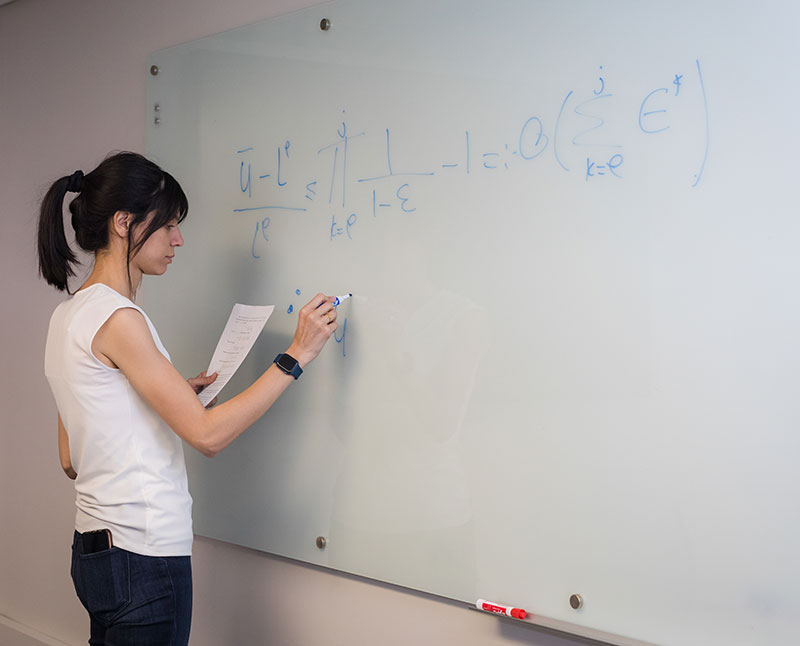
As a child growing up in Amman, Jordan, Karmel Shehadeh dreamed of becoming a university professor. She loved math and science, spent her free time reading about researchers around the world and knew early on that she wanted a career built around discovery, teaching and making a difference. Pursuing that dream meant leaving home to earn graduate degrees in the United States, but it ultimately led her to Lehigh, where she now combines research with a passion for mentoring students.
Today, Karmel’s research focuses on healthcare optimization—using mathematics, operations research and data to improve the way healthcare systems function. Her work explores questions involving hospital scheduling, patient flow, healthcare facility locations and access to care, with the goal of reducing wait times, improving efficiency and creating more equitable healthcare systems. She also discusses why healthcare presents some of the most challenging and rewarding optimization problems engineers can tackle, particularly in the wake of the COVID-19 pandemic.
Along the way, Karmel reflects on what she loves most about research, why she views her student researchers as family and the personal message she includes at the end of every faculty profile and research paper. It’s a reminder that every big accomplishment begins with someone willing to believe in an ambitious dream—and encourage others to do the same.
Key Moments
- 1:23 — Growing up in Amman, Jordan
- 2:16 — Discovering a love for engineering and problem solving
- 3:17 — Leaving home to pursue a Ph.D.
- 4:17 — Why Lehigh is “the home of optimization”
- 5:18 — How optimization improves healthcare scheduling
- 6:34 — The challenge of putting research into practice
- 7:08 — Making healthcare access more equitable
- 8:12 — Mentoring undergraduate researchers
- 9:34 — Expanding healthcare access research across the U.S.
- 10:50 — Why Karmel calls her research group a family
- 11:15 — The story behind the line she includes in every faculty profile
Featured Quotes
"Healthcare systems are one of the most complex systems to manage." — Karmel Shehadeh
"I see my research team as a family." — Karmel Shehadeh
"You have a voice, use it—and use it to make something good." — Karmel Shehadeh
Full Transcript
Transcript is auto-generated and lightly edited for clarity.
Welcome to Rossin Connection, a podcast about all things Lehigh engineering. Coming to you from the P.C. Rossin College of Engineering and Applied Science at Lehigh University. It's a show for students, alumni, faculty and staff, current, former and future. And for anyone interested in the many creative ways the engineers are solving the world's problems. I'm your host and producer, Christine Fennessy. Today's episode features Karmel Shehadeh. Karmel is an assistant professor of industrial and systems engineering, and she joined the Lehigh faculty in August of 2020. In this episode, she talks about how as a kid she dreamt about becoming a researcher and how today she's applying those research skills to making healthcare systems more efficient. She talks about what she considers the best part of her job at Lehigh and why she includes an unusually personal line in her faculty profile. Thanks for joining us. Karmel Shehadeh is from Jordan. She grew up in Amman, the capital, which is different from the Lehigh Valley in one very distinct way.
Oh, Amman is really busy, so it's nothing like Bethlehem. Yeah, that's why I like to go like in the weekends to New York because it's reminds me of my home. As busy as it is,
She says in Amman, people walk everywhere, and even though it's a big city, there's a real community feel.
People are really lovely. So people are always waving to each other saying hi, whether do you know them or not.
One question she gets a lot is about the food she misses. She says, Jordan has so many dishes that she can't really pin down anything specific. And anyway, It's more in the way that the food is prepared that makes it special.
I think the most remarkable thing is that it's always fresh. So we don't do a lot of like frozen or stuff. It's always like fresh and healthy and, um, really delicious to eat.
Looking back on it now, it's probably not surprising that she became an engineer.
I really loved math and science. Uh, I used to make my own toys, fix stuff at home, and then even when I grow up and I had a car, I used to change my own car oil. You know, if I need to change my tire, I do it by myself.
Pretty early on, she knew she was interested in problem solving, so she read a lot, almost exclusively about science.
I was not a reader of books, or novels.
She also read about the work that researchers were doing in universities around the world. So she read a lot of faculty profiles too. The idea of creating new knowledge, sharing it with students and making an impact really resonated with her. She dreamt about becoming a researcher and a professor, and she was determined to be both no matter what, but realizing her dream meant leaving her country and her family.
The goal was always to be a faculty who do research, you know, interact with people, uh, teach. So there was like no opportunity for me to do a PhD, um, in Jordan, unfortunately.
So she came to the U.S. And got her master's at Binghamton University in New York and her PhD in industrial and operations Engineering at the University of Michigan. The field combined her passion for math and healthcare.
I mean, as I always say, healthcare systems are, uh, one of the most complex system to manage, and we have seen how the health system pretty much break down during the pandemic. So this, you know, all of it makes very nice, lovely research problems to work on,
As an optimizer, she was drawn to the complexity of these systems, the sheer number of research problems
And the impact once you, you know, solve these problems. I think what this is what attracted me to healthcare.
She joined the Lehigh faculty in August of 2020.
As we always say, Lehigh is the home of optimization, right?
And by that she means it's where her amazing colleagues continue to develop new methodologies in optimization. At Lehigh, she says the primary goal of her research program is to build a multidisciplinary team that takes a data-driven approach to solving problems in service industries like healthcare. She says that in terms of her own methodological interest,
I am in love with mixed integer programming. You know, there's nothing in this world certain, so I really enjoy it when I solve the problems that, uh, involve, you know, random factors.
She takes that love of mixed integer programming and applies it to things like hospital readmission, capacity planning, scheduling, and more recently facility location.
The hope is to make the system run more efficiently, for better access, less waiting time, better provider and patient satisfaction and so on and so forth.
For example, she says, imagine trying to schedule an appointment with a healthcare provider.
Every provider, let's say they have eight hours a day, so how we can allocate their eight hours to different groups of patients.
Say there's 10 patients, they all need an appointment time and that time determines their order.
So applying some of my models, you can determine how many or what is the duration to allocate for each, uh, patient coming in and what is our order? Maybe I'm a complex patient, so I should come first. Uh, it's, it's like, you know, organizing your day like, I need to have a meeting with you first, then meet with my students and so on.
The model then directly impacts how and how well the problem is solved. It's the kind of challenge she thrives on.
Maybe I cannot explain how much I love it, but when I sit on my computer and work on this integer programming problem, I just feel like I own the world. I really love it.
A big part of why she loves it, because we could all benefit from smarter systems
Because if the provider has really enough time with every patient, you know, their mind is clear. They're not rushing anyone. So better outcome for the patient and more, you know, satisfaction for the provider and everybody's happy,
Everybody's happy. In theory, she says it's not as simple as coming up with a great model and then reveling in its widespread implementation, and that's the gap between theory and practice. She says there's often resistance to change, although it can be hard to pinpoint just where that resistance is coming from.
There is a lot of decision makers, there is a lot of rules and procedures, complex system, uh, ahead of the implementation. Um, so I don't have really a clear answer about that. I'm trying to figure it out. (laughs) I would say
Another area for research involves the location of healthcare facilities. She recently co-wrote a book chapter with Larry Snyder, who's a professor of industrial and systems engineering and director of the Institute for Data Intelligent Systems and Computation.
And we focus specifically on healthcare facility location because locating healthcare facility is more important than other facilities, right? And they have more, uh, constraints when you, when you locate them than others. For example, a hard to access healthcare facility might lead to, you know, a large percentage of death mortality, morbidity, but a hard to access maybe another type of facility might not have that impact on health.
She says they looked at the literature to see how uncertainty and equity are modeled in where these facilities are located.
Then we suggested key future direction to make healthcare facility location model more, uh, inequity averse, uh, to prevent any inequitable solutions.
Karmel also worked with a group of women engineering undergrads on a somewhat related project as part of a program called Lehigh ISE Outreach. The program has two initiatives, one of which is aimed at introducing undergrads to research the goal,
Expose them to research, let them take the lead on, uh, a research problem and learn about it in the hope that they either consider graduate, uh, school or maybe, um, it helps them to determine their path if they are going to industry.
The all women team that she supervised were measuring access to hospitals in Pennsylvania.
The, uh, three amazing female students. They were able to locate all hospitals in Pennsylvania, and then they found, uh, the traveling distance and time, uh, from each city in Pennsylvania to the existing, uh, hospitals. So this amazing female students, they really got the data. They clean it, they added to this geographical, uh, system. They created these maps, and then they ended up with a report that we will hope to hopefully will make it as a paper with more, you know, analysis and publicly available to colleagues in the field.
She says the work these students did is directly related to her own interest in developing a healthcare facility location model that is inequity averse, and it's just the beginning.
So this, uh, step one of the project that they finished, uh, and I hope to have it expanded to the entire us, which will help us to learn what is the current status of different healthcare facility. We started with hospitals, but this is going to be many year projects where there's different kinds of healthcare facility, I can't even count them, right? Outpatient clinics, uh, blood banks. Uh, so there is a lot to do.
There is a lot to do with this project and with many others that Karmel is involved with, including a COVID-19 related study that she's working on with faculty from the College of Health. It's exactly the kind of work she dreamt of doing as a kid in Amman back when she devoured article after article about science and the researchers who contribute to it.
I'm really in love and optimization and I'm in love with, with what I'm doing. I really feel happy.
She loves addressing problems in healthcare, of working with theories, developing new insights, and making an impact. And she really loves teaching.
You know, when students email you, when you tell you like, oh, I enjoyed your class, or you're teaching another one that's, I think this is, this is really awesome,
But the best part of her job, working with the students on her research team,
I see my research team as a family. I've never actually called them a team. Uh, I never actually asked them to call me a professor. So we are, we're both equal. So it's like a family. Um, maybe I am, you know, the mom here in the family and I really love, uh, the healthy environment we have. I hope they're happy with me. I don't know. You can ask them.
Karmel now has her own faculty profile and at the end of it, she's got a line that reads Professor Shehadeh is dedicating her career and accomplishments to every little dreamer in the world who has a dream so big and so exciting. It's not something you typically see on these pages, but Karmel doesn't just have it on her bio. She includes it in the acknowledgement section of her research papers. She wants students to know that she was that kid once too, the one with big dreams that came with tough choices for her, it was leaving her home and her family, but she did it. So whatever their challenge is, she wants them to know they can do it too.
I have that line because I want students to reach out to me, whether I become their advisor, whether they join Lehigh or not, and some actually students from the middle of nowhere, they email me and say like, I really like this line. It's really, you know, um, inspiring me and this is just a simple thing I can do to tell people, don't give up. You know, you have a dream. They are valid. You have a voice, use it and use it to make something good and, um, I really mean it I would say.
That's it for today's show. I'd like to thank Karmel for her time and her insight, and you can learn more about the Lehigh ISE outreach program on our show page. For more information about all the academic programs at the P.C. Rossin College of Engineering and Applied Science, and to find our show, head to engineering.lehigh.edu. Music in this episode is by Blue Dot Sessions. You can send us story suggestions or feedback on X at Rossin podcast. I'm your host and producer, Christine Fennessy. See you next time.
About the Guest
Karmel Shehadeh is an assistant professor of Industrial and Systems Engineering at Lehigh University. Her research applies optimization, operations research and data analytics to improve healthcare systems, with projects focused on scheduling, healthcare access, facility location and equitable decision making. She is also passionate about mentoring students and building multidisciplinary research teams that address real-world challenges.
Episode Details
Related Episodes
- Episode 24: How Angela Brown Is Engineering New Ways to Fight Antibiotic Resistance
- Episode 27: Powering a More Reliable Electric Grid with Javad Khazaei
- Episode 32: Engineering for Global Impact with Eric Obeysekare