Seeking to expand the boundaries of microgravity science and accelerate the global space economy, Lehigh University has joined a newly formed international research consortium spearheaded by The Ohio State University.
The consortium, which recently hosted its inaugural meeting in Columbus, Ohio, unites an elite network of global academic and research institutions. The coalition is designed to spark collaborative research, facilitate faculty and student exchanges, and develop foundational technologies for future commercial low-Earth orbit (LEO) platforms, including the planned Starlab space station and its terrestrial counterpart, the VISTA science park.
Driving an institutional vision for space systems and science
Lehigh's entry into the consortium follows a formal framework agreement signed by Anand Jagota, Lehigh's vice provost for research, aligning the university with other premier research institutions across the globe. For Lehigh, the partnership serves as an accelerator for a broader, long-term commitment to space exploration and engineering innovation.
Central to this effort is a vision to position Lehigh students and researchers at the forefront of the aerospace sector, a priority highlighted by Nathan Urban, provost and senior vice president for academic affairs.
"This consortium reflects Lehigh's commitment to preparing students for careers at the leading edge of science and engineering," Urban says. "Space is no longer the domain of a handful of national agencies. It is quickly becoming a commercial sector with its own supply chains, infrastructure needs, and workforce demands. By joining this network, we're positioning Lehigh faculty and students to help define that future rather than simply react to it."
"Our engagement in this consortium is a direct extension of the strategic investments we've been making in aerospace and space systems engineering across the Rossin College," says Stephen DeWeerth, the Lew and Sherry Hay Dean of the P.C. Rossin College of Engineering and Applied Science. "From new faculty, to thriving student clubs, to our recently-launched interdisciplinary Master's in aerospace and space systems engineering, we've built the foundation. A partnership like this helps to turn that foundation into real opportunity for our students and researchers."
A growing space research ecosystem
Lehigh's role in the consortium anchors a rapidly growing aerospace and space-research footprint across campus, particularly within the Rossin College. Key initiatives driving this expansion include:
- New faculty expertise: The Department of Mechanical Engineering and Mechanics (MEM) recently expanded its core research capabilities with the addition of new faculty member Yao Yao, whose work focuses on multifunctional deployable structures and the on-orbit assembly of large-scale space structures.
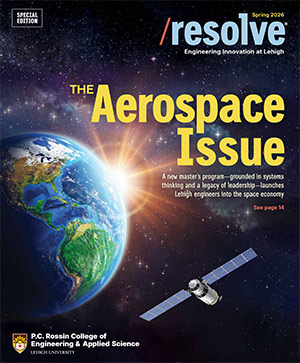
- Specialized academic pathways: The university continues to develop advanced educational initiatives, including the Master of Science in Aerospace and Space Systems Engineering program, tailored to equip the next generation of engineers with the skills required by a rapidly evolving aerospace industry.
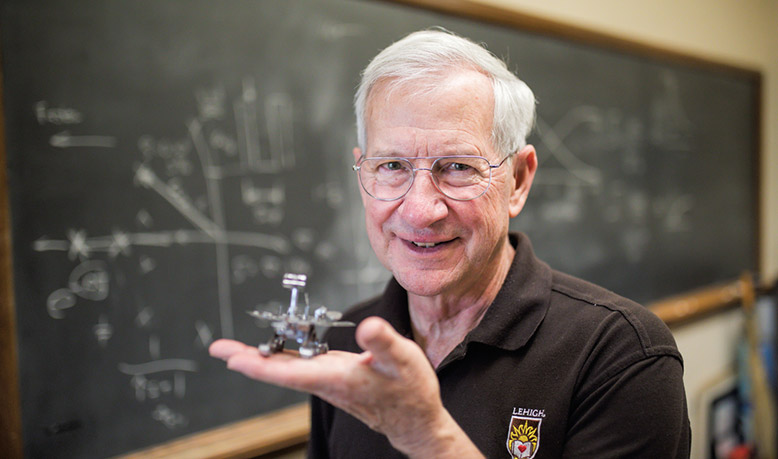
- A legacy of industry connection: Lehigh's expanding space initiatives build upon a strong foundation of alumni and faculty leadership. This includes long-standing expertise on campus, such as former NASA astronaut and current mechanical engineering professor Terry Hart, as well as ties to industry leadership through distinguished alumni like Scott Willoughby '89, vice president of performance excellence for Northrop Grumman's Space Systems sector.
Supporting the transition to commercial LEO platforms
The launch of the consortium arrives during a broader transition in global space exploration. As public and private entities plan the transition from the International Space Station to commercial platforms, sustained progress depends heavily on structured university research and technical pipelines.
The consortium will focus directly on generating the scientific research and talent pipeline necessary to support platforms like Starlab, a continuously crewed, free-flying commercial space station, and VISTA (the George Washington Carver Science Park) based at Ohio State, a U.S. science park dedicated to in-space research, manufacturing, and services.
By contributing to a highly unified network across global academia and industry, Lehigh is helping build the collaborative research foundation and talent pipeline necessary to sustain long-term operations and scientific discovery in low-Earth orbit.