
Duration: 18:21 | Published: September 10, 2024
Episode Summary
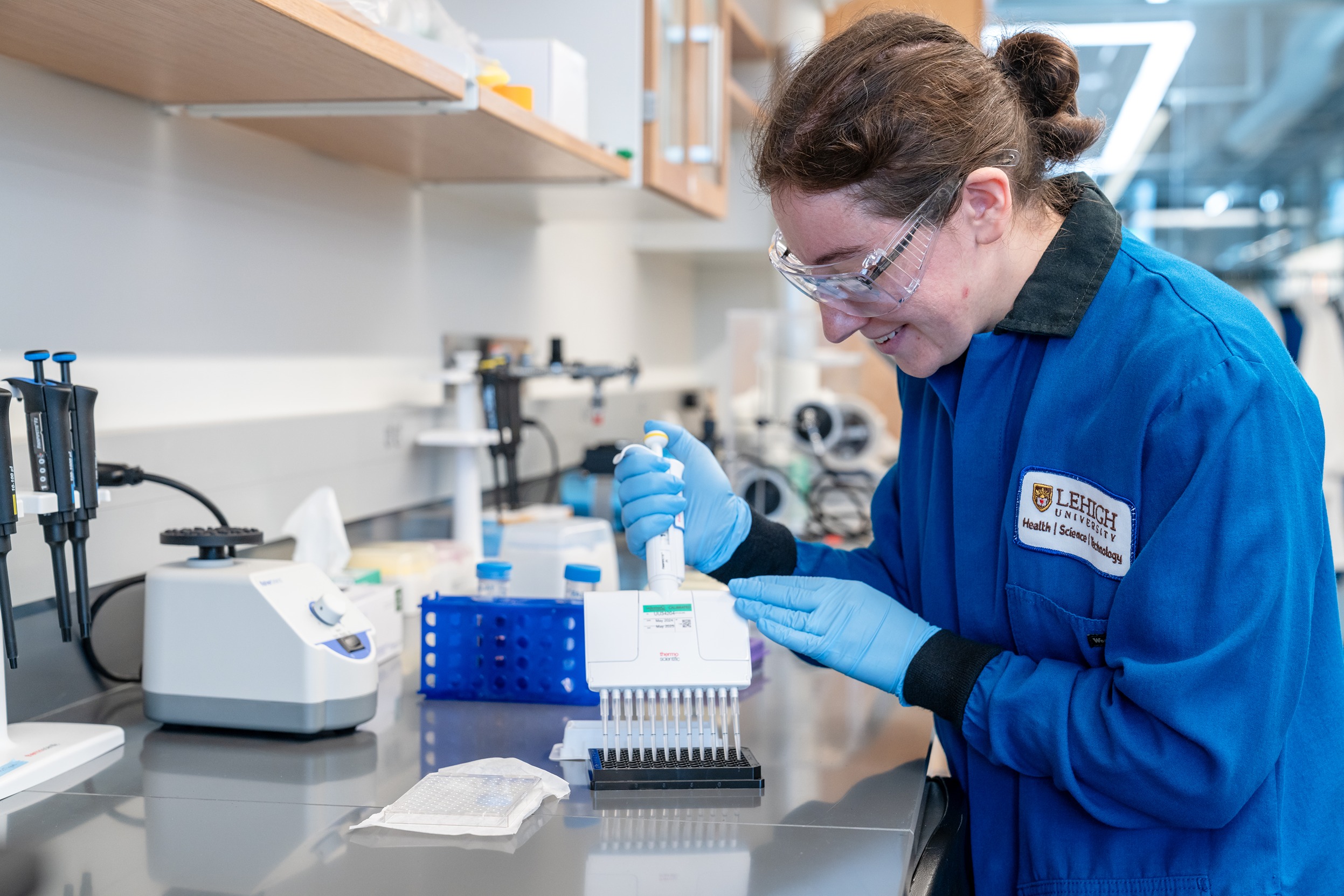
“You hear all the time about awesome science that’s being done, work that seems so pivotal, but then we as consumers don’t see the end product of it when we’re walking down the aisles,” says Whitney Blocher McTigue, an assistant professor in the department of chemical and biomolecular engineering.
It’s a long road from fundamental science to the hands of consumers—or in this case, health practitioners—but Whitney steers all her research in that direction. Her lab is using polymers and biomaterials to tackle practical healthcare challenges—from improving the stability of vaccines to designing next-generation wound dressings that could make treatment safer, less painful and more effective.
She’s currently got several projects underway, including working toward shelf-stable injections, a degradable bandage that could be particularly effective for burn patients, and a spray-on bandage that would immediately conform to the shape of the wound, while also delivering medicine and degrading in time for treatment.
“Even if these ideas don’t work, they’re adding to the knowledge around these concepts,” she says. “And when they do become commercialized, I’ll know that my work has helped with that. For me, that’s the best feeling you can get.”
Key Moments
- 00:06 — Meet chemical engineer Whitney Blocher McTigue
- 01:18 — Growing up building everything she could
- 02:25 — Early research on green fuels and synthetic muscle
- 03:22 — Discovering biomaterials research in graduate school
- 04:20 — Explaining polyelectrolyte complexation in plain English
- 06:15 — Why shelf-stable vaccines could transform healthcare
- 07:03 — The personal inspiration behind her research
- 09:43 — Current projects at Lehigh
- 10:46 — Improving mRNA vaccine stability
- 11:41 — Developing degradable bandages
- 13:05 — Smart bandages that detect infection
- 14:22 — Could spray-on bandages become reality?
Featured Quotes
"I love younger researchers. They’re very inquisitive." — Whitney Blocher McTigue
"I really want to push and do these things for as many people as I can." — Whitney Blocher McTigue
Full Transcript
Transcript is auto-generated and lightly edited for clarity.
Welcome to Rossin Connection, a podcast about all things Lehigh engineering. Coming to you from the P.C. Rossin College of Engineering and Applied Science at Lehigh University. Today we're featuring Whitney Blocher McTigue. She's an assistant professor in the Department of Chemical and Biomolecular Engineering. Whitney's been on the engineer's path since, well, since about forever. And while she's relatively new to Lehigh, she's got multiple research projects in the works and they all reflect her commitment to ultimately getting fundamental science out into the real world. And that commitment comes from a very personal place. Thanks for listening.
I grew up in a small little village and when I mean small, I mean you have to know where it is to find it on Google Maps, otherwise it will not show up.
That's Whitney Blocker McTigue and that Google invisible hometown of hers is Spencerport, New York. When Whitney was a kid, her parents were pretty sure she'd end up becoming an engineer in part because of what she calls her
Constant fiddling.
She was always building stuff even when they went out for dinner,
You know those like little half and half and the sugar packets. Well, I would try to make cities out of those.
She also took an early interest in home improvement.
I actually installed my own flooring in my bedroom. I thought that was like a super cool thing. Um, I don't know if most 14 or however old I was, year olds think that's cool, but I was like super proud of myself
And things just went up from there.
So I learned how to like put in a new toilet, how to hang up cabinets.
In high school, she was on the robotics team and as an undergrad at Clarkson University, she and a friend built a multi-room lean-to on one of the trails near campus,
Which is something for us to do. If you've ever been to Potsdam, New York, there's not a whole lot.
She was a chemical engineering major at Clarkson and at the time she didn't know much about what chemical engineering actually was,
But I absolutely loved chemistry
As an undergrad, she did research and had a couple of internships.
I worked for the Navy for a summer and I was sort of their organic chemist expert. I'm definitely putting that in quotes and I was learning all about green fuels.
She spent another summer working for a startup that was developing synthetic muscle.
It was this idea that you could use current to relax and then contract this polymer exactly like we do in muscle.
It was exciting, interesting stuff and it opened up a whole new world for her.
I started seeing chemical engineering, not as like a petroleum, or I'll say more traditional type of engineering. I was seeing so many other branches that I'm like, okay, this is so cool. I wanna try this.
By her senior year, she was pretty sure she wanted to get her PhD. She went to an open house at the University of Massachusetts Amherst and met with one of the professors there and that meeting sealed it.
And she told me about this idea of being able to stabilize blood plasma such that it could be like shelf stable so it wouldn't have to be refrigerated, any of these things. And this was the project that she was potentially gonna propose. And I think at that point my world exploded. Like my mind was just like, this is a thing I didn't even know people were thinking about this. This sounds awesome. Sign me up.
She ended up on a project that was similar to that world exploding research that brought her there in the first place.
Instead of blood plasma, I worked on proteins and other bio macromolecules and stabilizing them to be shelf stable at room temperature. And so I worked with proteins, enzyme viruses and other macromolecules and looked into their stability through polyelectrolyte complexation, which is actually part of what my lab does now.
When I interviewed Whitney for this podcast, it was summertime and we were enduring yet another 95 degree day, which oddly helped her explain what polyelectrolyte complexation is.
You have a positively charged polymer and a negatively charged polymer, and they wanna be basically best friends. They wanna be next to each other, they wanna be charge neutral. And you get this really nice dense liquid phase. And what's so cool is that it mimics what our cells do for proteins because you and I, right? We are unfortunately in a very strong heat wave, but we are still functional. And so we wanna know, okay, why would our proteins and stuff still be functional? And it turns out that the environment plays a huge role in this
By environment, she means the environment inside the cell.
It's kind of like being on the New York subway, right? You're bumping elbows with everybody. All these proteins and macromolecules are basically bumping into each other.
That super cozy environment allows for everything inside the cell to group together and interact. And it protects the proteins inside the cell.
And so we think that, you know, between the compartmentalization, this crowding and all of these interactions that we see, that's why our proteins are perfectly okay to be working at 98 degrees Fahrenheit. And personally, when it's 98 degrees outside, I wanna be an air conditioner. But our proteins are like, we're good. We'll keep on functioning, we'll do our job, everything's great.
So polyelectrolyte complexation is working with polymers to essentially mimic the environment that keeps cells happy and doing their jobs. If researchers can mimic that environment, they could use it to stabilize other things that can contain proteins like vaccines.
In the big ultimate, like this would be the best thing since sliced bread would be, let's say I have this vaccine, I don't need to refrigerate it. So you can imagine, just from a logistical and cost perspective, if I did not need to keep, let's say a flu shot cold and I could just ship it, well, I don't have to ship ice or other cooling systems, my truck doesn't have to have a cooling system in it. I don't have to worry about the refrigerator breaking. And so from a logistical and cost perspective, this becomes huge.
It was the kind of research that blew her academic world wide open. But it spoke to her personally too because she knew that it wasn't just people looking for COVID or flu shots that rely on refrigerated injections.
My mom has MS, and there was a point where she had to take injections once a week and they had to be in the refrigerator. And so traveling, as you can imagine with something that needs to be refrigerated is very difficult. So my thought was, well, it's not just vaccines, right? It can be if you're a diabetic, if you have another sort of disease, well, could we make this easier? So that was a huge part for me and that sort of end goal of my PhD was that I became very really good at encapsulating and even stabilizing these bio macromolecules, which then became a huge part inspiring part of my current work.
Whitney finished her PhD in 2020, which as we all know marked the first year of the after times for her postdoc. She went to the University of Illinois Urbana-Champaign, where a combination of COVID restrictions and her own curiosity led her to briefly pivot away from lab work to learning, modeling and simulation. But she always knew what she ultimately wanted to do.
I, in some ways am a bit of an oddball. Um, if you talk to a lot of grad students, almost all of them go into industry. I was that person like, Nope, I am going into academia. I wanna teach.
She'd actually been teaching in some capacity since high school. She'd been a physics tutor and a TA and is a grad student, started her own seminar to teach the programming language. Matlab.
I love younger researchers. They're very inquisitive and in some ways they're not bound by the same almost laws that you are as you learn more. 'cause you're like, oh, that won't work. But someone who isn't maybe bound in the same way, they might start thinking of all these things. And then it kind of makes you also think of, wait, well if we tweak this so that it works from our world's physics, right, maybe it actually can work. Who knows?
So she'd known for a long time that she wanted to go into academia. And when she saw a post for an opening at Lehigh, she jumped on it. The university checked a lot of boxes for her. Inspiring colleagues, motivated students, great opportunities for research and collaboration, and plenty of elevation.
I love the Northeast. I will say out a personal note, Illinois was a little too flat for me. I really wanted more topography and maybe I went a little too far considering Lehigh is built on a mountain and it's always leg day.
She started at Lehigh in the Department of Chemical and Biomolecular engineering in 2022. Today, her lab primarily focuses on the fundamental science of poly electrolytes. And she's got a lot going on. One of her projects is a continuation of the effort to thermally stabilize vaccines. Specifically, she and her team are looking at how to better understand and stabilize the mRNA used in COVID vaccines. And just a quick refresher here. mRNA is a molecule that tells cells to make copies of the viral protein, the bad COVID causing protein. When your immune system senses these invader proteins, it produces antibodies to kill them off. After the proteins are defeated, the antibodies stick around, which means if you do get exposed to the virus, they're ready to attack, which either keeps you from getting sick, or if you do get sick, it's often not as bad as it could be. But right now these mRNA vaccines must be refrigerated.
So two to eight degrees C, sometimes they have to be frozen. So that's negative 20 degrees C. And in the case early on with COVID, if you remember the first round of Pfizer vaccines, those had to be kept actually even colder to the point where a lot of places didn't have access to freezers that could do that low temperature. You know, this impact could easily just be, you don't need to keep it that cold. You don't need to worry that if it steps outta this so-called cold chain that it has to be thrown out because anytime you wanna give a vaccine, you wanna know a hundred percent that it's gonna work. So the World Health Organization has basically said that if you don't know, you don't use it. And so for that first project, it's really this sort of logistical change that we could make for all of these different therapeutics.
Another project was recently funded by the National Science Foundation.
One of the things I did as a postdoc was looking at, okay, if we have this signal and a polymer could basically break itself into smaller pieces, what could we do with that? And so one of the projects is to look at if I have these complexes, if I add in an enzyme, can I control how they break apart? And you can imagine that if you know I'm looking far into the future that this could be a new way to deliver medicine, right? This could be a degradable bandage.
A degradable bandage could be particularly useful for burn patients whose wounds need to be monitored and cleaned regularly, which means constantly replacing bandages.
A lot of early healing like scabs and such actually can almost integrate with the bandage itself. So when you remove that bandage, you're actually removing part of that healing. If I could trigger the bandage to gently remove itself, that would be a lot better than a nurse coming in and more or less ripping off that healing. Can we maybe reduce one the need for all this managing materials, but two, and I would say the bigger reason is, can we speed up that recovery time?
A third project is related to this idea of degradable bandages, maybe
Instead of an enzyme, what if we add something that will change color based on pH? So I think a lot of us remember in, I think it's high school, you had those pH strips and you could dip the paper and it changes different colors. But what if you could do that with a bandage and it could tell us, oh, your pH is shifting. That could mean you have a bacterial infection. And so instead of constantly removing this bandage, could it actually indicate to either the patient and or the nurse that, Hey, something is changing. You should definitely come take a look.
She says the same concept could work for produce because how many times have you bitten into a mealy apple or choked down a bunch of bad blueberries? A color coded pH indicator could save you a whole lot of disappointment.
Having that idea of, okay, this is still an acceptable pH range, it's good for you to snack on, versus you will probably not want to eat this particular apple because maybe it's starting to rot. So having an indicator that's like, yes, this is still peak time, you should totally eat this as a consumer. Sounds fantastic.
She's also exploring how poly electrolyte complexes might be spray painted. It's an idea spawned from a horror game,
Sort of a joke between my husband and I now, but inspired by a game called Resident Evil, where it kind of looks like they have this spray gun, they kind of just spray you and, you're magically healed. And it became a very big joke. I'm like, that's not how that works. And Sean was like, well, it would be so cool if you, you could make that work. And then it ended up being like, wait a minute. Could we actually do something like that? Because I'm a really big sci-fi nerd. And of course the first thing I'm thinking of is Star Trek and all of these other things. And I'm like, you know what? Let's see if we can't do something with this. So
She and her team are working out the details, which of course are many, but while the idea may have been the product of a joke, its potential is serious.
So the spray-on bandage and the degradable bandage are sort of tangential paths. And my ultimate goal, at least in terms of the lab science, would be to actually combine the two and see if I can start pairing some of these things together and make them multifunctional.
So imagine you have an accident and you've got an open wound on your shoulder, a joint that's pretty awkward to bandage. An EMT shows up, armed with an aerosol can and sprays a bandage embedded with an antibiotic.
And this bandage would conform to that shape. And what's really nice is if it also could degrade. You can imagine that when they get to a hospital, it could be easily taken off without as much damage as say, you know, maybe conventional bandages. And so they could go right in to surgery or to see the doctor, whatever they need,
Whatever they need. Her research is fundamental, but the ethos behind everything Whitney does is based on need. What exactly is necessary and useful in the real world medicine that doesn't need refrigeration, bandages that can be sprayed on, and then degrade indicators that can signal disease or decay. These are big ideas with the potential to help a lot of people like her mom who didn't know until recently that her experience of living with multiple sclerosis has guided Whitney to where she is today.
She actually had a a bit of a moment when I told her, um, I actually have part of it in my thesis. Um, there's an introduction and I wrote that out. My mother doesn't cry usually. I apparently made her cry because she didn't realize how much of an impact, um, MS was. And she constantly is telling me how proud she is. And of course, you know, that's very much a mom thing to say, but I think she is really happy that I'm doing something that I feel like can be really inspiring and really beneficial. She sees how much that I really wanna push and do these things for as many people as I can.
That's it for today's show. Thanks so much to Whitney for sharing your research. For more information about all the academic programs at the P.C. Rossin College of Engineering and Applied Science, and to find our show, head to engineering.lehigh.edu. Music in this episode is by Blue Dot Sessions. You can send us story suggestions or feedback on X at Rossin podcast. I'm your host and producer, Christine Fennessy. See you next time.
About the Guest
Whitney Blocher McTigue is an assistant professor in Lehigh University’s Department of Chemical and Biomolecular Engineering. Her research focuses on polymers, biomaterials and protein stabilization, with applications ranging from shelf-stable vaccines and mRNA therapeutics to smart wound dressings and advanced drug delivery systems. Her lab combines fundamental materials science with practical healthcare challenges to improve patient outcomes.
Episode Details
Related Episodes
- Episode 14: Can We Regrow Cartilage? Lesley Chow on Osteoarthritis and Tissue Engineering
- Episode 16: Bioengineering, Regenerative Medicine, and the Future of Healthcare
- Episode 22: The "Magic" Behind the Materials That Power Modern Technology
- Episode 31: Engineering Better Patient Care: Dhruv Seshadri on Wearable Devices and Finding Your Why