
Duration: 17:36 | Published: January 14, 2025
Episode Summary
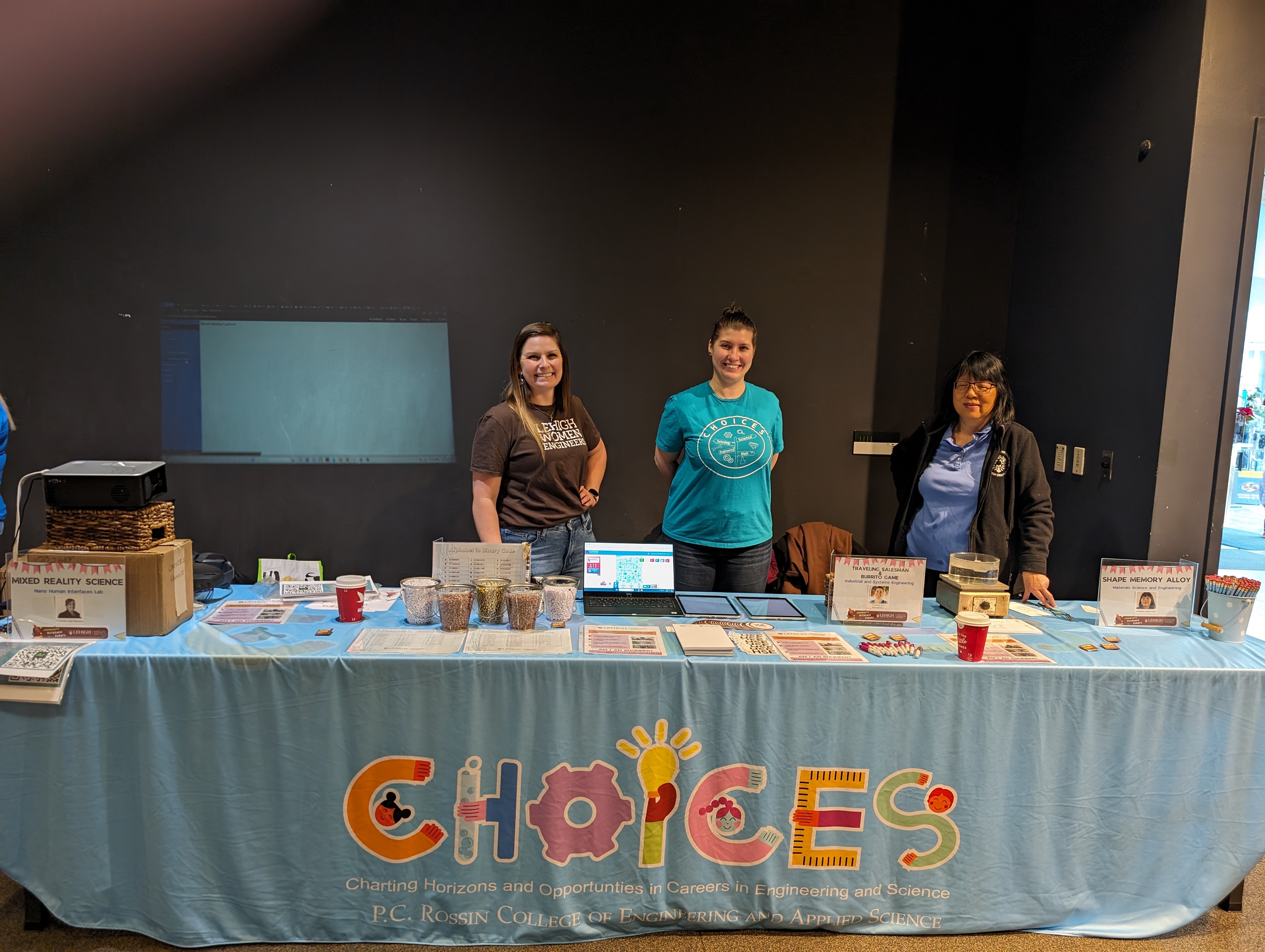
Lehigh has been doing STEM outreach for years. Programs like CHOICES and the Summer Engineering Institute have helped countless middle school and high school students discover the many fields of engineering, and how they can bring their own unique perspectives into solving real-world problems. Recently, the university has begun to expand its reach.
“Technically, we are preschool through 12th grade in serving our local community,” says Chayah Wilbers.
Chayah is the program manager for the P.C. Rossin College of Engineering and Applied Science, and the head of the university’s newest outreach initiative, the STEM Squad. Together with Lehigh faculty, staff, and students, she’s leading novel efforts to bring the wonder, joy, and delight of engineering to kids of all ages.
A big part of that push is connecting Lehigh students to area teachers who must now meet new state requirements in STEM education. The students are using their expertise in areas like computer science to build free lesson plans for the educators.
“Our Lehigh students are engaging with local teachers to hear their needs, and then working with me to create these lessons,” she says.
In this episode, we also hear from Lehigh engineering faculty members Ana-Iulia Alexandrescu-Anselm and Jennifer Winikus as well as a local science teacher about the work they do as part of the STEM Squad—and why they believe it can truly change lives.
Key Moments
- 00:06 Introducing Lehigh's STEM Squad
- 01:06 Connecting local schools with Lehigh engineers
- 02:02 Bringing space exploration into kindergarten classrooms
- 03:49 Teaching preschoolers the basics of coding through binary
- 05:47 Why hands-on STEM learning matters
- 06:31 Using role-playing to teach systems engineering
- 08:35 Challenging stereotypes about engineering careers
- 09:58 Lehigh students inspire the next generation
- 11:18 Creating free STEM lesson plans for teachers
- 12:31 A teacher's perspective on STEM partnerships
- 14:16 Why engineering outreach leaves a lasting impact
Featured Quotes
"Engineers are really creative problem solvers." — Chayah Wilbers
"We're preschool through 12th grade in serving our local community." — Chayah Wilbers
"Engineering is not about building something. It's about finding solutions to problems." — Ana-Iulia Alexandrescu-Anselm
"There is a place for everyone in engineering." — Jennifer Winikus
"I wish someone would've done that for me." — Chayah Wilbers
Full Transcript
Transcript is auto-generated and lightly edited for clarity.
Welcome to Rossin Connection, a podcast about all things Lehigh engineering. Coming to you from the P.C. Rossin College of Engineering and Applied Science at Lehigh University. Today we've got a special episode for you. It's about the many ways that Lehigh is bringing engineering and all its wonder, delight, discovery and opportunity to kids of all ages.
When you get to love your job. That's pretty cool.
That's Chayah Wilbers and that job she loves is being the program manager for the P.C. Rossin College of Engineering and Applied Science. And being program manager means that Chayah does well way too many things to go through in a single podcast episode. But one very important, very influential, and let's be honest, life-changing thing that she does is outreach. Specifically connecting Lehigh with local schools.
So really when a school contacts us and says, Hey, I have this need of bringing engineering into my classroom, we then go back to our faculty, our student clubs, even staff and say, Hey, who's interested in this? For example, I had a school reach out to me saying, we are finishing a unit on space. What do you have for us that we could bring space and engineering together to do like an end of unit activity?
Lehigh has been doing outreach like this for years with programs like Choices, which is a STEM initiative for middle school girls that Chayah also runs and the Summer Engineering Institute, an overnight engineering camp for high school kids. Lately though, Chayah and her team of faculty and students have been working on how to bring Lehigh and the world of engineering to all ages.
We've done three different preschools. So technically we are preschool through 12th grade in serving our local community.
So what does that service look like? Let's take the class of kindergartners who just wrapped up a unit on space. Chayah showed up with quite possibly the coolest presentation ever because she could share the experiences of Terry Hart who is a Lehigh alum, a professor of mechanical engineering and mechanics and aerospace engineering and a former NASA astronaut.
Their job when they were out there is they brought the first film to outer space. So I actually showed them videos of Terry under a bag changing film in an IMAX camera recorder. And I was like, yeah, so when you see, you know like videos of outer space from this timeframe, that's our professor. And the students are like, wait, this guy works at your school where you work? And I said, yeah, I talked to him yesterday. It was so cool. And they're like, they just thought it was the coolest thing that an astronaut is somebody that I talk to on a normal basis. And then all the things that he did in outer space, they didn't know that that was something that could be a job.
Those kids didn't just sit through a presentation on one of the coolest jobs on the planet after they learned what an aerospace engineer does. They get to build their own rockets.
And we had a little competition in their gym on how high their rocket would go and how far their rocket would go. But the whole thing is we want them to be creative problem solvers, right? So we just gave them a box of supplies and like 10 minutes and we're like, think through the engineering process. Do you have to think about weight? Do you have to think about what's gonna come into contact with like how high the ceiling is? But it was really fun watching them just their faces light up as they're like chucking their homemade rockets up into the air.
For Chayah's team, no kid is too young and no topic is too complex. Maybe you think that preschoolers can't handle coding, you'd be wrong.
So with this age level, we had to go to basic what is an engineer. We took it from the viewpoint of what is a community helper and in this case a community helper could be an engineer.
So some engineers such as computer science engineers and electrical engineers use binary code to talk to computers. So we talked about what that looks like, but I wasn't the only one who went. I had a group of five Society of Women Engineers undergraduate volunteers that came with me and they worked in small groups with these four-year-olds putting together these binary codes and they spelled out the word love using beads—binary codes, zeros were the brown bead, ones were the white bead. So it met them on their preschool level but also introduced them to the very basics of binary code. And then they got a really cool key chain to take home that spelled the word love.
When it comes to her youngest audiences, Chayah usually kicks off her talks by asking what does an engineer do?
You always have one kid that says they work on cars, and then the other one says they're the person who runs a train every single time. Those are the two answers. And now again, they're four-year-olds, so it's really adorable. But then you say yes, but engineers are really creative problem solvers. I said, have you ever had a problem that you had to really think about and you had to solve this problem? And they're like, yeah. And then I go, okay, how many of you have played on a tablet or on your parents' phone or anything like that or turned something on and you know, they all raise their hands. I said, well, did you know you have to thank an engineer for that? And they're just like, whoa. And you're just broadening their view of what life is.
If it sounds like Chayah missed her calling, don't worry, she was a teacher.
So I have a dual degree for early childhood and elementary education and then I was a teacher for seven years. So I taught preschool for a year. I taught a fifth grade and sixth grade combined class for two years and then I had a few years of middle school and high school science. So I've taught the whole scale and now I'm in higher ed. So I've always had this huge passion for hands-on engaging learning and to combine that with my love of STEM has just really been fulfilling.
That kind of learning, working with your hands and trying and failing and trying again can have a huge impact on young minds.
These type of outreach initiatives I think have a lot of great benefits. My name is Ana-Iulia Alexandrescu-Anselm. I am a professor of practice at Lehigh University in the industrial and systems engineering department.
Ana also leads outreach efforts for systems engineering, which means she and Chayah collaborate a lot. Ana is one of the many Lehigh professors who participates in Choices doing workshops during the one-day spring event and the week-long summer day camp, introducing middle school girls to the range of engineering disciplines. For her workshop, Ana used role playing to teach the girls how systems engineering could streamline the workload of a busy hospital emergency department.
So we had some students that were playing doctors and nurses and radiology technicians and then the rest of the students were patients showing up at the emergency department. And the challenge was to figure out how do we get our emergency department to run smoothly so we don't have people waiting for a very long time to be seen. We try to talk about things like bottlenecks and load balancing and some of these things that you can do with a lot of math later on when you learn them as a college student. But for now, intuitively, they were able to come up with very good solutions to try to make that emergency department run better. And I remember a specific student and she was really surprised that you could be an engineer and not build physical things. So we had a whole conversation about how engineering is about problem solving, about teamwork, about coming up with solutions. And this was, I wanna say, the first experience she had that opened her mind that engineering is not about building something, it's about finding solutions to problems. That was one of those moments that I'm like, yeah, this is why I do this.
Jennifer Winikus is an associate professor in the Department of Electrical and Computer Engineering who also does a lot of outreach work with Chayah. And she does it because, well for one it's fun, but she also sees it as a chance to knock down a few engineering stereotypes.
Unfortunately, most of society doesn't fully understand what engineering is. So when you say engineering, they probably think bridges. They don't think the nuances of pacemakers or robots to assist with medical technologies, tools to help socialize children with autism. Those are some of the broad ranges that engineering can take you that aren't known. Plus the whole what an engineer looks like is always a great one because we're not that way anymore. We're diverse from all over the place. All different backgrounds and cultures.
Like Ana, Jennifer runs a workshop during Choices where she introduces girls to soldering.
They would look at it and it's kind of scary until you explain to them it's not much hotter than a curling iron and you can also use it to make stained glass. So once it was rephrased as something that was an art form, it was more than just putting components together, like they were more relaxed, which is the idea that there is a place for everyone in engineering.
While Lehigh faculty are a big part of Chayah's outreach team, it's Lehigh students who are most often by her side in classrooms and school gyms at career fairs. And it doesn't take a whole lot of convincing on Chayah's part either, because as Lehigh engineering students, they know the value of experiential learning.
Every time I bring a group of students to something, they turn around and they go, one that was so much fun. Two, I wish someone would've done that for me. Or I would've had something like this when I was their age because I would've gone so much further. Like, that's huge. They're already top tier people and for them to say, I wish I would've had this, I would've done so much more. Like, that's cool. So they really learn to appreciate that they're doing something that's going to inspire future makers.
And it's not just the K through 12 future makers who benefit from having Lehigh students in their classes, their teachers do too.
It is really difficult as a teacher to try to plan out your entire year, all your curriculum, and then go, oh yeah, I should really do some enrichment pieces. A lot of times teachers have to do that all by themselves and they may not have any resources. They're planning on their own time. That's a lot of work for teachers and I know that because I've been there, I've had to do that.
Chayah says teachers in Pennsylvania are working hard to accommodate new standards in STEM education. And Lehigh students are trying to make that task an easier one by creating free lesson plans that reflect those new standards.
Our Lehigh students are engaging with local teachers to hear their needs and then working with me to create these lessons.
I was talking to a teacher about this and how we have a group of students who are specifically working with computer science steel standards and creating lesson plans to be implemented into the classroom and they're like, oh my gosh, that's what I need. Can you introduce me? And luckily one of the students was with me and I'm like, Hey, come on over here. Come talk to this teacher. Tell her what you've been doing. And they're like, we wanna be your guinea pigs. Can we test run this in our classroom? And we're like, they're almost done, you know? And then when we do implement things into the classroom, they're like, thank you. It really brought the unit together and we've already had schools reach out like, Hey, you're gonna do this again next year, right? So it's like, yeah, yeah, we'll be there. So it's exciting to just have that excitement. It gets you hyped up.
One of the teachers who's working with Chayah to explore even more opportunities for collaboration is Rich Staniec.
So I teach sixth grade science. This is my 25th year teaching. I've taught from kindergarten all the way to postgraduate.
Rich works at Upper Perkiomen Middle School in Pennsburg, Pennsylvania. And he says sixth graders are special.
Well, one, they have a lot of enthusiasm for learning, so they're still excited about things in school. So when we do labs, kids are like, this is awesome, can't wait to come to science today. So they're also old enough and mature enough to be able to do a lot of the activities, but they're also not afraid to have a good time and be a little kid and just geek out on stuff.
Geek out on stuff just like their teacher.
I love myself learning about the world around me. I just love learning how things work. I was always that kid that got in trouble for asking too many questions. Like, well why? What's this do? I always took stuff apart at home. I was always messing with stuff, trying to figure out how it worked. So the reason why I like teaching is 'cause I can bring those hands-on, kind of like explaining the world to the kids that are in my classroom.
Rich first got involved with outreach programs while working in Philadelphia. His middle school at the time partnered with the University of Pennsylvania's Penn Engineering.
The kids could see meaningfully how this stuff is applied in the real world and they could see a path for themselves. And I think the college students really liked giving back and kind of getting other kids inspired to do what they do.
He knows well the value of making that connection between kids and the world around them. In fact, that's exactly how he teaches science.
I mean, you get so much of the kids in the middle school age, like why is this important? When am I ever gonna use this? How does this affect my everyday life? And it's like that's literally what engineering does. It talks about how we use science concepts in everyday life to solve everyday problems.
Rich has brought students to the one-day spring Choices program for the past two years. And both times it's been the same story. The girls dove right into workshops run by Lehigh faculty and students—workshops that are built around real world problems, like how to clean dirty water. And at the end of the day they tell Rich all about what they did, what worked, what didn't. And in fact, some of the girls loved it so much they came back to campus for the week-long day camp in the summer.
They couldn't wait to come back and tell me about it. Actually, they were super excited to come back and tell me all the cool things that they were working on.
Lehigh is working with teachers like Rich to expand how the university can serve schools like his. For Rich, that could look like Lehigh students mentoring his kids during their engineering projects, where maybe the older students could help the younger ones think through different approaches to problem solving. They could make regular visits over the course of the project and then come to the sixth graders' final presentations.
But just a chance to meet with kids periodically along their engineering process—like, hey, we're trying to solve this problem and here's the problem that we're having, we're having trouble—and having an expert kind of sit in with them is super valuable.
He'd also love to get his class involved with the different student groups on campus, especially when he is teaching topics on things like bridge building and magnetic levitation cars.
So having like one of the groups where they could come over once or twice and talk to the kids or have our kids go to Lehigh to see what does it look like on the next level. Like you're working with real cars now, not just model cars and you're gonna be the people building real bridges. Now let's look at your testing machines and let's break some stuff and see how that works. So seeing what it actually looks like in the real world, having the kids visit them and maybe having some of the students visit us, I think would be great.
So this is why Chayah says she's hyped up and why she loves her job. She's part of a team of Lehigh faculty and students.
We've been calling it the STEM Squad.
That's helping local schools connect to Lehigh and helping Lehigh find even more ways to give back to the community. It's early days yet for the STEM Squad.
It's a baby, it's new, we're still learning.
But there is so much potential, so many ways the university can spark a child's curiosity and empower them to believe that they can do the coolest things. That's it for today's show. Thanks so much to Chayah, Ana, and Jennifer, and all the faculty and students who make up Lehigh's STEM Squad for the important life-changing work that you're doing for the next generation of engineers. For more information about all the academic programs at the P.C. Rossin College of Engineering and Applied Science, and to find our show, head to engineering.lehigh.edu. Music in this episode is by Blue Dot Sessions. You can send us story suggestions or feedback on X at Rossin podcast. I'm your host and producer, Christine Fennessy. See you next time.
About the Guests
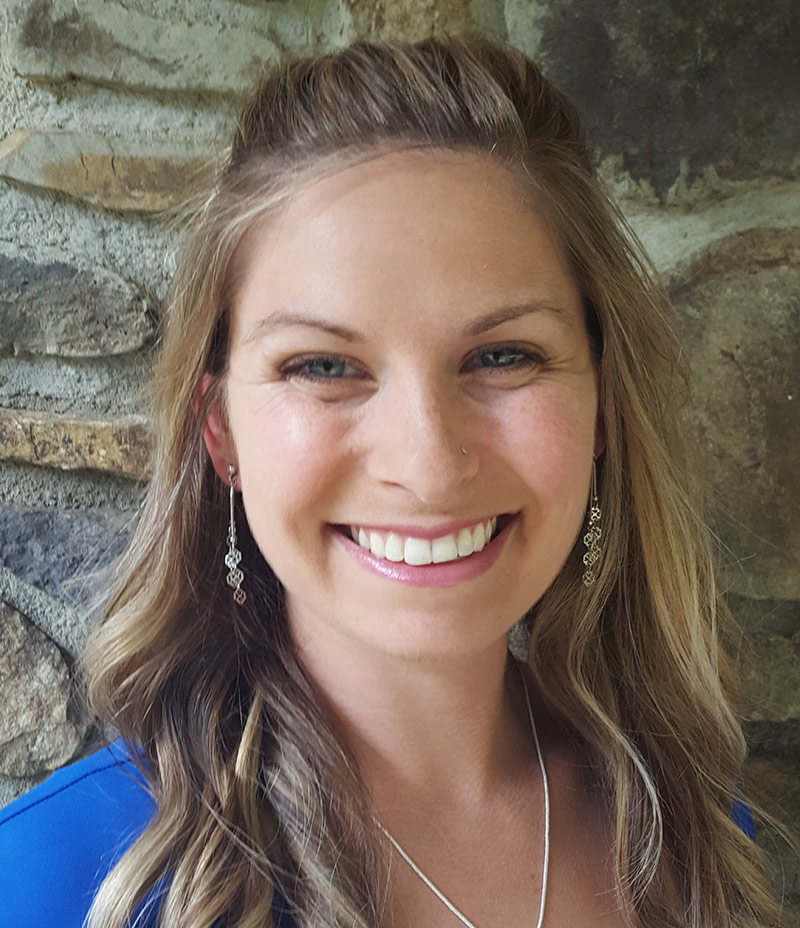
Chayah Wilbers (pictured) is program manager for the P.C. Rossin College of Engineering and Applied Science at Lehigh University, where she leads K–12 STEM outreach initiatives, including CHOICES and the Summer Engineering Institute. She works with faculty, students and local schools to bring hands-on engineering experiences to young learners throughout the region.
Ana-Iulia Alexandrescu-Anselm is a professor of practice in Lehigh's Department of Industrial and Systems Engineering, co-director of the Integrated Business and Engineering Honors Program, and director of the ISE Outreach Program. Through STEM outreach, she introduces students to systems engineering and demonstrates how engineers solve complex real-world problems through teamwork and critical thinking.
Jennifer Winikus is a teaching associate professor in Lehigh's Department of Electrical and Computer Engineering. Her outreach activities encourage students to explore engineering through creative, hands-on experiences while helping broaden perceptions of who can become an engineer.
Rich Staniec is a sixth-grade science teacher at Upper Perkiomen Middle School who partners with Lehigh on STEM outreach programs that connect classroom learning with real-world engineering.
Episode Details
Related Episodes
- Episode 12: From Engineer to Astronaut: Terry Hart's Journey to NASA (Part 1) — A Lehigh alum and former NASA astronaut on his path from engineering student to space explorer.
- Episode 15: From Engineering Student to Robotics Entrepreneur — A Lehigh alum on turning a classroom project into a robotics company.
- Episode 31: Engineering Better Patient Care: Dhruv Seshadri on Wearable Devices and Finding Your Why — Wearable medical devices and the students-over-GPA philosophy driving them.
- Episode 32: Engineering for Global Impact with Eric Obeysekare — A humanitarian engineer on using technology to improve lives around the world.