
Duration: 36:53 | Published: October 4, 2021
Episode Summary
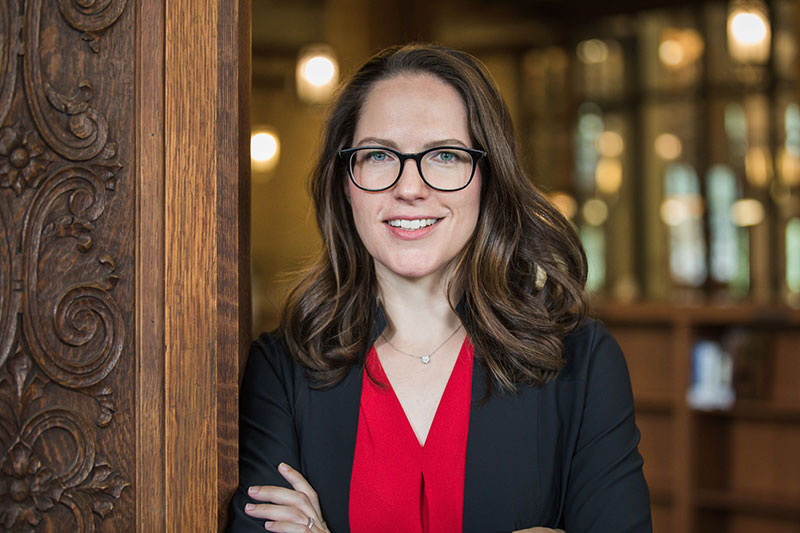
Mechanical engineering touches nearly every object we use—from smartphones and automobiles to medical devices that help patients recover from traumatic injuries. In this episode, Lehigh mechanical engineering associate professor Hannah Dailey explores the breadth of the discipline, explaining why mechanical engineers are uniquely positioned to solve problems across industries ranging from aerospace and robotics to healthcare and orthopedic medicine.
Her own path to Lehigh might have been predetermined.
“I grew up as a little kid hearing about what a special place Lehigh is from my grandparents,” says Hannah Dailey, assistant professor of mechanical engineering and mechanics. She says her grandparents worked on all their grandkids, hand delivering admissions packets so they could read them over, and hopefully, apply. “I was their last hope, and I actually took the bait.”
After obtaining all her degrees at Lehigh, Dailey moved to Ireland where she joined a medical device incubator. The experience introduced her to orthopedic biomechanics, a field that studies how forces, movement and mechanical conditions influence bone healing. She eventually co-founded an orthopedic startup called OrthoXel, where she is the chief scientific officer focused on improving fracture repair technologies.
Her experiences in Ireland sparked the research program she leads today as a professor of mechanical engineering. She and her team are developing a virtual mechanical test that will someday enable surgeons to better determine how well a fractured bone is healing. It’s one of the many perhaps unexpected routes that mechanical engineers can take, she says, and one with real potential for societal impact.
While most broken bones heal successfully, some patients experience delayed healing or nonunion, requiring additional surgeries and months—or even years—of recovery. Hannah’s research combines medical imaging, CT scans, computer simulation, finite element modeling and virtual mechanical testing to create quantitative tools that help surgeons evaluate whether a fracture is healing properly.
Rather than relying solely on visual interpretation of X-rays, her goal is to provide objective measurements that can support evidence-based medical decisions, improve patient outcomes and reduce unnecessary healthcare costs. She also investigates how orthopedic implants and mechanical conditions influence the biology of bone repair, helping engineers and surgeons design more effective treatments for patients recovering from fractures.
In sharing her research, Hannah makes it clear that the field of mechanical engineering is far broader than many students realize and she encourages prospective engineers—especially women—to see mechanical engineering as a pathway into medicine, sustainability, robotics, energy and numerous other industries.
“I want to help broaden perceptions around what mechanical engineering is,” she says, “so that more students from more diverse backgrounds can see it as a pathway where they can fit.”
Key Moments
- 0:36 — Discovering engineering through hands-on projects
- 6:03 — Why she chose mechanical engineering
- 7:47 — Arriving at Lehigh as a terrified transfer student
- 9:06 — Why more women belong in mechanical engineering
- 12:46 — From Lehigh alum to researcher, entrepreneur and professor
- 14:27 — Falling in love with orthopedic biomechanics
- 18:16 — Explaining bone fracture healing
- 19:57 — Using CT scans and computer simulations to improve patient care
- 23:09 — Why helping patients inspires her research
- 27:22 — Expanding diversity in mechanical engineering
- 30:03 — Never having a female engineering professor
- 33:26 — Helping students overcome imposter syndrome
Featured Quotes
"If I can contribute to restoring life and mobility and freedom of movement…I absolutely love the idea that I have contributed." — Hannah Dailey
"You have to be willing to do things that you’re unprepared for." — Hannah Dailey
"You’re more capable than you know, and you’re very much wanted." — Hannah Dailey
Full Transcript
Transcript is auto-generated and lightly edited for clarity.
Welcome to Rossin Connection, a podcast about all things Lehigh engineering. Coming to you from the P.C. Rossin College of Engineering and Applied Science at Lehigh University. It's a show for students, alumni, faculty and staff, current, former and future, and for anyone interested in the many creative ways that engineers are solving the world's problems. I'm your host and producer, Christine Fennessy. So this year, 2021 marks the 50th anniversary of female undergraduate education here at Lehigh. And the university is doing a lot of things to mark the occasion. There's gonna be events, lectures, exhibits, podcasts, and the goal is to really celebrate the impact of all women on campus, past, present, and future. And you've probably seen the logo, but if not this year long celebration is called Soaring Together. And Rossin Connection is marking this milestone too. We'll be bringing you even more stories from our female faculty and they're all making an impact in their departments, on their students, in their fields and on the world.
We're kicking off this series with Hannah Dailey. Hannah has a pretty unique story. She started here as a mechanical engineering undergrad. She left for a while and did some pretty cool stuff. Then she came back and got her PhD here and now she's an assistant professor of mechanical engineering. In today's episode, she talks about that journey, how she went from a terrified transfer student to launching a startup to specializing in medical devices. She also talks about never having a single, not one female professor for any course ever. And about the challenges, efforts and the wins in getting more female students and faculty into the mechanical engineering department. And one quick listening note, for those of you who might not be familiar with our college shorthand, you will hear Hannah say MechE or ME. That's just our verbal shortcut for mechanical engineering. Thanks for joining us.
My name is Hannah Dailey and I'm an associate professor in Mechanical Engineering and Mechanics and I feel like I've been at Lehigh for my whole life, I guess.
And why do you say that?
Um, well so I grew up as a little kid hearing about what a special place Lehigh is from my grandparents. My grandfather is a Lehigh, alum, graduated in the forties and when I was a kid my grandparents would sometimes swing by Lehigh on one of their summer vacations visiting friends and they'd pick up an admissions packet and bring it home to me to look at. Uh, but I didn't really seriously think about going to Lehigh until I was in high school and I decided that I wanted to be an engineer. And then of course, you know, Lehigh has a great reputation as an engineering school. So then I started to look into it more seriously and I was like, oh, this looks like it could be the perfect fit.
Okay, so let's step back for just a second because I am curious who was the kid he was bringing that admissions packet too?
Oh, I was the last hope, like I think they did this for all their grandchildren. Um, but then it came to my turn and I actually took the bait. Um, you know, I don't know if when I was a little kid people would've said, oh that one's gonna be an engineer. Although I did always really enjoy understanding how things worked. Like one of my favorite books when I was a kid was David Macaulay's, the Way Things Work. And I would like pour over those pictures and try to understand them. And I enjoyed doing hands-on projects, um, with both my parents actually. They're both very hands-on people. Um, did some carpentry and building projects, a little bit of mechanic stuff with my dad. My mom, I did a lot of like handcrafting and sewing and you know those can be quite architectural construction projects when you really think about it.
And so there was a lot of hands on stuff that we did together. Uh, I also love Legos. Lots of MechE's grow up saying, oh I loved putting together Legos but my favorite was Lego Technic. You know, the ones with all the gears and everything. So I think that there were definitely some signs but I didn't have a lot of engineers in my family or people that I could turn to and ask questions like what did the different kinds of engineers do? So I did what a lot of students do. I made a relatively uninformed decision and picked mechanical engineering because it sounded like things I like and also very broad. So I knew I was gonna have a job of some kind when I was done with that degree.
Tell me about one of those projects that you did as a kid that really stands out in your mind that the light bulb was kind of going off a little bit in your head of like, huh, can I, could I do this for my life?
Oh gosh. I don't know if I had a light bulb moment. My family, I think we did a lot of over ambitious epic projects. Like we built a train table with a mountain to go under the Christmas tree. And I remember like my dad and I ruined the concrete porch in the back patio because we were like pouring the mountains in minutes. It's like a two part expanding foam. So you mix the two parts of it together and then it starts exploding everywhere. He ruined like a spatula and we got this on the floor and my mom was mad. But also, I mean we had that train table under the Christmas tree for my whole life growing up. And I think that's a characteristic that sometimes a lot of engineers share this idea that you have to be willing to do things that you're unprepared for that you haven't already learned how to do. I think that that can sometimes be a struggle for our engineering students to get their heads around the idea that you're gonna be asked to do things in life that nobody gave you the formula for in advance, but you gotta just get in there and try and then you'll surprise yourself with what you can do.
You did talk a little bit about what kind of drew you to mechanical engineering, but were you even aware that there were so many different disciplines in engineering and even so even if you were, why mechanical engineering out of all that were available?
That's a great question. Okay, so you know, I'm gonna take you back to like my 17-year-old self and the, one of the things that was certainly true for me and I see a lot in students now is that you have a lot of stereotypes about what you think different disciplines are. So I started going down the list of the available types of engineering. So by the process of elimination I excluded chemical engineering 'cause I really did not enjoy chemistry. To my great regret I excluded computer science and computer engineering because I thought that was just for hacker boys who liked to stay up all night and dropped outta high school. Uh, which is totally an unfair stereotype, but that's what I thought that it was. And so, you know, I kind of like came down the list and then I got to mechanical engineering, you know, it's like well I really enjoyed all of my Lego sets that had gears and I enjoyed learning about the simple machines and the way things work and I kind of like um, thinking about how things work and take them apart and put them together and sure, that sounds great.
And so then when I got into Lehigh and I started taking my classes each semester just validated that choice because I really enjoyed what I was learning. There were very, very few classes that I ever had as a mechanical engineer. In fact, I can't even tell you one where I was like, I absolutely hate this and if I had to do this for my job I would die. I just enjoyed it. And so that helps to build your confidence that you're doing something that's gonna be a good fit. 'cause even when it's hard, if you find it interesting, that's a little bit inspiring to put the work into it. Oh
Totally. Okay. I do wanna know a little bit more about your experience as an undergrad in mechanical engineering. Like what was it like for you coming into that program? Like did you know what you were getting yourself into? Were you full of self-confidence and self-assured about what you were doing or was it not like that at all?
Oh no, it was not like that at all. I was terrified. And part of it is because I technically came to Lehigh as a transfer student. So when I was in high school I grew up in Florida and Florida has this really cool program for accelerated high school students where you can take classes and get dual credit toward your high school degree and also community college credits. So when I came to Lehigh I never had a freshman experience and I moved straight into like sophomore housing and everybody knew what they were doing and they knew where they were going and they knew why they had chosen their major and they already like had the lay of the land. And I was desperate to not appear to be like a total fool. So I just kind of like, uh, I, I remember the day before, the first day of classes I walked campus to try to figure out my route and know, you know, this is before smartphones.
Like I had it all printed out. I was like okay, I need this many minutes to walk from here to here 'cause I just wanted to do it right. You know, which in retrospect I wish I could have gone back and told myself, look the people around you are just as scared as you are. Like it's all new and different. I would've told myself to chill out for sure, but I just, I wanted to make a good impression and prove to myself that I wasn't crazy for wanting to do this and I could pull it off.
When you started, do you remember or or have some idea of the ratio of male to female students in mechanical engineering?
Yeah, um, so our long-term historical average, this is, I'm really interesting that you bring this up uh, because this is an area that we're really working on. We're very, very committed in mechanical engineering to improving our diversity representation in the department across all levels for undergraduate students, graduate students and faculty. This is really important to us. So we've been looking at some long-term historical data and uh, for women we're doing a little bit better, like not just at Lehigh but mechanical engineering as a discipline. We're doing a little bit better than we were 20 years ago, but we're not one of the ones where girls tend to flock. Um, so my experience was probably very similar to what students have now when they're coming into our department. You know, something like 15 to 20% of the class would be female students in any given year.
You know, at Lehigh we're doing actually awesome as a college of engineering and representation of women who are getting undergraduate degrees in engineering. And that's something I'm very proud of that you know, we can say at Lehigh we're doing above national averages, but uh, you know, getting those girls who have chosen to be a Lehigh who want to be engineers to be excited about mechanical engineering, that's something that I really wanna work on because there are again some uh, discipline stereotypes where people look at mechanical engineering and they think it's something but it's more than cars and planes, which are awesome and very cool. But if that's not something that you're into, I would love for more women to know that there's still a home in Meche for them too. Like I do medical devices, which a lot of people don't expect to find in mechanical engineering.
They expect to find that in bioengineering. And then once you get into it you realize that MechE's are the ones who design and build things. And if you wanna have a positive impact on society, medical devices is an awesome career path to go into because you can help to alleviate human suffering through the things that you design. And that's a really cool thing that makes me feel very inspired and I wanna help, uh, broaden perceptions around what mechanical engineering is so that more students from more diverse backgrounds can be seeing it as a pathway where they can fit.
What are the other surprising aspects of mechanical engineering that you would want prospective students to know about?
Well what I always tell students is think about everything that you've touched and interacted with today. Just today, your smartphone, the pen that you pick up, the doors that you open, the car that you drove in, like every single thing that you have touched and interacted with had mechanical engineers who were involved in designing it, building it, testing it, breaking it, redesigning it and making it better. And so kind of regardless of what you're interested in, there is a job for a mechanical engineer who's gonna be part of that. And I think that that can be both very exciting and also a little bit overwhelming for students because you don't maybe have the luxury of having a real clear picture in your mind of what you might be doing at the end of your four year degree. But it's also exciting because of the breadth of things that you can get into. We have students who are definitely in the aerospace and the automotive industries and loving that. We also have students who are doing all kinds of cool jobs in places where you would never even think that a mechanical engineer would end up, you know, bottling and packaging to medical devices. Like there's just so many things that you can do with that degree, but you gotta get them in the door in the first place. And that's something that we're really working on very hard as a department. Oh,
That's great. That's so good to hear. Okay, so tell us the story of how you went from an undergrad to now being a professor at Lehigh. Because I, I'm not sure in, in the engineering school at least how many of you there are with this story?
No and it, there are not very many and it's not a very typical pathway. So after I got my bachelor's in mechanical engineering, I went to work for the Naval Surface Warfare Center in West Bethesda, Maryland. And I loved that job, it was really fun. Uh, but it was one of my first immersive experiences in a research culture. I was actually kind of in a small group at NAVSEA of people who all had advanced degrees. Most of them were PhDs. There were one or two guys who had a master's degree. And I, it sort of dawned on me because my supervisor said it like, Hey, you know, you seem like you'd be cut out for research, you should consider going to graduate school. I was like, oh, I should consider going to graduate school. So I applied to a bunch of different schools and I ended up coming back to Lehigh, uh, because they had, they gave me a nice offer to come back to the graduate program and also just because I loved Lehigh so much, which is not a reason why people are supposed to make decisions.
But I just did. I mean I've, I, like I said, I grew up since I was a little kid. Like we, we love Lehigh. So when I had a chance to come back for grad school I was like, yes, that sounds great. So, I did that. And then when I graduated with my PhD, I uh, ended up with an unexpected opportunity to move overseas. So my husband was also finishing PhD, his from Lehigh is in electrical engineering and we were expecting a baby and uh, got a chance to move to Ireland and he was hired into a national institute called the Tyndall National Institute in Cork, Ireland. And I got an offer to work at a medical device incubator in the Cork Institute of Technology. So I ended up kind of falling backward in an unplanned way into the orthopedic industry through this medical device incubator.
And I had no prior background in orthopedics, but I figured I had enough skillset as a mechanical engineer that I could figure out what I needed to know. And so that was a real turning point in my career because I fell in love with orthopedics as a discipline and that's what I do now. And that's, it has really defined like the last 12 years of my life have been completely and totally devoted to this idea of orthopedic biomechanics. And specifically what I study is bone fracture healing. So this is a super cool process of um, restoration of mechanical integrity of a, of a tissue structure. And what makes bone so special is that it heals itself with itself and instead of with a scar. And that's just a, once I learned about that process, it was so intensely fascinating. And then knowing that there are mechanical conditions that we can change through the design of implants that are going to change the biological response during that process of the bone healing itself, that just like ignited a passion inside of me that I hadn't felt for the jobs that I had had before that I enjoyed.
But now I felt like this is the thing that I wanna do that I could devote my life to. And so that is what I do now.
Wow. So how did that translate into you coming back to Lehigh and becoming a professor?
So that was because of my accidental adventure as an entrepreneur. So I am, I am very much an engineers engineer. I am risk averse. I plan things, I have spreadsheets for packing lists when we go on vacation. Like I don't, I do not fly by the seat of my pants for anything that I do. But then uh, when I was working in Cork in the medic center, that was the name of the incubator, I had worked on a technology for an orthopedic implant and had had a couple of really lucky breaks including some funding that I won from the Irish government to advance the research. And we had gotten to a point where we had evidence that this technology actually might be viable for improving the bone healing response. And so you, that's sort of, once you get to kind of animal level research, that's sort of the end of the road for what people typically do in academia.
And then if you wanna advance it further to the commercialization stage for a technology, then you really talking about a startup. So I had this opportunity that I didn't wanna miss out on to get involved in founding a startup company with three other guys that I had worked with. One orthopedic surgeon and two other engineers from this incubator who had long careers in medical device process and product development in industry. And so the four of us get together and like, okay, we're gonna do this. And that was in 2014 we made the decision to do this. So during the lead up to founding the company, I had considered going to work for a multinational orthopedic company. And while I was trying to decide what I wanted to do, 'cause you know, I would've had to walk away from this thing that I had been working on to go and work for one of the household names.
I was adjunct teaching at Lehigh and I was taking care of my two very little kids. I had um, a three-year-old and a baby. And as you know, like life was crazy. Uh, my department chair at the time responded to a Christmas card that I sent the department and said, Hey, would you be interested in doing some teaching? And I was like, sure, I'll do some teaching. So then I got back in the classroom in at Lehigh and decided that I was really enjoying that component of it. And then they eventually interviewed me for a tenure track position. So then starting in 2015 I became a member of the tenure track faculty and then I started working on the research that takes place in my group today at Lehigh.
Now tell me a little bit about your research. You, you've talked a bit about it, but break it down to its basic components for the lay listener here. Yeah, because it's very cool, we've talked about it a lot, but I wanna make sure that people really do understand what it is that you're doing and how cool it's
Aw, thank you. Well, okay, so break it down to its basic, most basic pieces. Sometimes bones break and after they break, most of the time if you're an adult you get some sort of surgery to help put the bones back together while the body's natural healing process can take place. Uh, the orthopedic implants are generally speaking very mature technologies. So most of the time things go well but sometimes they don't. And when that happens, a patient can experience lingering pain disability, sometimes necessity for additional surgeries over a period of many months or years. It can be a real problem if a bone fails to heal. And there's a lot of reasons why that could take place. It's usually a very complicated cocktail of factors. There's risk factors based on a patient's kind of baseline health status. So if a bone is healing slowly, typically the only way a surgeon can tell is by looking at x-rays.
And X-rays are very difficult to interpret beyond just kind of qualitative visual inspection. Like what am I looking at? Do it, does it look like it's healing? And when it's healing well it's really easy to see that it's healing. But if it's healing really slowly or if it's not healing, it's really hard to see if there are any changes over a period of weeks and months. So what ends up happening is this long waiting period for a patient who may end up someday needing a second surgery, but we're waiting, waiting, waiting hoping that that healing response is gonna take over. So as a mechanical engineer, I look at that problem and I think to myself that is just a problem of a failed structure, right? And we should be able to find out whether that structure is making any progress. And the way that we can find out is by taking three dimensional medical images, we do CT scans, so some people call them CAT scans, CT and CAT, they, it's the same thing.
CT stands for computed tomography. So it's like a three dimensional x-ray picture that we can put back together and then we can build a three dimensional model in a simulator the same way that we would run a simulation of any other mechanical structure, part of a car, part of a plane, a bridge that people might walk over. Like any kind of mechanical thing you can do simulations on that. So that's what we do on the bone, but it's just put back together from the image. So we extract all this information outta the image, we make these 3D models and then we do what's called virtual mechanical testing. So we can take this 3D model that we put together and we could pretend like we're putting loads on it and you, those loads can be anything. It can be like a patient weight bearing and they can be very specific types of mechanical tests.
And then by looking at the response of the structure you can tell is it healed or is it not healed? And there's usually a score that we can assign to it. So is it 10% healed? That's very concerning. Is it a hundred percent healed patient's good to go? So this whole idea of using imaging is really exciting because it's not invasive. You know, you can get a low dose, three dimensional image, it doesn't require much more radiation exposure than just getting an x-ray and then you can get all of this very helpful information. So what I'm trying to develop with my research here at Lehigh, among the other projects, this is a big one, I'd like to have a diagnostic test that a surgeon could order. So in addition to getting the CT scan, we want a little virtual mechanical test that could be ordered to provide a quantitative and actionable decision point so that we know this patient is five months along after their surgery, they're at 10% healing.
This is justification to proceed with an intervention. And that's really important because in the grand scheme of the overall necessity to reduce the cost of healthcare, 'cause healthcare is so expensive, we don't wanna be doing unnecessary interventions 'cause there's you know, costs and risk associated with that. We wanna be able to know which interventions are going to be clinically um, beneficial and we wanna be able to do uh, what's called evidence-based medicine. And so having these kinds of tests that are very quantitative and that just means you have a number score instead of somebody's impression, right? I feel like what I'm seeing is good or bad as opposed to it's 10% or it's 50% or it's a hundred percent. So we want a quantitative outcome measure that we can say yes we should intervene or no we should not. And that's what I'm trying to develop.
And in addition to that, I have other research that's all very closely related to bone fractures and how they heal. Um, we're really interested in kind of the basic science of how mechanical conditions influence the bone healing response either for good or for bad. So we do computer simulations of that. We do computer simulations of putting hardware and bones together and looking at how they interact mechanically. But it's all related to these basic ideas of, you know, surgeons understand the mechanics because they're very mechanics, orthopedic surgeons are very mechanically inclined but they can't actually measure what they're interested in 'cause they don't have the tools. So in my lab we're trying to provide the tools to do the measurements that can help inform their patterns of practice, design better clinical studies, get better diagnostic tests for being able to make those difficult decisions when they come up. And that's the vision.
And what makes this research just so meaningful to you?
Oh gosh. So for me, I love the idea that every day there are patients who are coming into hospitals, into trauma centers who are kind of at their worst day of their life yet so far right? You've had a traumatic accident, you've been in a car accident, uh, you crashed your motorcycle, you fell off of a ladder, you're all banged up, you're at kind of a low point. And the surgeons there are gonna do their absolute best to put those patients back together and get them healed and restore their function, their mobility, their ability to work and play with their kids and do the things that they love in life. And as an engineer, I will never operate on a person but if I can contribute to either the basic science understanding of how bones heal or to the technologies that are used for doing those surgeries and if I can have an impact that improves the way that patients have healed, I absolutely love the idea that I have contributed to restoring life and mobility and freedom of movement to people who have lost it as the result of an accident. And that's a very inspiring thing for me to feel like I am part of that.
Yeah. And you have a team that you're working with, you have students that you're working with. And how do you see your enthusiasm and drive and commitment to this like rubbing off on them like when they first come in, do they not maybe have a sense of just how important this could be? Do have you seen that sort of evolve over time with some of them? Like what is it like to see that mission kind of becoming more and more clear to your students as they work with you on this?
That is an amazing question. I love it. So the evolutionary process, when students first come into the lab, they begin totally overwhelmed and very terrified I think because we use so many different software tools and we have this like enormous rack of computers in the corridor of the office and it's very technical and it's very overwhelming and nobody starts by just washing glassware in a sink 'cause we don't do that right? So they have a lot to learn and over the period of months or years that they're working on a project, they start to read more in the literature and understand why these unsolved problems are still really important in clinical orthopedics. And then they begin to see how what we as engineers specifically mechanical engineers can contribute to solving these unsolved problems. And then I, it's cool to see that individual sense of ownership.
So I just had a student who graduated and like at the end of his PhD it was very cool to see that he could stand up and present and uh, answer questions in exactly the way that I would like laying it out so that people who are not us, they don't understand what we do. Totally understand why this is so important and why it's so exciting. And so I think, you know, it's sort of a two-way street. I hope that the students are able to understand, you know, why I'm so excited about these problems, why I think it's so cool what we do, but also that they can sense my commitment to them as scholars. I try to be generous with my time and you know, make it clear to them that I'm like on their team. Like as much as they're on my team, we are doing this together.
I have a new PhD student in the group and he's just putting together his very first, first author paper, which is a huge milestone, like that first paper that you write. And I said to him like, research is like a road that you're building as you travel on it. Like if we knew in the beginning how to get around all these like little sticky corners of putting together this study, it wouldn't be research. But this is a thing where it unfolds naturally as we do it together. And then you can reflect backward and see how far you've come because you look over your shoulder and you see oh wow, all the things that I didn't know even six months ago. And that's a cool feeling to have, but you have to be open to the little setbacks that come along the way because that's just part of building your own pathway.
Oh absolutely. Alright, let's just pivot to another topic here back actually to what you said earlier. You mentioned earlier that the mechanical engineering department is actively doing things to encourage more female students. And so can you talk to me about what some of those efforts are?
Yeah. Okay. So in mechanical engineering we have a diversity equity and inclusion working group. So it's a small group of faculty who are specifically focused on, you know, kind of taking a look at our department and understanding where we're at right now and setting some goals for where we want to be. And particularly in the representation of women and underrepresented minority students and LGBTQ plus students. We really want to be a leader here at Lehigh and a leader nationally. That's clearly our ambition is to get there. And so with women, I think there's a really exciting opportunity at Lehigh because our uh, engineering school as a whole has great representation of women. We're not at 50 50 but we're definitely doing better than national averages. So the women are here, they've come to Lehigh, they wanna be Lehigh engineers and so our is our job to get them excited about mechanical engineering and we've done some strategic things to try to pull in people who have less siloed research interests and more multidisciplinary interests.
So we restructured, for example our master's programs, which is very common for students, especially now to recognize that a bachelor's degree might not be quite enough to get them the types of jobs that they want, especially in emerging areas. And so there's a lot of students who are interested in doing bachelor's plus master's. So we did a lot of things with our graduate program to make it easier to do those degrees quickly to get them done in a year and to make it easier to do multidisciplinary degrees. So let's say for example that you are a student who's really passionate about energy and environment. Well, mechanical engineering is a great degree to do. We give you lots of opportunities in the undergraduate curriculum to pick and choose from electives in other engineering majors and other science majors to bring in your interests into your degree.
And a lot of people don't realize that you can do that. You don't have to take all me classes the whole time. You can bring these other things in and then if you build that together with a master's degree program, we have an interdisciplinary option where you're actually only taking about half your classes in MechE at the graduate level, but then you can put together the degree that fits you and the career that you want. Whether that is energy, whether that's in robotics, whether that's in machine learning, computer science, whether that's in medical devices, bioengineering, like you can put together something that's gonna get you where you wanna go. So we're really excited about that 'cause this is not just the traditional mechanical engineering, this is a much more broad based approach. And you know, if I were a student coming to Lehigh now, I'd be very excited about that.
Alright. Switching to faculty, what are the efforts of the department right now in trying to attract and retain more female faculty?
Well, it's very exciting that there are female faculty now, you know, people are astonished when I tell them this, but I never had a female professor for any course that I took really at any college ever.
Wow, that's amazing.
Yeah, no, it just, I know it just, it it, it worked out that way. Um, you know, so I, there were no women on the faculty mechanical engineering when I was a student. Uh, but now we have a few, and actually I'm very excited that we have just hired another tenure track faculty member, uh, an amazing woman. Her name is Ebru Demir and she's coming to Lehigh, her area of research is mechatronics and so kind of like mechanical and electronic devices. And this is something that our students are so excited about and this is an area where we really wanna have more accessibility for them to be doing projects and lab experiences and research. And so it's, it's very cool that she's coming, you know, Lehigh and specifically mechanical engineering is very aware that our faculty needs to reflect our student body. And that both of those things really do need to reflect larger society.
We have a long way to go and this is not a ship that you can steer on a dime. And part of that is because when you have gross underrepresentation of certain groups starting at the lowest levels of education, like what are the kinds of students who go to enrichment programs that are targeting stem? When you recognize that there's a limited pipeline of diverse representation, then you have to work even harder to try to keep those students from the undergraduate level into the graduate level and then into postdoctoral training and then into faculty positions. But it's something that I know Steve DeWeerth, our dean, is very, very committed to and the highest levels of leadership at Lehigh are very committed to. And so we're excited that there's potential for transformation 'cause it does really require that long-term commitment to get from where we are now to where we'd like to be.
I'd like to see 50% women sitting in my classes and I don't think that's crazy 'cause you know, women and girls have all the same aptitudes that boys and men do. And it's just cultural forces that tell us things that we're good and not good at that really become quite insidious. Starting in the kind of like preteen tween years. I have a 12-year-old and a 9-year-old daughter. And so this is something that's on my mind all the time. 'cause I see the messaging that's coming to them about the things that they should be interested in and the things that they should not be interested in. And it's really a tough battle to fight, but it's worth doing because there's a lot of research that shows that more diverse teams are more creative and more productive. And so the more that we can do as a society to build that pipeline of kids that want to be engineers who come from all different walks of life and all different kinds of experiences, the better we're gonna have in terms of outputs from those people, right? Their, their creative products, their inventions, their technologies that they bring to market, the kinds of problems that they wanna solve. Like if you're too narrow in your representation, you're only gonna be solving the problems of people who are like you. And then, uh, that's a much more limited scope for impact for what engineers can think of and dream of and do. So these are big problems, but it's something that we're very committed to working on. So I'm excited.
That's great. I'm excited for you too. In, um, considering your own arc at Lehigh, what do you draw on from your own experience as a student and now as a professor to help support students to, to keep them there?
I think the most important thing that anybody wants to hear, certainly that I've always wanted to hear is how much you are valued just by being there. And that you're doing great. I have had a lot of experiences of female undergraduate students coming to me either because they were my advisees or just because they know that they can come to me worrying that their academic performance isn't good enough. And then when I look at their academic performance with their permission, I realized they're doing just fine. It's just that voice in the back of your head that's telling you I don't belong or I'm worried that I don't. And so having somebody to just say, you're doing great. Like, don't doubt that you can be here and that you are wanted and valued and that your performance is just fine and like your grades actually don't define you or your ability to be a creative problem solver, which is the number one thing that engineers need to be like, not every engineer is gonna be equally good at solving differential equations at high speed, which is sometimes what you have to do to do really well on your exams.
Sometimes what you need is really good creative intuition about mechanical things and how they work and just the willingness to try. You just have to find it from within yourself and go for it. There's been all kinds of things in my career that I totally wasn't prepared to do, but then I did them and I surprised myself and then I was able to build on that toward future bigger things. And so that's what I'm always telling students who come to me with those kinds of concerns. Like, don't let it phase you. Just keep on doing your thing, right? 'cause you're more capable than you know, and you're very much wanted.
And how do they react?
Oh, usually, well there's crying. I keep, I keep tissues in my office for that reason. But um, then they keep coming back, which means that they stayed, which is great.
That's almost it for today's show. I just wanna share a couple numbers with you. According to the latest data from the American Society of Engineering Education, nationwide, female undergraduate students made up 23.8% of all students enrolled in the fall of 2019. Here at the Rossin College in the fall of 2020, women made up 32%. So, like Hannah said, we are above the national average, 32% compared to 23.8%. And in case you're curious, Hannah Dailey is still the chief scientific officer of the startup that she co-founded. It's called OrthoXeL and it's based in Ireland. They design and manufacture nailing systems, basically long nails that fit inside the hollow spaces of your tibia or your femur, and they help fractures heal. Okay. That really is it for the show. Thank you so much, Hannah, for a great conversation. For more information about all the academic programs at the P.C. Rossin College of Engineering and Applied Science, and to find our show, head to engineering.lehigh.edu. Music in this episode is by Blue Dot Sessions. You can send us story suggestions or feedback on X at Rossin Podcast. Thanks for listening.
About the Guest
Hannah Dailey is an associate professor in the Department of Mechanical Engineering and Mechanics at Lehigh University whose research focuses on orthopedic biomechanics, bone fracture healing and medical device innovation. A Lehigh engineering alum, she previously worked at the Naval Surface Warfare Center, co-founded the orthopedic startup OrthoXeL in Ireland and continues to develop technologies that help surgeons better evaluate and improve fracture healing. Her work combines mechanical engineering, medical imaging, computer simulation and orthopedic research to improve patient care while advancing the science of bone repair.
Episode Details
Related Episodes
- Episode 20: Scott Willoughby: How Engineers Built the James Webb Space Telescope
- Episode 24: How Angela Brown Is Engineering New Ways to Fight Antibiotic Resistance