
Lehigh University’s resident NASA astronaut, Professor Terry Hart, was recently featured on two celestial-themed podcasts, This Week in Space and Space Minds.
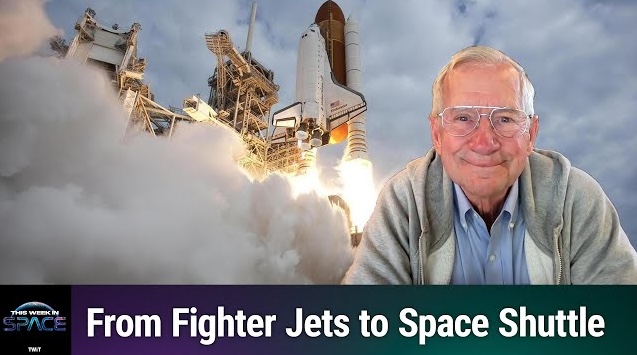 In This Week in Space, Hart joins hosts Rod Pyle and Tariq Malik to reflect on his 1984 Challenger mission, describing the first satellite rendezvous and the groundbreaking Solar Max repair. He highlights the teamwork among the crew, Mission Control, and engineers at NASA’s Goddard Space Flight Center. He also shares lessons from the Challenger tragedy on leadership, transparency, and a strong safety culture, and discusses the continuing risks of human spaceflight and the growing potential of satellite servicing.
Hart, a teaching full professor of mechanical engineering and mechanics in the P.C. Rossin College of Engineering and Applied Science, also introduces listeners to Lehigh’s new master’s program in Aerospace and Space Systems Engineering (MS-AERO), which prepares students from diverse STEM backgrounds for careers in a rapidly expanding industry.
“It’s interdisciplinary. You don’t have to be a mechanical engineer or aerospace engineer from undergraduate to start the program. You could be a physics major and get a master’s in aerospace engineering. It’s the future, I think, of education being adaptable.”
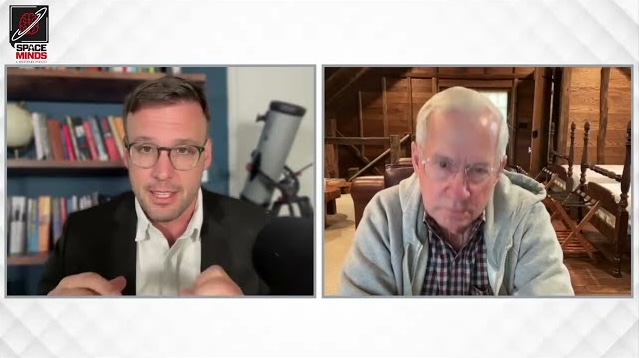 In Space Minds, Hart talks with host David Ariosto about the shift from NASA-led exploration to private ventures such as SpaceX, emphasizing the need to balance innovation with risk. He expresses optimism about artificial intelligence and the next era of human spaceflight, noting that his students share his passion for exploration and for managing risk responsibly.
“We focus on the positive, but always keep risk in mind. When you’re young, like I was when I joined NASA, you accept the danger because being part of exploration is worth it. Then you spend your career minimizing that risk. My students are optimistic. They don’t need to be convinced. They want to go out there and make it happen.”
The podcast appearances are part of Hart’s broader @iHartAerospace initiative launched earlier this year to share his lessons and experiences with a wider audience. Through short videos, he breaks down topics such as orbital mechanics, rocket propulsion, spacecraft design, and satellite operations, while recounting stories from his career—including his time as a NASA capsule communicator (CAPCOM) during tense mission moments. The project reflects Hart’s belief that aerospace is not only a technical field, but also a source of inspiration that can spark lifelong curiosity in science and engineering, as he describes in the Space Minds episode.
“That passion [for space] often starts when they’re young, maybe five years old, seeing something exciting happen in space. That spark drives them to study aerospace engineering, and I see that excitement every day.”
In addition to serving aboard the Space Shuttle Challenger in 1984—where he conducted the first satellite servicing mission by capturing and repairing the Solar Max satellite using the shuttle’s robotic arm—Hart is a former U.S. Air Force fighter pilot, telecommunications executive, and Lehigh alum.
At Lehigh, he leads the new MS-AERO program, a 30-credit, one-year master’s degree that prepares students for careers in the aerospace sector. The multidisciplinary curriculum includes courses in propulsion, astrodynamics, flight control, and spacecraft design. Hart helped shape the program’s curriculum and introduce new courses, some to be taught by visiting industry experts. He sees the initiative as a natural evolution of Lehigh’s longstanding strengths in aerospace education and research.
“The most rewarding part of this stage of my career is helping students see themselves in the future of aerospace. We’re not just studying past missions—we’re building the foundation for the next ones.”
