
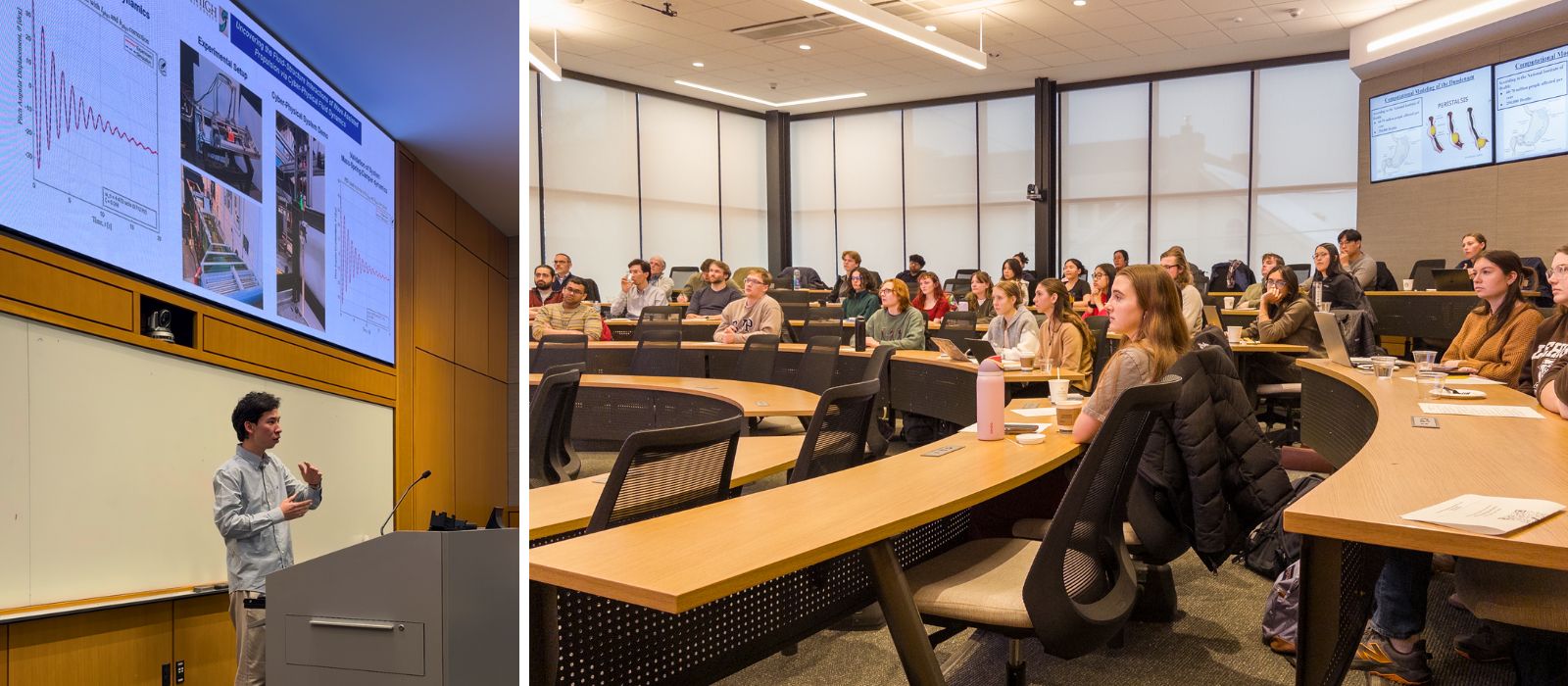
Undergraduate researchers gathered on February 10 to present a year of discovery and collaboration at the annual Rossin Research Scholars Research Roundup, the capstone of the Rossin Research Scholars (RRS) program at Lehigh University.
Launched in 2024, RRS pairs undergraduates with doctoral students for sustained research collaborations spanning the academic year and summer. Undergraduates gain hands-on experience in active research labs while developing technical and professional skills; PhD mentors, in turn, build leadership and communication capacity through structured mentorship. The yearlong model supports undergraduate contributions that may lead to authorship and prepares graduate students to guide emerging researchers.
The Rossin Research Scholars program is jointly led by Mark Snyder, professor and associate dean for graduate education, and Derick Brown, professor and associate dean for undergraduate education, in the P.C. Rossin College of Engineering and Applied Science. “The program is designed to create a true research partnership,” says Snyder. “Undergraduates gain sustained exposure to how knowledge is produced, while doctoral students develop the mentoring and leadership skills essential to their professional growth. Both groups leave better prepared for the next stage of their educational and career paths.”
At the event, each of the 20 students in this year’s cohort delivered a three-minute presentation supported by three slides, after which attendees voted on their favorites. Four researchers—Ben Childs ’26, Kavya Famolari ’28, Lily Paschke ’27, and Alexandra Tsarenkov ’27—were selected to present posters at the Rossin College’s annual David and Lorraine Freed Undergraduate Research Symposium, which takes place April 17.
The format not only showcased technical achievement but also challenged students to communicate their ideas clearly to a broad audience.
“I learned the importance of distilling a complex scientific topic into its fundamental details and focusing on the ‘why,’” says Famolari, an IDEAS major concentrating in bioengineering and molecular biology, who was selected for her project, Investigating the Effects of Polypeptide Length and Salt Concentration on Complexation of Nucleic Acids. Famolari was mentored by Kimia Mirlohi, a doctoral student in the Department of Chemical and Biomolecular Engineering.
“Many vaccines and nucleic-acid-based therapies are thermally unstable and require expensive refrigeration, which limits distribution and access,” she says. “I study how positively charged polypeptides can encapsulate nucleic acids to form thermally stable droplets called coacervates. These droplets can make nucleic acids more resilient and, in turn, more accessible in low-resource settings.”
Such effective communication is an invaluable skill, and one that students continually develop throughout the RRS experience.
“I’ve read and dissected many scientific papers, which taught me how to ask the right questions and anticipate what others might ask about my research,” says Childs, who was selected for his project titled PEGylation of a Cell Penetrating Peptide for Increased Serum Stability and CRISPR Efficiency. Childs worked with PhD student and fellow bioengineer Josh Graham on modifications that could lead to more efficient delivery of the gene-editing technology, CRISPR.
For the doctoral mentors, the experience offers a chance to guide emerging researchers while refining their own approach to leadership.
“The most rewarding part was seeing my mentee’s hard work get recognized by others,” says Bohyeon Kim, a fifth-year doctoral student in chemical engineering who mentored Tsarenkov on her project, None of Your Bismuth? Why This Synergist is Actually Everyone’s Business. The research focuses on catalysts that accelerate the conversion of renewable biomass and alcohols into valuable chemicals.
“The quality of research across the board was so high,” says Kim, “and it was a real honor for her to be selected for the Freed Symposium.”
The recognition provided by the Research Roundup is a testament to how much young investigators can grow throughout the RRS experience. They not only develop technical skills, but they learn how to cope with the inevitable failures that come with experimentation. Over time, that resilience builds confidence, and it's never too early to build that mindset.
“For anyone looking to pursue a career in research, it's vital to gain research experience early,” says Pieter Heyn, a fourth-year PhD student in environmental engineering. Heyn mentored Paschke on her project, Modification of the Surface Charge of Activated Carbon. Heyn mentored Paschke on her project, Modification of the Surface Charge of Activated Carbon where they chemically modified water filter material to make it better at grabbing certain pollutants out of water.
“In class, you work toward a known objective,” says Heyn. “In research, you don't know what your results will be. The change in perspective from pursuing the known to the unknown can be difficult to achieve, and the earlier you start changing it, the better.”
—Story by Christine Fennessy