
Duration: 15:07 | Published: August 1, 2026
Episode Summary
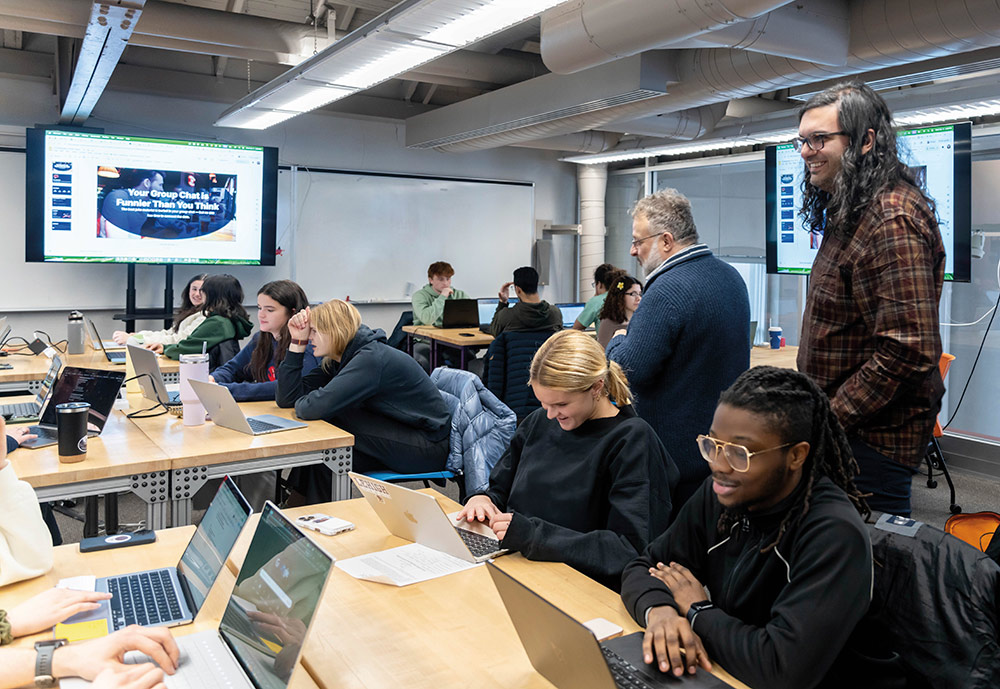
“My grandfather and my mother and father, and most of my aunts and uncles are all engineers, so there was never really a doubt in my mind that I was also going to be an engineer,” says Eric Obeysekare.
The question was, what kind of engineer? Initially drawn to computer science because of his love of programming and video games, everything changed for Eric after taking a college course on engineering for the developing world. The class introduced him to the idea that technology could be used not just to build products, but to improve lives.
“Taking that class was the first time I realized that I could do these positive things for the world with my computer science skills,” he says.
After working in industry, a stint in the Peace Corps, and an eye-opening experience as an entrepreneur, Eric landed at Lehigh. At the university’s Office of Creative Inquiry, he mentors interdisciplinary student teams tackling global challenges, and as associate director of the First Year Rossin Engineering program (FYRE), he is part of a team of educators immersing first-year engineering students in hands-on problem solving.
“Giving students authentic engineering experiences early on develops creativity, confidence, empathy, and an entrepreneurial mindset that will serve them throughout their careers,” he says.
Throughout the conversation, Eric reflects on how engineering can become a force for global good—and why helping students see the impact of their work may be the most important lesson an educator can teach.
Key Moments
- 00:07 Meet Eric Obeysekare and his journey into humanitarian engineering
- 01:46 The class that changed his career trajectory
- 02:18 Building technology for developing communities as an undergraduate
- 03:17 Teaching computer science as a Peace Corps volunteer in Cameroon
- 05:09 Researching entrepreneurship in Rwanda and launching a startup
- 06:36 What failure taught him about resilience and innovation
- 07:37 Why he joined Lehigh University
- 08:17 Using AI to improve healthcare access in Sierra Leone
- 10:12 Reinventing first-year engineering through FYRE
- 12:10 Teaching students how large language models actually work
- 13:22 Watching first-year students become innovators
Featured Quotes
"There are lessons you learn when you fail that you cannot learn if you always succeed." — Eric Obeysekare
"I realized I could do positive things for the world with my computer science skills." — Eric Obeysekare
"I felt a calling to something bigger and something more impactful." — Eric Obeysekare
"Our students are going to be hands-on from day one." — Eric Obeysekare
"It really helps students develop a much deeper sense of empathy about the world." — Eric Obeysekare
Full Transcript
Transcript is auto-generated and lightly edited for clarity.
Welcome to Rossin Connection, a podcast about all things Lehigh Engineering. Coming to you from the P.C. Rossin College of Engineering and Applied Science at Lehigh University. Today, we're featuring Eric Obeysekare. Eric has many titles here at Lehigh. He's a teaching assistant professor in the computer science and engineering department. He has a joint appointment with the Office of Creative Inquiry and he's the associate director of the First Year Rossin Engineering Experience, otherwise known as FYRE. As you'll hear, Eric has the kind of backstory that could have landed him just about anywhere. He's using those experiences at Lehigh to build the type of mindset and skillset students will need to address the very real problems in the world today. Thanks for listening. Eric Obeysekare comes from a family that has a bit of a legacy.
So my grandfather and my mother and father and most of my aunts and uncles are all engineers, so there was never really a doubt in my mind that I was also going to be an engineer. I think just finding the right field for myself was more of the exploration I was doing as a kid.
His dad worked with computers and pretty soon Eric was passionate about programming. He went to Penn State with a plan to do something with computer science.
At the same time, I also loved video games when I was a kid. So I came into college thinking I wanna study computer science, I wanna be an engineer, and I wanna do those things so that I can go and make video games.
That first year, he took a class taught by a professor who was also doing work in Kenya.
And he had this class called Engineering Design for the Developing World.
Eric's dad is from Sri Lanka and they'd taken plenty of family trips there. So he understood what it meant to be a developing country.
And there was a lot that engineering could do to improve the lives of people in Sri Lanka.
He signed up for the course and it changed everything.
Taking that class was the first time I realized like, oh, okay, I love computers, but I didn't actually ever know that I could do these positive things for the world with my computer science skills, with my programming skills.
Eric worked on a project developing a cell phone-based social network that relied on text messages. It was 2007.
So I like actually had an old candy bar phone that was connected to my laptop with the USB cable and then wrote this Java code that could send text messages through that phone over the USB cable.
The project was based in Kenya and it was a turning point for Eric. He was applying his skills in a real world scenario as a very young engineer.
I think I took the class and was like, okay, I, this is what I wanna do with my career. And I still like video games. Like, you know, there was nothing wrong with that dream, but I think I felt a calling to something bigger than that and something more impactful.
When he was a senior at Penn State, he started looking into the Peace Corps. His mom had been a Peace Corps volunteer in Malaysia and he'd grown up hearing her stories and knew it was something he wanted to do too. He applied and eventually got in.
So I was a high school computer teacher in Cameroon, I guess middle school and high school. So the way the Peace Corps works, you go to another country, you get three months of training where you often learn a language and some technical skills to help you succeed in, in whatever position you're assigned to. Um, so I spent three months learning French and learning a little bit about how to be a teacher. I was a computer scientist. I had never been in a classroom in that role before. So, uh, you know, had to learn a lot about how to think about lesson planning and classroom presence and all of that.
His school in Cameroon was bilingual with classes in French and English. So Eric was able to teach his classes in English. The school was also relatively well off. It had 50 computers for about 3,000 students.
One of my classes had 87th graders in it. So if you can imagine what having 80 13-year-olds is like, that was, uh, per- perhaps chaotic is a good word.
Eric had just one hour a week with each class. Most of his sixth graders had never even touched a computer before.
The class I would do with that year, it was mostly just like learning how to use the mouse. And then I would just have them draw pictures in Microsoft Paint because I thought that was something that was fun and also would help you develop these like mouse skills and, and just get you, you know, comfortable and excited about computers.
He taught seventh graders how to use Microsoft Word and his seniors how to do C++ programming. The Peace Corps taught him a lot about what he did and did not want to do.
I think I also realized I didn't wanna be a middle school teacher especially, but I think more than anything, the Peace Corps experience just made me want to continue working in developing countries and continue to explore how technology and computers could be a force for good and a force for development.
While in Cameroon, Eric had spent a couple weeks writing code for a startup accelerator there. He'd always been interested in entrepreneurship and he was inspired by the people around him. So when he came back to the US, he went back to Penn State to get his PhD in information science and technology. He applied for a Fulbright scholarship to do research on entrepreneurship in Rwanda and he got it. He moved back to Africa and interviewed entrepreneurs, investors, advisors, and wrote his dissertation.
You know, that was a solid two years of living in that world and then writing about it. I really just got sick of writing about startups and felt like I wanna do this myself.
As his PhD experience was wrapping up, he attended a conference on social entrepreneurship in San Jose.
And then like two weeks later, I got this email from this person who's like, "Hey, I was at this event. We didn't get a chance to meet in person, but I really wanted to talk with you. I'm interested in starting a company and I'm looking for a technical person to help me do that. Um, would you wanna meet and chat more about it?" And I was like, "Yeah, this is great. This is like exactly what I was looking for."
The two formed a nonprofit. They were building an app to help business owners in Uganda record their sales and inventory. Things started out pretty good. They won some money in a startup competition and they got accepted into an accelerator in San Francisco where they got a little more funding and some training, but it wasn't enough.
I think when it came down to it, the shopkeepers, the business owners weren't necessarily interested in actually entering the data into the ap. So there was kind of this disconnect, like, where people wanted the output, but then not, weren't necessarily ready to do the input side of things.
They had worked so hard. But more often than not, that's just how it goes with startups.
I think there's lessons that you learn when you fail that you cannot learn if you always succeed. And so I'm super grateful for that experience. It was devastating at the time. Like I was devastated when, when we actually finally threw in the towel and admitted defeat. I think, I feel like it's more about admitting defeat than failing. And that was, that was a tough moment, but I think I learned a lot about resilience and, and about founding a startup and like I would like to be a founder again someday.
He stayed in that entrepreneurial world for a while longer working as an engineer for an education technology startup. But then he started to look around again and that's when he found a position at Lehigh.
The really a- appealing part of it was the opportunity to do multiple things like, you know, working closely with Creative Inquiry and some of the similar projects to how I was inspired as a student. And then also this opportunity to influence engineering education and, and maybe even the future of engineering education.
The Office of Creative Inquiry at Lehigh turns undergrads into problem solvers. For a year, students work in interdisciplinary teams and address complex real world problems in areas like sustainability, healthcare, education, and economic development, both here at home and abroad. Eric mentors several creative inquiry teams.
One of my teams is called Artificial Intelligence Strengthening Healthcare Access, or AISHA. And that is a team operating in Sierra Leone. And we are trying to improve access to health information in the healthcare system of Sierra Leone.
It's a smart speaker device like an Amazon Alexa that runs on the credit card size computer called Raspberry Pi, and contains a database of pre-vetted health information.
Healthcare workers in Sierra Leone can get one of these devices. They can verbally ask it a question and then it will respond with an answer from our database.
And it works even when it's offline.
I like to think of this project as like edge AI. We're bringing these AI models like really close to people who would frankly not be able to access them because internet access is such a challenge and even electricity access is such a challenge.
It's an important project. According to the World Health Organization, a country needs about 44 skilled health workers per 10,000 people. Sierra Leone has about six health workers for every 10,000 people.
A lot of the healthcare professionals,- they're extremely passionate. You know, they care deeply about health and their communities and they really wanna make a difference. But the reality is they might get like a one-week workshop on how to be a nurse and then they're like thrown onto the front lines.
The project is meant to augment that training. And like all the creative inquiry initiatives, it's a unique opportunity for students. They get to apply their skills and see how those skills can improve the lives of those around them. And that leads to a profound sense of perspective.
I think it really helps them develop a much deeper sense of empathy about the world, um, and seeing how people are living in, you know, very different contexts than what we are here in the US and, and some of the challenges and opportunities that come along with that I think is a super valuable experience for our students.
In addition to his work with Creative Inquiry, Eric is also the associate director of the First Year Rossin Engineering Program or FYRE. FYRE launched as a pilot program in the fall of 2025. It's designed to transform the way that first year engineering students are taught here at Lehigh.
We were looking back through some old course catalogs and we found one from the 1930s. And the first year of engineering in the 1930s was pretty similar to what students have been going through for the past couple years here at Lehigh. So you take chemistry, physics, math, some engineering classes, some writing classes. Um, and that's the way it's been for many years.
Another thing that hasn't changed too much is that it usually takes a while before students move from theory to practice and actually apply the skills that they learn.
You know, one of our principles is our students are gonna be hands-on from day one. They're gonna be building stuff from day one.
Ultimately, FYRE will comprise a series of modules where students will apply math, physics, computing, and design to build stuff that addresses real challenges. Three seven-week modules were piloted in the 2025 2026 academic year. For the Design and Making Foundations module, students learn technologies like 3D printing, laser cutting, Arduino programming and basic electronics to create a working prototype of a machine meant to solve an actual problem.
There was a team who was working on a proof of concept for like a health vending machine. They saw that a lot of students in the dorms are, you know, they're getting sick and they just need some like basic stuff, but it's to go all the way down to CVS from the dorms is kind of a pain. And so they had this idea of like, what if we made a little vending machine that could dispense ibuprofen and things like that?
In the Energy Storage module, students worked in a wet lab to learn how materials store and release energy. The third module was Harnessing Agentic AI for Engineers.
And I was actually leading the teaching for that module. So when I was an undergrad, I felt like I learned the most when I was able to build something that helped me to understand a system or a process or something like that. And so I wanted to bring that experience into this module as well. And so we were teaching them Python coding, but then actually having them build little pieces of a large language model so they could actually understand more of like what's going on under the hood of these.
Students then got to come up with a problem and build a chatbot or an AI agent that could potentially solve it.
So we had a team of students that built this like smart alarm clock. So I guess they have trouble waking up. So they wanted to build this alarm clock where when the alarm goes off, it will start asking you questions from whatever class you next have an exam in. And you have to answer five questions in a row correct before the alarm to actually stop ringing.
They didn't finish it, but they got pretty far. Their prototype was able to generate questions on the fly. And in case you're curious, the time from initial idea to that prototype, three weeks. At the end of the module, students presented their ideas to the class.
That was the most fun I have ever had watching presentations because they were just so proud of what they had built.
In many ways, Eric has come full circle from a student inspired by a class to believe engineering can make the world a better place to the professor now helping lead an innovative new program that will spark the curiosity and drive of the next generation of future makers.
I had a student come up to me after class and he was like, "Every idea that was presented today could be a real company." And I was like, "Yeah, this is like, you know, this is really great. These are like all actually good ideas that, that they've been able to prototype and work on. It makes you excited to see what they're gona do with the next three years here at Lehigh. If that's what they were able to do in like one of their first semesters, then I think the sky is the limit from here.
That's it for today's show. Thanks so much to Eric for sharing his story. For more information about all the academic programs at the P.C. Rossin College of Engineering and Applied Science, and to find our show, head to engineering.lehigh.edu. Music in this episode is by Blue Dot Sessions. You can send us story suggestions or feedback on X at RossinPodcast. I'm your host and producer, Christine Fennessy. See you next time.
About the Guest
Eric Obeysekare is a teaching assistant professor in Lehigh University's Department of Computer Science and Engineering, with a joint appointment in the Office of Creative Inquiry and as associate director of the First Year Rossin Engineering program (FYRE). His work focuses on humanitarian engineering, artificial intelligence, entrepreneurship, and engineering education, helping students apply technology to address real-world challenges both locally and around the globe.
Episode Details
Related Episodes
- Episode 12: From Engineer to Astronaut: Terry Hart's Journey to NASA (Part 1) — How one Lehigh engineer traded the lab bench for the space shuttle.
- Episode 15: From Engineering Student to Robotics Entrepreneur — A Lehigh alum on turning a classroom project into a robotics company.
- Episode 16: Bioengineering, Regenerative Medicine, and the Future of Healthcare — Engineering solutions built to improve patient outcomes.
- Episode 31: Engineering Better Patient Care: Dhruv Seshadri on Wearable Devices and Finding Your Why — Wearable medical devices and the students-over-GPA philosophy driving them.