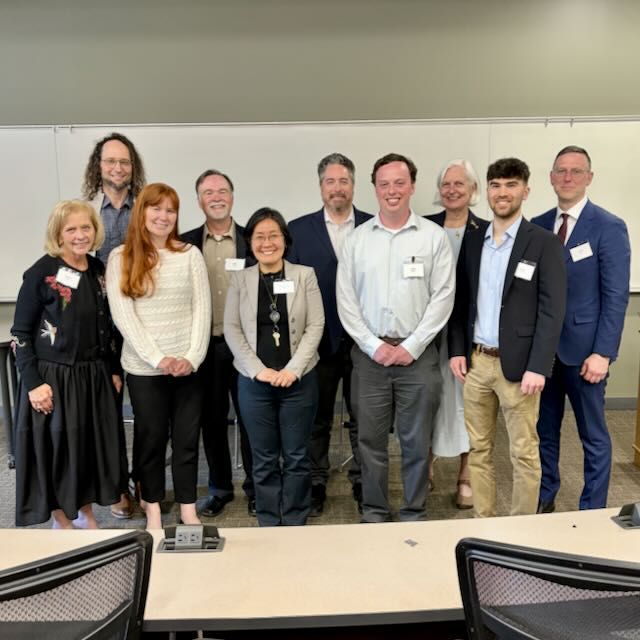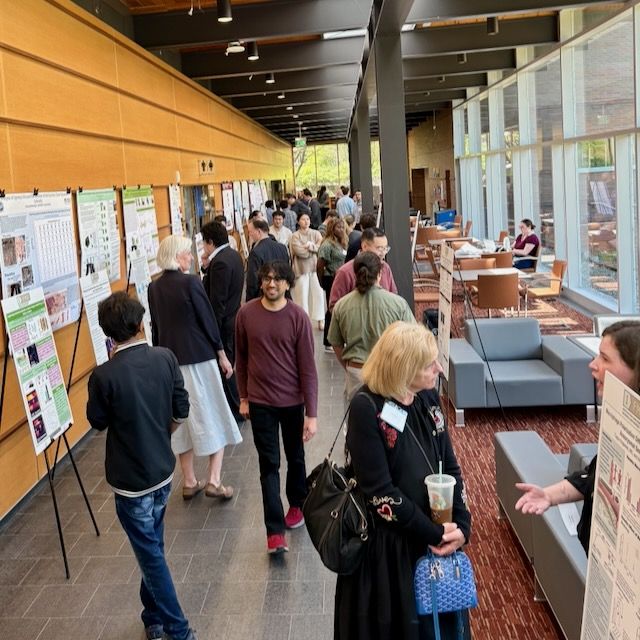
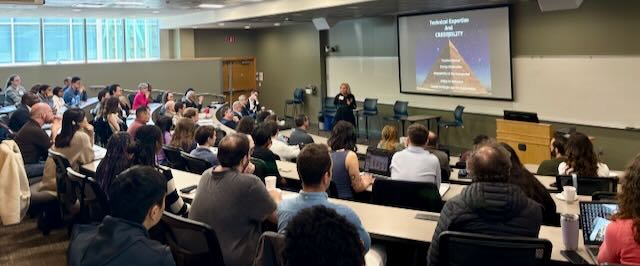
Researchers, industry leaders and students gathered at Lehigh University on May 4 for the 2026 Lehigh Materials Symposium. Hosted by the Institute for Functional Materials and Devices (I-FMD) and the Department of Bioengineering, the annual event explored emerging challenges in semiconductor manufacturing, cancer research, and sustainability.
“Materials research depends on collaboration across disciplines, industries, and generations of scientists and engineers,” says I-FMD Director Elsa Reichmanis, Professor and Carl Robert Anderson Chair in Chemical Engineering. “This symposium allows us to not only share cutting-edge research, but also to help students connect with leaders in academia and industry.”
Semiconductor Scaling and Industry Growth
In opening remarks, Nathan Urban, provost and senior vice president for academic affairs, emphasized the growing importance of materials research to Lehigh’s research enterprise and national priorities. Robert Visser of Applied Materials delivered a keynote on the rapid growth of the semiconductor industry, noting projections suggest it could surpass $1 trillion in 2026.
Visser described the extraordinary precision required in modern manufacturing, comparing the process to reading the inscription on a dime in Manhattan while flying 5,000 feet overhead at 200 miles per hour. A panel discussion featuring Visser, Matt Wehrman PhD'18 (IBM Semiconductor), and Jeff Shakespeare PhD'79 (Product Realization Specialties) examined technical and policy challenges facing the sector.
The panelists discussed the difficulty of integrating semiconductor materials with different processing temperatures and the need for improved thermal management. Wehrman also highlighted IBM’s participation in CHIPS Act–funded initiatives and the role of domestic manufacturing in national security. The discussion also touched on workforce development and maintaining pathways for international students and researchers.
Innovations in Bioengineering and Therapeutics
The symposium’s second keynote shifted focus to medicine. Michael King of Rice University presented research aimed at preventing metastatic cancer by targeting circulating tumor cell clusters, which are associated with poor clinical outcomes.
King’s team has developed methods using superhydrophobic surfaces and 3D printing to isolate and study these clusters, with promising results in prostate cancer models. A bioengineering panel featuring King, John McGlynn PhD’22 (Merck), and Dylan Smolen ’19 (Prime Medicine) further explored the future of biomaterials and therapeutic development.
Panelists identified lipid nanoparticles for RNA delivery and gene therapy as major growth areas. They also discussed manufacturing and cost challenges associated with personalized medicine. McGlynn noted that the healthcare industry still has significant opportunities to improve sustainability and reduce waste.
In addition to research and industry discussions, the symposium included sessions focused on professional development and career pathways.
Leadership and Professional Development
Lehigh President Joseph J. Helble ’82 introduced keynote speaker Nancy Gray and participated in a closing panel focused on graduate student professional development. Gray, President and CEO of Gordon Research Conferences, reflected on lessons from her career in science and leadership.
Gray encouraged students and early-career researchers to remain open to unexpected opportunities and prioritize professional credibility. She emphasized the importance of interpersonal relationships alongside technical achievement, telling attendees, “the quality of your work matters…but how you treat people matters most.”
The event concluded with a career panel featuring Gray, McGlynn, Smolen, and William “Skip” Dodge (Pfizer). Much of the session focused on student questions regarding leadership and navigating unexpected career challenges as industries and technologies evolve.