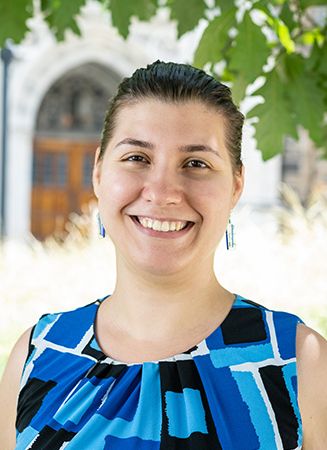
When Chayah Wilbers talks to preschoolers about engineering, she has a pretty good idea of what’s going to come to mind.
"It never fails," she says. "You always have one kid that says engineers work on cars, and another one who says engineers are the people who run trains. Every single time."
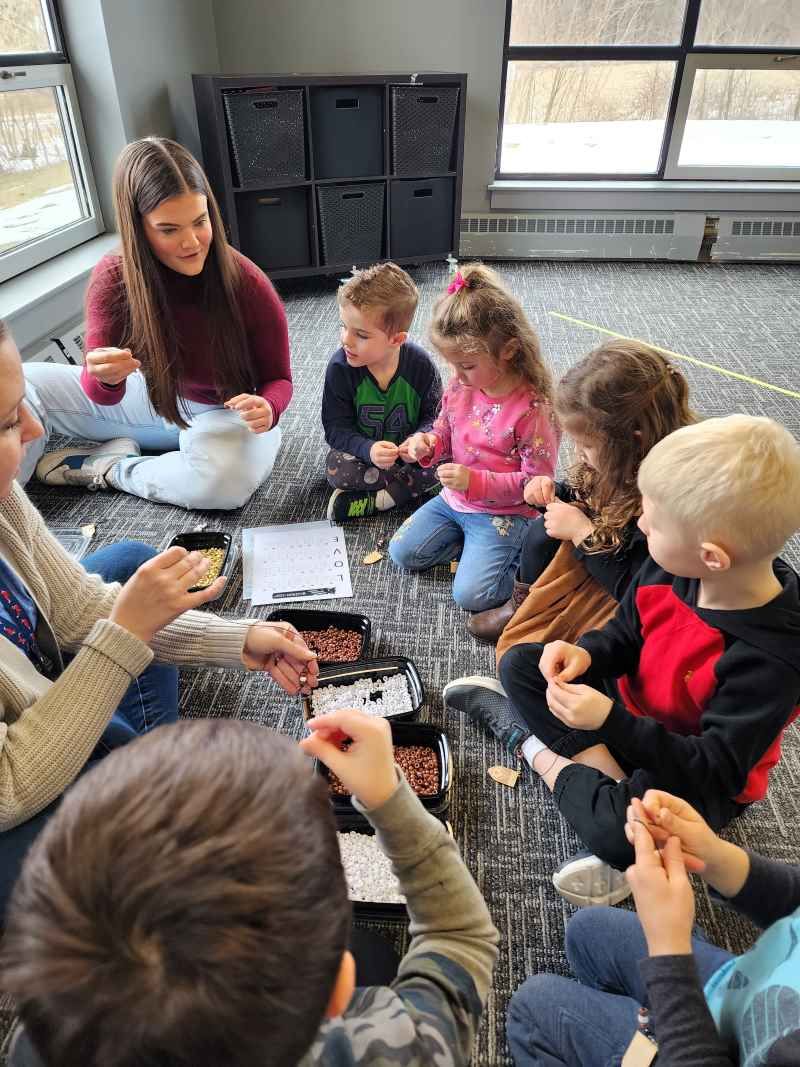
Wilbers is the program manager for Lehigh University’s P.C. Rossin College of Engineering and Applied Science, and one reason (of many) why she knows a lot about how four-year-olds think is because she also leads the college’s efforts to expand its outreach programs to include preschool through 12th grade students through an initiative called the STEM Squad. The goal, she says, is to engage Lehigh faculty and students to share their love and passion for science, technology, engineering, and math with area schools and, ultimately, inspire future makers.
“We're connecting teachers who want help in teaching STEM with Lehigh faculty and students who want to give back to the community,” she says.
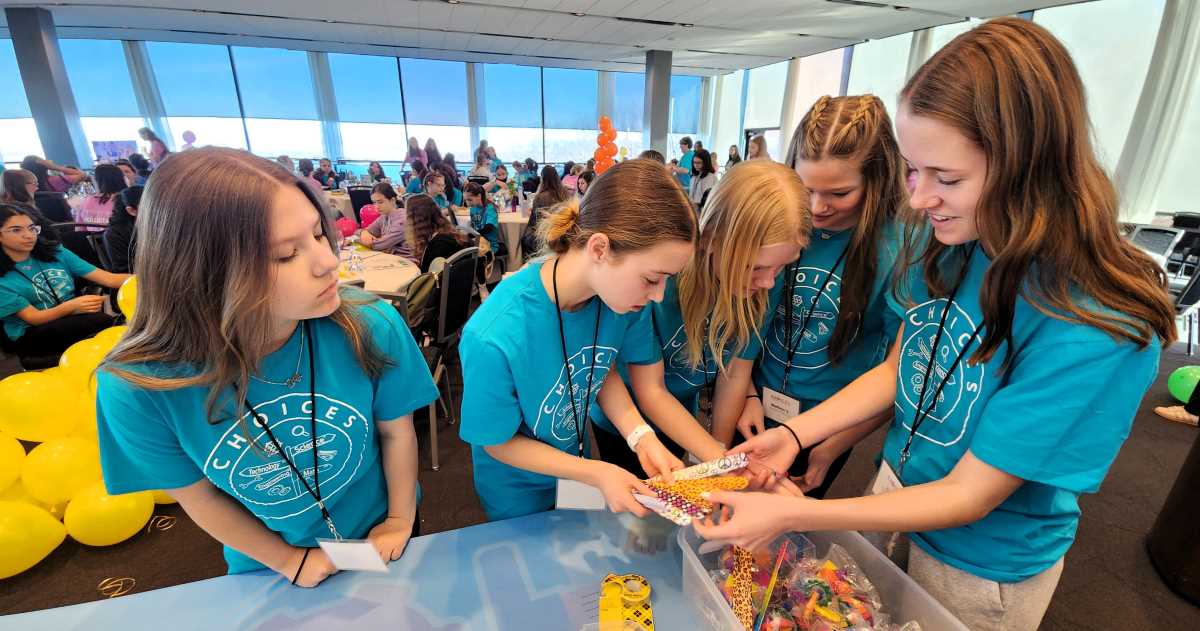
The STEM Squad is a new avenue for forging these types of bonds and builds on the college’s long history of outreach. The college hosts a number of events throughout the year, including the Summer Engineering Institute, an overnight engineering camp for high schoolers who are nominated to attend by their school districts, as members of the Lehigh University School Study Council (LUSCC). And Wilbers says that both faculty and students have long engaged with local schools in myriad other ways, including longstanding Mechanical Engineering 240 course, which includes students from nearby Broughal Middle School in the design and manufacturing of miniature race cars, and annual field trips from local schools to the College's David and Lorraine Freed Undergraduate Research Symposium.
“After Covid, a lot of teachers retired, and so a lot of the relationships that faculty and student groups had made over the years have disappeared,” says Wilbers, who was a teacher herself for seven years before moving to higher education. “On top of that, school policies have changed, and it’s trickier to navigate the system if you’re not familiar with it. This effort really began organically after Covid, when faculty, staff, and students were saying, ‘Hey, I want to collaborate with schools but I don’t know how.’”
The STEM Squad facilitates those collaborations in several ways, from classroom demonstrations to career days and curriculum enrichment creation.
When a local kindergarten teacher asked for help developing an activity that tied into a unit on outer space, Wilbers developed a presentation around Lehigh’s astronaut-in-residence, Terry Hart (now a teaching full professor of mechanical engineering and mechanics). She showed up with photos and videos of Hart working in space, passed around model rockets and other cool NASA memorabilia that Hart had provided to illustrate things like what an engineer needs to think about when designing a rocket, and explained what an engineer is and how exploring the cosmos was just one of many things they can do. Afterward, the kids got to build rockets and take part in a mini-competition to see who could get theirs to soar the highest.
“We gave them a box of supplies and 10 minutes, and asked them to think through the engineering process,” she explains. What did they need to consider in terms of weight or the height of the ceiling? “It was really fun watching their faces light up as they’re chucking their homemade rockets into the air.”
It was also revealing. The kids were blown away that Wilbers personally knew—and talked to! In the hallway!—a real astronaut. And for many, it was the first time they’d realized that being an engineer and doing what Hart had done in space, was something they could do, too.
“They didn’t know that engineering was actually a job,” she says.
Creating community
For members of the STEM Squad, so much of the appeal in its mission lies in being present for that moment of discovery and promise.
Ana Alexandrescu is a professor of practice in the Department of Industrial and Systems Engineering (ISE) and leads the Lehigh ISE Outreach Program (OutreachISE), which aims to promote awareness of industrial engineering and operations research; and, as a member of the STEM Squad, she often accompanies Wilbers to local career fairs.
As a kid, Alexandrescu was good at math and science, but that kind of proficiency didn’t make her cool.
“It was lonely,” she says. “There weren’t that many kids like me.”
Her past is part of what drives her today to create a sense of community among kids with similar interests.
“If we can put these students in environments where they feel connected, they have a better chance of learning who they are and what they’re excited about,” she says. “And then if they do eventually self-select out of STEM, at least they’re not doing it from a lack of information.”
Her other motivator is to clarify the misinformation around what engineers do (something that persists long past preschool). She runs a workshop that introduces middle schoolers to the concept of systems engineering by challenging them to optimize the operation of a hospital emergency room. The students role play as doctors, nurses, and patients, and simulate different ways to avoid bottlenecks and inefficient care. After one session, a student told her she’d always assumed that engineers built things. She wasn’t all that interested in building stuff, and so she figured engineering wasn’t for her.
“We had a whole conversation about problem-solving and teamwork and data,” says Alexandrescu. “The experience opened her mind to the idea that engineering isn’t just about building something. It’s also about finding solutions to problems and designing systems and processes.”
It was a moment that validated Alexandrescu’s efforts and reminded her, “This is why I do what I do.”
Learning through service
Jennifer Winikus, a teaching associate professor in the Department of Electrical and Computer Engineering, uses her involvement with the STEM Squad to dispel similar notions. Engineering is a nuanced profession, she says, and the skills engineers develop can propel them almost anywhere—medicine, law, business, even politics. She loves introducing the hesitant student to something as foreign as soldering and watching their face light up when they realize it can be a twist on making art.
“Those are really fun moments, when you see their perceptions change on what they thought they could do,” she says. “All of a sudden, it’s not a scary activity, but a creative one. I really think all students deserve the opportunity to learn about all the possibilities and pathways there are with engineering.”
Lehigh students are taking an especially active role in the STEM Squad. In 2024, a group of computer science students chose a new project—spearheaded by Wilbers—as their junior-year Computer Science and Engineering Capstone Design experience. The goal was open-ended: figure out a way to help local teachers meet new K-12 STEELS (Science, Technology, Engineering, Environmental Literacy, and Sustainability) standards. The standards are meant to build skills in critical thinking and problem-solving, and will be required in all Pennsylvania schools starting with the 2025-2026 school year.
Kyra Lee '24, a computer science and engineering major, had already been involved in outreach as a member of a computer science club that went to Broughal Middle School, in the Bethlehem Area School District, a couple times a month to run activities aimed at sparking interest in engineering. Lee and her peers lead participants in, for example, guiding a robotic ball through a maze using code.
“I wasn’t exposed to computer science until I was a senior in high school, and I would have loved to have learned about it sooner,” says Lee. “I really enjoyed being part of the club and giving back to younger students and introducing them to all the cool things they can do with computer science. So when I heard about the capstone project helping teachers meet the STEELS Standards, it sounded super exciting and right up my alley.”
One of the reasons teachers need that help is because they're already stretched mighty thin, says Wilbers.
“Teachers have to pack a lot of information into a short period of time,” she says. “It's really difficult to plan out your entire year, and all your curriculum, and then try to figure out how to add in these enrichment pieces. They're often working on their own, without resources, and on their own time. That's a lot of work for teachers.”
Lee and her team worked closely with Wilbers to lighten that load. They first met with teachers to discuss how they could best meet their needs, specifically as it related to teaching computer science to students in grades ranging from sixth through 12th. The capstone team then took that information, and built the online Lehigh K-12 Computer Science Toolkit. Each module, or lesson plan, in the toolkit includes an objective, a materials list, an introduction, and a discussion, and identifies the related STEELS Standards. Teachers can review the website and download the lesson plans at no cost.
“We wanted to create fun, engaging activities that would keep the students interested,” says Lee. “And we wanted to make the lessons easy to teach. The teachers didn't need to have any experience in computer science.”
For example, they developed a cryptography module that teaches students how to use a cipher and encrypt a message. Their module on programming requires just pen and paper and teaches the basics of coding by guiding participants through a maze. Another introduces students to MakeCode, a free online learning platform, and teaches them how to program a beating heart.
As the Lehigh team worked, Wilbers reminded them often of their audience. It isn’t easy to distill complicated subject matter into a comprehensible, fun activity for a little kid. It’s even harder when the teacher, too, is unfamiliar with the subject. Add to that a general lack of resources in many of the schools, and the task could have felt daunting. But the team embraced it.
“It honestly wasn’t as hard as I thought it was going to be, and I think it was because we are students,” says Lee, who has since graduated. “We were all going to classes and so we built these modules around what helps us learn. We made sure we had a clear objective with each lesson because it’s nice to know why you’re doing something. We also had the opportunity to go with Chayah to outreach events throughout the year, and we tested some of the activities with the kids. They responded really well.”
And, says Wilbers, so did the teachers.
“When they heard we were developing this website, they were so excited, and they asked, ‘Can we be your guinea pigs? Can we test run this in our classroom?’” says Wilbers. And when they did, the teachers responded with gratitude. “This is some of the best lesson planning I’ve ever seen,” Wilbers says. “I am so impressed with what this Lehigh team has done.”
Lee's team has passed the project down to a new group of capstone design students. The next goal is to broaden the website and add modules from different disciplines of engineering, as well as to improve the website’s functionality (for instance, adding a feature that allows the user to type in a specific STEELS Standard and find corresponding modules).
For Lee, her time with the STEM Squad has been intensely rewarding. From a technical standpoint, she and her team built something that works, from scratch. But from a humanist perspective, they built something meaningful. Something that could inspire the next generation. Something that, for the foreseeable future, connects Lehigh in a powerful way to the community around it. The reception they’ve gotten from both students and teachers has been a powerful lesson in what it means to truly make an impact, says Wilbers.
“They took the Lehigh philosophy of learning by doing,” she says, “and turned it into learning by service.”
—Story by Christine Fennessy