
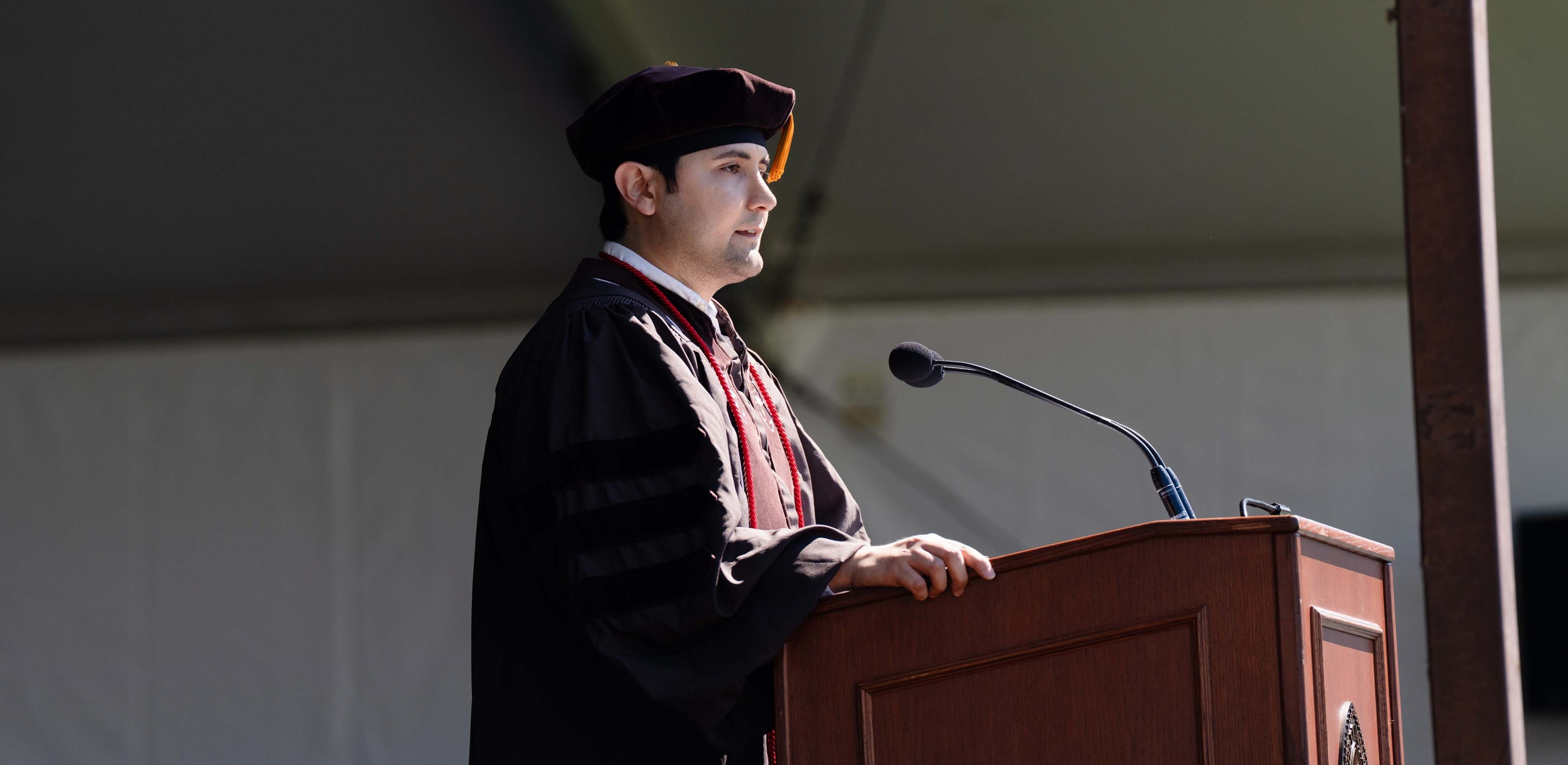
They say write what you know.
So when Mohammad Mohammadisiahroudi ’24 PhD was selected to speak at this year’s Graduate Commencement and Doctoral Hooding Ceremony, he tapped into his experiences as an international student—and what they revealed about the people who make Lehigh a singular place.
“I started my PhD during Covid, and about the same time, I switched my research focus to quantum computing,” says Mohammadisiahroudi, who went on to study how quantum computing could be used to solve large scale optimization problems in industrial engineering under the guidance of Tamás Terlaky, a professor of industrial and systems engineering (ISE) and director of Lehigh’s Quantum Computing and Optimization Lab (QCOL).
Isolation, homesickness, and the challenges inherent in studying a novel and highly complex topic in another language could have collided into a perfect storm making a difficult endeavor even harder. But again and again, Mohammadisiahroudi found support among Lehigh’s many academic offices and programs, faculty, staff, and fellow students.
“As students, we learned how to stay connected, and how to support each other,” he says. “My advisor, the QCOL team, and the ISE department gave me the mentorship I needed to move into quantum computing. And as international students, no matter what we needed—help with our visas, financial support, professional development, teaching development—Lehigh had so many resources for us.”
Those resources had a direct impact on his current trajectory. He started his PhD primarily focused on research, and was unsure if he’d ultimately end up in academia or industry. Back then, the idea of teaching seemed too daunting, too intimidating, especially given the language barrier. But he joined several development programs across campus, including ISE’s FACET program, which gives graduate students opportunities to teach and mentor other students. (ISE professor Frank E. Curtis, who also heads the department’s PhD program, is the founding director of the Lehigh ISE Future Academic Career Experiential Training Program.)
Mohammadisiahroudi learned how to teach and became the primary lecturer for two courses. The more confident he became, the more he enjoyed it. Especially those moments when he saw concepts become clear in his students’ minds. Or when they impressed him with tough, thoughtful questions.
“It felt so good to see them learn,” says Mohammadisiahroudi, who favors project-based learning around real-world data and problems. “Teaching has become my favorite part of being an academic, and so when it came time to apply for positions, I knew I wanted to stay in academia.”
Perhaps he’ll one day have the same experience as his own advisor had with him. “Mohammad was that special kind of doctoral student that every PhD supervisor wishes to have,” says Terlaky. “He bravely jumped on the most challenging revolutionary new topic, quantum computing optimization, and was a founding member of QCOL His intellectual power, curiosity, enthusiasm, and perseverance propelled him to the top.”
Mohammadisiahroudi, who has been postdoctoral researcher in the ISE department for the past few months, is now joining the Department of Mathematics and Statistics at the University of Maryland, Baltimore County, as an assistant professor. He’ll also be affiliated with its Cybersecurity Institute and Quantum Science Institute.
“It’s a major cybersecurity institute in the U.S.,” he says. “The next application I will explore will be using quantum computing to solve problems of cybersecurity.”
As a PhD student, Mohammadisiahroudi developed algorithms and quantum methods that are capable of solving large-scale problems faster than traditional computing in applications such as healthcare.
“For example, a primary treatment for cancer is radiation therapy,” he says. “Providing the best treatment approach involves solving the huge optimization problem where radiation on the tumor site is maximized while minimized everywhere else. We were able to show that quantum computing could solve that problem much faster than classical computers could and deliver a better treatment plan.”
Mohammadisiahroudi’s dissertation, “Quantum Computing and Optimization Methods,” won first place in the 2025 edition of the Pritsker Doctoral Dissertation Award. The award recognizes outstanding research in industrial engineering and is given annually by the Institute for Industrial and Systems Engineers (IISE). And while he’s won multiple awards and published papers in flagship journals, the IISE’s recognition took him by surprise.
“My work isn’t traditional in industrial engineering,” he says. “It’s very new. But it was exciting to see that senior professionals in the field are open to this kind of novel research, and I think that’s going to really motivate other students and researchers to explore new things.”
As a professor, Mohammadisiahroudi will soon be in the role of academic motivator and mentor. And he’ll be ready. Lehigh has given him the template for what works.
“Lehigh is on the cutting edge of research,” he says. “But it’s also got everything you need in terms of resources. So many people here helped me in my academic journey.”
—Story by Christine Fennessy
