
Duration: 11:54 | Published: May 2025
Episode Summary
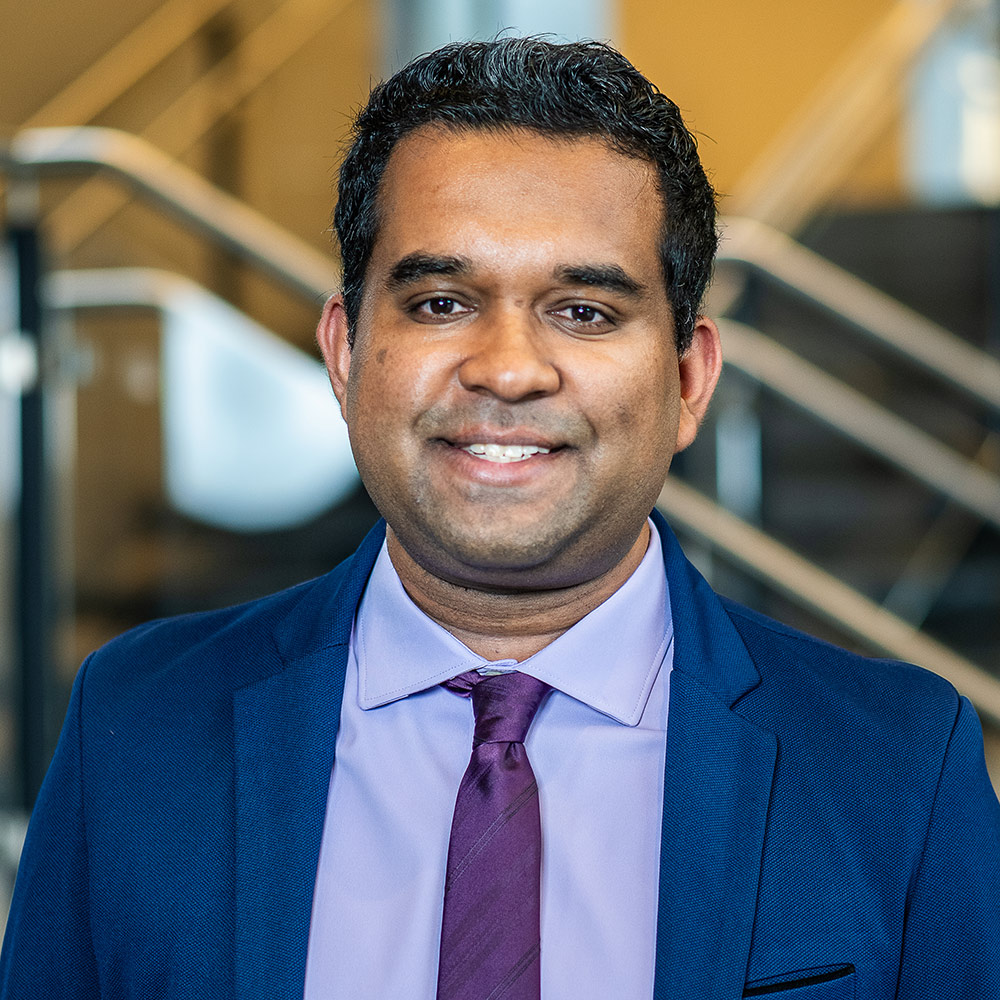
Lehigh bioengineering assistant professor Dhruv Seshadri studies wearable medical devices that improve patient outcomes. In this conversation, he explains why he hires students for their motivation rather than their GPA, how his volunteer work as a child shapes his research today, and what curiosity looks like in an engineering lab.
Dhruv Seshadri joined Lehigh University's Department of Bioengineering in August 2023. Raised in Saratoga, California, his early life was shaped by baseball, tennis, music, and an extensive commitment to community volunteering. From making sandwiches for shelters to preparing vegetables for the Second Harvest Food Bank, he learned at a young age the joy and profound value of directly serving others. This deep-rooted desire to give back later merged with his passion for medical materials, leading him to major in polymer science at Case Western Reserve University.
His interest in wearable biosensors was sparked during the NBA Finals while reading about how the Golden State Warriors monitored athlete recovery. Spurred by this sports medicine connection, Seshadri proactively emailed the head physician of the Cleveland Browns. This bold move resulted in an eight-year research collaboration that pioneered the use of wearable technology in guiding clinical rehabilitation after ACL reconstructions.
Today, Seshadri applies this mission-driven focus to his powerhouse lab at Lehigh. He oversees 43 students across three core research avenues: Equitable Data, Equitable Analytics, and Equitable Devices. His projects include collaborating with the Indian Institute of Technology in Palakkad to develop smart menstrual pads for cervical cancer and preeclampsia screenings, building low-cost vital monitoring sensors for operating environments subject to power outages, and engineering a non-invasive neck wearable to monitor swallowing disorders (dysphagia).
Key Moments
- 00:07 Meet bioengineering professor Dhruv Seshadri and the mission behind his research
- 00:52 How his father's advice shaped his career
- 01:44 Childhood volunteer work that inspired a life of service
- 02:49 Discovering wearable medical devices through sports medicine
- 04:26 The email that launched an eight-year research collaboration
- 05:27 Why Seshadri hires students for purpose instead of GPA
- 06:27 Three research areas transforming equitable patient care
- 07:59 Developing a smart menstrual pad for disease screening
- 08:18 Building low-cost surgical monitoring systems for low-resource settings
- 09:00 Creating a wearable device to monitor swallowing disorders
- 10:34 Why engineering can improve lives today—not years from now
Featured Quotes
"Every time I hire a student here at Lehigh, I don't look at GPA. I want to know whether they're hungry for opportunity." — Dhruv Seshadri
"The overall objective of our research is to engineer to improve patient outcomes." — Dhruv Seshadri
"My job as a faculty member is not to get in your way. It's to provide the resources you need."— Dhruv Seshadri
"There's a true opportunity to affect the individual—not ten years from now, but tomorrow." — Dhruv Seshadri
Full Transcript
Transcript is auto-generated and lightly edited for clarity.
Welcome to Rossin Connection, a podcast about all things Lehigh engineering. Coming to you from the P.C. Rossin College of Engineering and Applied Science at Lehigh University. Today we're featuring Dhruv Seshadri. He's an assistant professor in the Department of Bioengineering, and while he hasn't been at Lehigh long, he's already established a powerhouse of a lab dedicated to improving people's lives. It's work that in some ways he might just have been destined to do. Thanks for listening. It's so nice when you can remember something a parent said to you when you were young, especially when it was something meaningful.
I remember as a kid, one conversation after dinner, my dad, you basically said, I don't see yourself working in a traditional nine to five. And he said, I see you doing something where you can give back to society, educating folks and contributing to the greater good.
Dhruv Seshadri is an assistant professor in the Department of Bioengineering. He came to Lehigh in August of 2023, and today he's doing pretty much exactly what his dad saw him doing.
The overall objective of our research is to engineer to improve patient outcomes.
Dhruv grew up in Saratoga, California. He was an athlete who played baseball, basketball, and tennis, and a musician. He played the piano, French horn and the Mellophone. And in case that last one is a mystery to you because it was, to me, it's a brass instrument that's common in marching bands. But what Dhruv did a whole lot of was giving back to the community as a member of the local Hindu Sunday school.
On a monthly basis, we would pack peanut butter jelly sandwiches and deliver them to a nearby shelter. I would also volunteer at the Second Harvest food bank. Also, there was a kitchen in California called Martha's Kitchen where we would go and chop veggies for a couple hours and those would then be sent to places like Second Harvest Food Bank or to other folks that would then use it to cook meals with.
Volunteering. Gave him a chance to hang out with his friends for sure, but it also gave him insight as a kid into what it meant and how it felt to serve others.
Just the act of seeing the folks that you're giving to the, the smiles on their faces, and it's that level of happiness that really made your day better. Whether it was a simple, Hey, thank you, I needed this or this hot meal hit the spot. Or you know, thank you for donating these sandwiches. You know, and over time you, you realized how much small things mean to folks in communities like that.
When he got older, his plan was to go into medicine in some capacity, and he got particularly interested in how materials were used in the medical field.
I've always been a hands-on person. I like to just get my hands dirty and just kind of figure it out.
He went to Case Western Reserve University in Ohio, majored in polymer science and got involved in a research lab as soon as he could. It was during his time as a master's student there that he first got interested in wearable devices. He was fascinated by the idea of incorporating biomedical engineering with material science to create devices that could ultimately help real people lead better, healthier lives.
Being in Cleveland for 10 years, I was a diehard Cleveland Cavaliers fan, and I still am to this day. Being from the Bay Area, most of my family is a Golden State Warriors fan. The two teams were playing in the NBA finals, and my dad would send me articles about how technologies in sports, the Golden State Warriors being in San Francisco, had access to the top tier startups and the venture capital funding. And so there was one such article that talked about how wearables are used by the Warriors to monitor workloads, recovery profiles, heart rate, and I thought, oh, this is really cool. But there's a direct clinical focus, which is Athlete Wellbeing and Performance.
The paper was written by the head team physician of the Cleveland Browns. So Dhruv just emailed the guy.
I was just reading about this every day and I said, well, let's make this dream a reality. And so I emailed him first time, didn't get a response, right. I was kind of bummed. I was like, oh, okay. And then I was like, well, what's the worst case that can help me try again? So I waited a week and sent him an email, got a response, and he basically is like, I have 15 minutes. I'm in the middle of the NFL combine right now. I can meet with you at 4:45 PM on a Wednesday.
The meeting was at University Hospitals of Cleveland. Dhruv went armed with a PowerPoint and an idea.
You know, I must have had five cups of coffee that day. My hands were shaking and I could feel like the sweat dripping down my back. And I basically asked him, Hey, Dr. Voos, can we work together? And I said like, what do I have to lose? If it's a no, my life goes on. If it's yes, then I just found what I wanna do. He's like, yeah, sure, let's do it. And that led to publishing multiple papers, you know, over 10 papers, multiple conferences, and led to about an eight year collaboration where we ended up getting a grant from the American Orthopedic Society for Sports Medicine, where we became the first research group in all of sports to utilize wearable technology to guide rehabilitation following interior cruciate ligament reconstruction. They look at folks in Cleveland today as the thought leaders in how we go about this, and I'd like to think our collaboration helps set the stage for that.
The meeting was at University Hospitals of Cleveland. Dhruv went armed with a PowerPoint and an idea.
You know, I must have had five cups of coffee that day. My hands were shaking and I could feel like the sweat dripping down my back. And I basically asked him, Hey, Dr. Voos, can we work together? And I said like, what do I have to lose? If it's a no, my life goes on. If it's yes, then I just found what I wanna do. He's like, yeah, sure, let's do it. And that led to publishing multiple papers, you know, over 10 papers, multiple conferences, and led to about an eight year collaboration where we ended up getting a grant from the American Orthopedic Society for Sports Medicine, where we became the first research group in all of sports to utilize wearable technology to guide rehabilitation following interior cruciate ligament reconstruction. They look at folks in Cleveland today as the thought leaders in how we go about this, and I'd like to think our collaboration helps set the stage for that.
It's a story he's told a lot because before that meeting with a team physician, he didn't have a clear path to a PhD and a career, but what he did have was passion and a vision and the conviction that what he could do with those things mattered.
All my students know the story because this underpins the question of what's your why? Every time I hire a student here at Lehigh, I don't look at GPA. What I want to know is are they hungry for opportunity and do they have a story as to like what wakes them up in the morning?
Druv came to Lehigh in 2023 after an interview process that he says, felt more like talking to friends.
Everyone was very supportive, friendly, and what I appreciated about Lehigh is you can be as competitive as you want at Lehigh, or you can have a small group and do you at Lehigh, and both are welcome.
He says it's the kind of place where he feels supported on a personal and professional level, especially after his dad passed away unexpectedly.
And I remember the next morning I woke up with about 20 emails from different faculty members across campus just saying, Hey, we're here for you. And that's what I tell people who are interested in applying to Lehigh for a university, is you need to look at the holistic wellbeing. And if you're interested in an institution that cares about your success in and out of the lab, this is the place for you.
Today, Dhruv has 43 students working in his lab. They work in three primary areas. The first is in developing what he calls equitable data.
Medical device testing. One of the pitfalls of such testing is it's limited to subject or patient demographics, whether it's sex, whether it's BMI, et cetera. What we're interested in doing is taking the collective and assessing the accuracy of these devices across folks with different skin tones across different BMIs, different sexes, to provide the most accurate and comprehensive dataset to look at the accuracy of current technologies.
It's important he says, because so many of these devices, like heart rate monitors, are used for clinical decision making.
So by testing these devices before different patient populations, we can assess how good they are, publish these results, and kind of be a thought leader in this. I feel it's my responsibility to deliver to the scientific community and to the broad American public accurate, efficacious data that people can use for their own decision making and for their own purposes.
Their second research area is in developing equitable analytics.
But once we know the efficacy of data, we want to enable and develop equitable analytics or models that can be applied to different patient populations so everyone can use this data for their overall wellbeing.
The third thrust of his research involves equitable devices, and here he and his team are particularly interested in the impact they can have in lower and middle income countries.
A study that we're doing right now in collaboration with the Indian Institute of Technology in Palakkad so a, a leading engineering institution in South India. We're looking to develop a smart menstrual pad, like how can we screen for disease like cervical cancer, preeclampsia, et cetera, in such patient populations leveraging smart technologies and biosensing technologies as well.
They're also developing a low cost physiological monitoring system that can track a patient's information during surgery. The idea stems from an experience Dhruv had when he was shadowing cleft palate surgeries in the Philippines.
During the surgery. The power went out. When the power went out. You cannot monitor vitals. And when we are working with compromised patient populations like neonates or pediatrics, any subtle changes in vitals can be catastrophic to their overall wellbeing. So we believe that if we can develop low cost, reusable, deployable sensors that can recapitulate a lot of the same ICU grade vitals, but do so in a non-invasive and unobtrusive manner, that could help the anesthesiologist or the surgeon monitor these vitals in the event of power outages.
Closer to home. Dhruv's lab has partnered with local healthcare providers to develop a device that could monitor dysphagia. It's a swallowing disorder and it can be caused by a range of things including cancer, Parkinson's, stroke, or inflammation of the esophagus. Those who have it are at risk of malnutrition, dehydration, weight loss and aspiration pneumonia.
We often call aspiration pneumonia, the kiss of death. And so for me personally, and my grandfather is 93, he has dysphasia, and over the last year and a half has been in and outta the hospital seven times. Going back to the fundamental question I asked my students, it's What's your why? It's let's develop a device for dysphagia so I can have my grandpa home on Christmas and celebrate Christmas with him.
Dhruv knows that for a lot of his students, their why is also intensely personal. Maybe it's a family member or a friend or even their own experience of being sick or hurt that drives them, and he knows there's no greater motivator than that. So when they come on board, he mostly steps to the side.
When I hire a student, I tell them, this is your project to lead. This is your collaboration to lead. My job as a faculty member is to not get in your way. It's to provide you the resources you need. Of course, there are times when all need to make a decision, however, take it and run with it and where you want to go with it.
In many ways, Dhruv embodies his father's vision from all those years ago. He's serving the greater good and he's doing it with novel devices that are more than just smart. They're life changing.
Knowing I'm developing technologies that could have helped my dad, that could have helped my grandfather. Knowing that a lot of this work hits home, people resonate with it, and there's a true opportunity to affect the individual not 10 years from now, but tomorrow. And that's the coolest thing for me. And that's why I went into bioengineering. That's why I picked Lehigh, and that's why I have the students I do, and I couldn't ask for a better job and better place to do it.
That's it for today's show. Thanks so much to Dhruv for sharing his story. For more information about all the academic programs at the P.C. Rossin College of Engineering and Applied Science, and to find our show, head to engineering.lehigh.edu. Music in this episode is by Blue Dot Sessions. You can send us story suggestions or feedback on X at Rossin podcast. I'm your host and producer, Christine Fennessy. See you next time.
About the Guest
Dhruv Seshadri is an assistant professor of bioengineering at Lehigh University, where he leads research focused on wearable medical devices, biosensors, and equitable healthcare technologies. His lab develops tools that improve patient outcomes across diverse populations, with projects ranging from surgical monitoring systems to wearable devices for swallowing disorders and disease screening.
Episode Details
Related Episodes
- Episode 14: Lesley Chow — Biomaterials and Cartilage Regeneration
- Episode 16: Anand Ramamurthi — Engineering Treatments for Cardiovascular Disease
- Episode 18: Hannah Dailey — Bone Mechanics and Orthopedic Devices