
Doctoral program · Rossin College
PhD in Structural Engineering
The PhD in Structural Engineering at Lehigh University’s P.C. Rossin College of Engineering and Applied Science combines analytical and experimental study of structural behavior to prepare researchers who can design and construct complex, large-scale structural systems.
- Degree awardedDoctor of Philosophy in Structural Engineering
- DepartmentCivil and Environmental Engineering
- Typical time to degree5 to 5.5 years
- Credit hours72 minimum
- Fall deadlineDecember 15
- GRENeither accepted nor reviewed
- Application fee$50 USD
Overview
What the PhD in Structural Engineering is
The qualifying examination shows where the program places its technical core: dynamics, mechanics of materials, stability, structural analysis, and concrete and steel materials and structures. From that base, doctoral students add training in project management, scientific communication and leadership alongside original research.
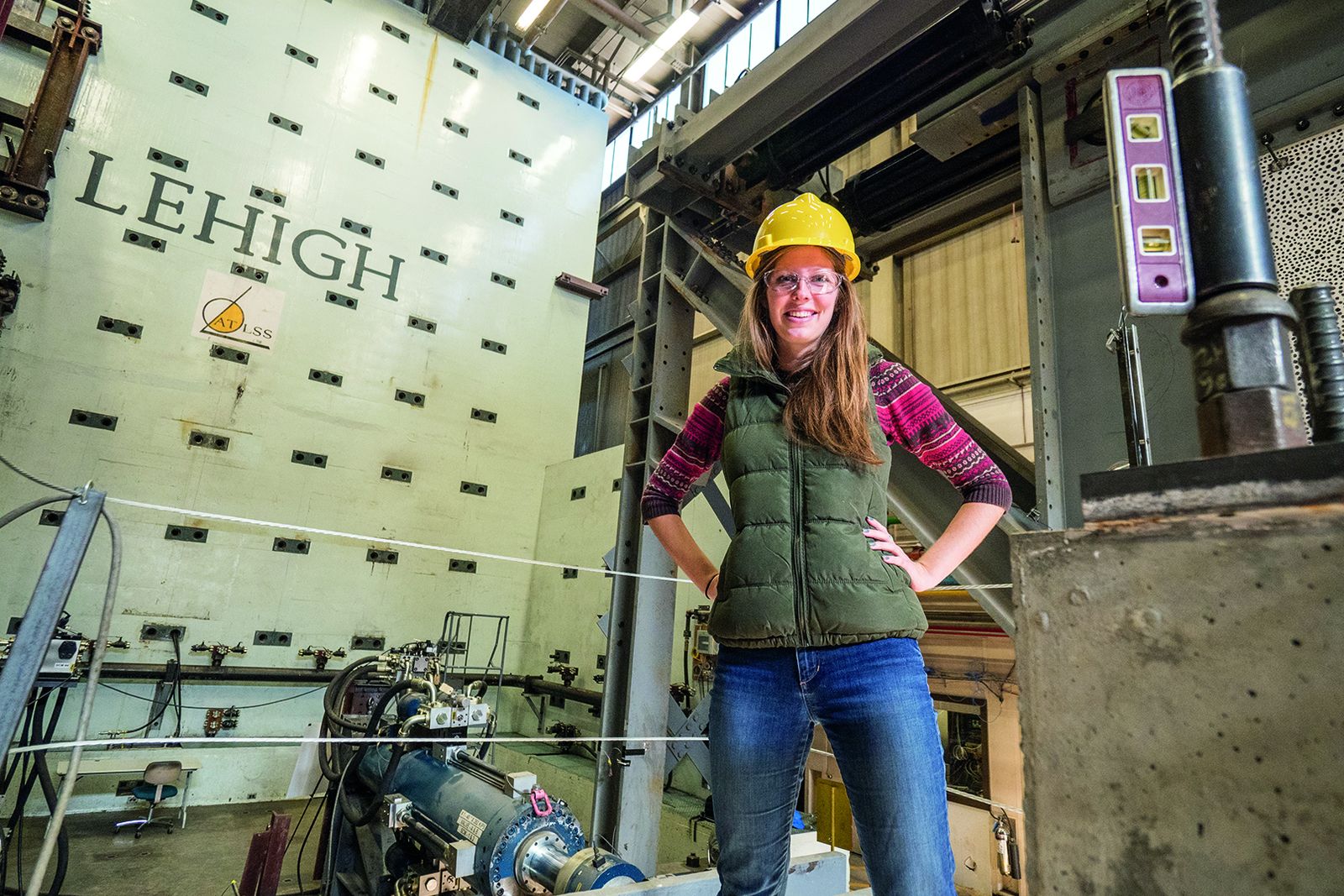
Research draws on Fritz Engineering Laboratory, home to a 5-million-pound universal hydraulic testing machine, and on the ATLSS Research Center, whose three-dimensional test bed is the largest in the U.S. Students use these facilities to simulate, measure and evaluate structures under realistic conditions, then take their results into practice, government and the university classroom.
The Department of Civil and Environmental Engineering maintains the authoritative program detail. See the department page.
Research
Research on the structures society relies on
Together, the department’s faculty and doctoral students address large, complex problems in the nation’s built environment: making buildings and other structures withstand earthquakes and other hazards, developing advanced materials and systems, and keeping infrastructure dependable over its full life.
Advanced Materials and Structural Systems
Large structures succeed or fail on the performance of their materials and systems. This work develops advanced structural materials and systems, then tests them analytically and experimentally in some of the largest structural testing facilities in North America, so that designs are checked against evidence.
Focus topics: Advanced structural materials and systems, Simulation, measurement and evaluation of new and in-service structures.
Hazard-Resistant Structures
Structures have to protect the people inside them when the ground shakes or a hazard strikes. Researchers study how structures respond to earthquake loading and other hazards and develop methods that make them more resistant, using full-scale testing to validate their ideas.
Focus topics: Earthquake resistant structures, Infrastructure hazard mitigation.
Intelligent and Reliable Infrastructure
Infrastructure serves communities for generations, so how it is monitored and maintained matters as much as how it is built. Work in this area develops intelligent infrastructure systems that sense and report on their condition, and it studies reliability, maintenance and life-cycle performance.
Focus topics: Intelligent infrastructure systems, Infrastructure reliability, maintenance, and life-cycle performance.
Research facilities
Fritz Engineering Laboratory
Home to a 5-million-pound universal hydraulic testing machine.
ATLSS Research Center
Advanced Technology for Large Structural Systems, the largest three-dimensional test bed in the U.S.
Degree requirements
What the doctorate requires
A minimum of 72 credits beyond a bachelor’s degree, or a minimum of 48 credits if a prior technical master’s degree was earned at another institution. Lehigh publishes the following complete set of requirements.
- Credit hours
Doctoral students complete a minimum of 72 credits beyond a bachelor’s degree, or a minimum of 48 credits when a prior technical master’s degree was earned at another institution.
- Grade standards
Doctoral students in the CEE department are held to the grade requirements the Rossin College sets for master’s students. You need a C- or better in all classes, a B- or better in at least 18 credits, and a B- or better in all 300-level CEE classes. Receiving more than four grades below B- in courses numbered 200 or higher makes you ineligible to qualify for the degree or to register for further 400-level courses, and 200-level CEE courses do not count toward the PhD.
- Coursework
You have flexibility in choosing courses, subject to at least 20 credits of technical coursework. The technical electives, 20 to 30 credits in all, come from CEE or other relevant areas at the 300 and 400 level. Dissertation credits (CEE 499) or Maintenance of Candidacy credits (ENGR 499) account for the remainder of the 48 or 72 credits.
- Courses that cannot be counted
Courses with an ESLP or EAPC subject code, master’s thesis credits (CEE 491), the undergraduate-only courses CEE 364 (Advanced Project Management) and CEE 385 (Research Procedures Seminar), ENGR 492 (Summer Research) and ENGR 496 (Summer Work Experience) are excluded from the degree requirements.
- Qualifying examination
The structural engineering faculty administer a course-based exam with a written part and an oral part, designed to show that a candidate has the ability, motivation and grasp of structural engineering fundamentals to finish the PhD. It covers dynamics, mechanics of materials, stability, structural analysis, concrete materials and structures, and steel materials and structures. Take it at the first offering, typically in January, after earning your master’s degree, or at the end of your first semester in residence at Lehigh if your master’s degree is from another university. Direct PhD students may petition to take it after their first semester but must take it before their sixth semester. A student who fails may retake it within one semester, typically in May.
- Research plan defense
Under your research advisor’s supervision, you write a tentative plan of the research you will carry out. Submit it within one year of forming your PhD committee and no less than twelve months before graduation, circulate it to the committee at least one week before you present it orally, and obtain signatures from each committee member and the department chairperson. You then submit the completed program of study to the Rossin College.
- General examination
Taken once coursework is essentially complete and before you are deep into your dissertation, the general exam is administered by your PhD committee. Take it preferably at least one year before your expected graduation, and pass it at least seven months before the degree is awarded. The written part normally lasts five calendar days and presents open-ended problems, at least one testing your ability to do independent research. The oral part comes one to three weeks later, focuses on defending your ideas before a group, and normally runs no more than 90 minutes. If the committee cannot reach a clear decision it may continue the exam for up to three months, and after a failure you may try again no sooner than five months later.
- Admission to candidacy
A successful research plan defense admits you to candidacy.
- Dissertation and defense
Candidates present their results in a public dissertation defense open to questions from the whole audience. The PhD committee then continues its examination of your work in a private session and decides whether the dissertation has been successfully defended.
Careers
Where structural engineering graduates work
Structural engineering alumni design and evaluate the large structures that communities rely on, and many lead the firms that build them.
Most Lehigh structural engineering alumni work in engineering firms, construction and consulting, with others in higher education, information technology and finance. Typical roles include structural engineer, project engineer, senior engineer, project manager and principal engineer, and many advance to senior associate, principal and vice president. Others join university faculty, where doctoral research experience is the foundation for a teaching and research career.
Employers where our alumni most often work include:
- Thornton Tomasetti
- AECOM
- Simpson Gumpertz & Heger
- WSP
- Walter P Moore
- Wiss, Janney, Elstner Associates
- HNTB
- Kiewit
Alumni also work at OConnell, Stantec, HDR, Jacobs, McLaren Engineering Group, DeSimone Consulting Engineering and KL&A Engineers and Builders.
Based on current employers of Lehigh structural engineering alumni, all degree levels, who graduated between 1997 and 2025.
Funding
Financial support
All PhDs at the Rossin College are 100% fully-funded, however, funding sources may vary by department. Funding covers PhD tuition and a stipend.
The Department of Civil and Environmental Engineering does not publish program-specific stipend or assistantship figures; ask the graduate contact below what funding looks like for this program.
- PhD applicants wishing to be considered for financial assistance should submit a complete application no later than December 15 for a fall semester start.
- Named opportunities open to Rossin College doctoral students include the Rossin Research Scholars program, Pasteur PhD Partners (P3), and the SEED-EF NSF National Research Traineeship, see special opportunities for Lehigh PhD students.
- Financial aid for Lehigh’s graduate programs consists mainly of fixed-rate federal student loans through the Office of Financial Aid.
- Loan eligibility requires enrollment at least half-time, six credits during the academic year, three credits in summer.
- Emergency loans and grants are available through the Graduate Life Office.
Admissions
How to apply
Applications for admission, all semesters, all levels, are completed online. Applications open September 1; PhD applications for fall admission are due December 15 for financial aid consideration.
Application open dates and deadlines are determined by individual departments. Contact the department concerning relevant deadlines and available start terms.
What to submit
- Completed online application
- Official transcripts (with English translation for international applicants)
- Statement of purpose / essay
- Letters of recommendation (typically three)
- Résumé or CV
- Application fee of $50 USD
Civil and Environmental Engineering requirements
- Prior degree: At least a bachelor’s degree, or the equivalent from a foreign institution of higher education, at the time you matriculate.
- GPA: A GPA (US equivalent) of at least 3.0 on a 4.0 scale is preferred, applying the same standard to international institutions. A trend of strengthening core GPA across your final semesters of study is considered.
- Deadline: December 15 for a summer, spring or fall start.
GRE scores are neither accepted nor reviewed for any Rossin College graduate program.
English proficiency minimums
| Test | Minimum score |
|---|---|
| TOEFL iBT | Overall 81 (old scale) / 4 (new scale); Speaking 22/4, Writing 20/4, Reading 20/4, Listening 16/4 |
| IELTS | Overall 6.5; Speaking 6.5, Writing 6, Reading 6.5, Listening 6 |
| Duolingo English Test | Overall 125; Speaking 125, Writing 120, Reading 125, Listening 110 |
| Cambridge | Overall 176; Speaking 176, Writing 169, Reading 176, Listening 169 |
| Pearson (PTE) | Overall 68, with 53 or higher on each band |
Scores expire two years from the test date. MyBestScore and One Skill Retake formats are not accepted. Waivers are available for applicants who are citizens or permanent residents of an English-speaking country, earned a U.S. degree with two or more years of in-person study, earned a degree taught in English in an English-speaking country, or studied or worked full-time in an English-speaking country for two or more years within the last five.
Questions
Frequently asked questions
What does the PhD in Structural Engineering focus on?
The program focuses on analytical and experimental studies of structural behavior. Doctoral students develop the capability to design and construct complex, large-scale structural systems, and they also receive training in project management, scientific communication and leadership.
Which department at Lehigh offers the PhD in Structural Engineering?
The PhD in Structural Engineering is offered by Lehigh University’s Department of Civil and Environmental Engineering, within the P.C. Rossin College of Engineering and Applied Science. Full program detail, faculty and current requirements are maintained on the department’s own page: https://engineering.lehigh.edu/cee/graduate/structural-engineering-ms-phd
How long does the PhD in Structural Engineering take?
5 to 5.5 years. Students who enter with a prior technical master’s degree from another institution need a minimum of 48 credits rather than 72.
How many credits does the PhD in Structural Engineering require?
A minimum of 72 credits beyond a bachelor’s degree, or a minimum of 48 credits if a prior technical master’s degree was earned at another institution.
Can I apply with only a bachelor’s degree?
Yes. Applicants must hold at least a bachelor’s degree, or the equivalent from a foreign institution, by the time they matriculate. Students who enter with a bachelor’s degree complete a minimum of 72 credits, while those with a technical master’s degree from another institution complete a minimum of 48.
What GPA should I have?
A GPA (US equivalent) of at least 3.0 on a 4.0 scale is preferred, and GPA standards for international institutions are followed accordingly. A strengthening trend in your final semesters of study is also considered.
Is the GRE required for the PhD in Structural Engineering?
No. GRE scores are neither accepted nor reviewed for any P.C. Rossin College of Engineering and Applied Science graduate program.
What is the application deadline for the PhD in Structural Engineering?
December 15 for a summer, spring or fall start. At the college level, PhD applications for fall admission are due December 15 for financial aid consideration, and applications open September 1. Application open dates and deadlines are determined by individual departments. Contact the department concerning relevant deadlines and available start terms.
Is the PhD in Structural Engineering funded?
All PhDs at the Rossin College are 100% fully-funded, however, funding sources may vary by department.
What subjects does the qualifying exam cover?
The exam, which has written and oral parts, covers dynamics, mechanics of materials, stability, structural analysis, concrete materials and structures, and steel materials and structures. It is administered by the structural engineering faculty and designed to show that you have a sound grasp of structural engineering fundamentals.
What if I do not pass the qualifying exam?
A student who fails may retake the exam within one semester, typically in May. Direct PhD students may petition to take the exam after their first semester and must take it before their sixth semester.
How is the general exam different from the qualifying exam?
The qualifying exam tests fundamentals early in your studies. The general exam comes once coursework is essentially finished and before you are deep into your dissertation, and it combines a written part of normally five calendar days with an oral part that runs no more than 90 minutes. It must be passed at least seven months before the degree is awarded.
How much of the degree is coursework?
At least 20 credits of technical coursework are required, and technical electives run from 20 to 30 credits at the 300 and 400 level. Dissertation credits and Maintenance of Candidacy credits make up the rest of the 48 or 72 credits.
Which facilities support structural research?
Fritz Engineering Laboratory houses a 5-million-pound universal hydraulic testing machine, and the ATLSS Research Center has the largest three-dimensional test bed in the U.S.
Where do structural engineering alumni work?
Alumni work at engineering and consulting firms, construction companies, universities and in finance and information technology. Titles include structural engineer, project manager, principal engineer, senior bridge engineer and professor.
Who do I contact about the PhD in Structural Engineering?
Julie DeMotte, jud200@lehigh.edu is the graduate contact for the Department of Civil and Environmental Engineering. The department can be reached at incee@lehigh.edu or (610) 758-3530. General Rossin College graduate inquiries go to engineering@lehigh.edu.
What courses do students take in the PhD in Structural Engineering?
Courses students can choose from include Mechanics and Behavior of Structural Members, Structural Reliability of Components and Systems, Analysis and Design of Steel and Composite Structural Members, Analysis and Design of Ductile Steel Structural Systems, Structural Behavior Laboratory, and Life-Cycle of Structural Systems, among others. Coursework is planned with your advisor and doctoral committee, and the Lehigh course catalog carries the current requirements.
Contact
Talk to the department
Department of Civil and Environmental Engineering
Graduate contact
Julie DeMotte · jud200@lehigh.edu
Address
Fritz Engineering Laboratory
13 East Packer Avenue
Bethlehem, PA 18015-3176
Phone and email
(610) 758-3530
incee@lehigh.edu
P.C. Rossin College of Engineering and Applied Science
19 Memorial Drive West
Bethlehem, PA 18015
engineering@lehigh.edu
More from the department