
Doctoral program · Rossin College
PhD in Bioengineering
The PhD in Bioengineering at Lehigh University’s P.C. Rossin College of Engineering and Applied Science is a research doctorate that prepares critical thinkers, problem solvers and innovators to generate new knowledge at the interface of the physical and life sciences and engineering.
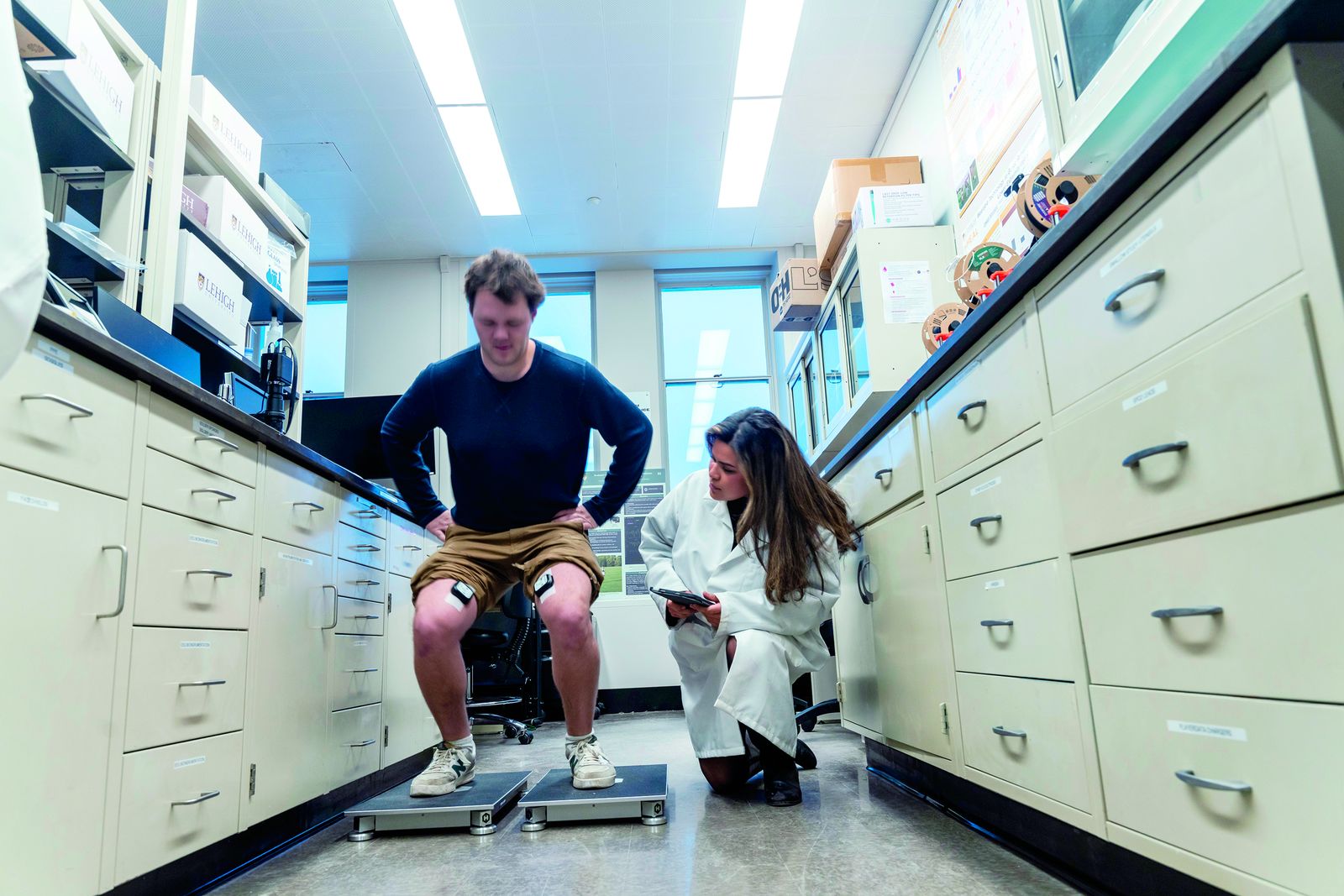
- Degree awardedDoctor of Philosophy in Bioengineering
- DepartmentBioengineering
- Typical time to degree5 to 5.5 years
- Credit hours72 minimum
- Fall deadlineDecember 15
- GRENeither accepted nor reviewed
- Application fee$50 USD

Overview
What the PhD in Bioengineering is
Doctoral students come to the program from engineering and science backgrounds that include biomedical, chemical, electrical and mechanical engineering, physics, materials science, biochemistry and biology. The program emphasizes academic rigor and quantitative problem-solving for biomedical applications, and it develops leaders and life-long learners who can keep pace as the field changes.
After a core of mathematics or statistics, scientific communication and life sciences coursework, your time shifts toward research with a faculty advisor. A qualifying exam early in the program, a thesis committee that includes a faculty member from outside the department, and annual progress updates give you regular feedback, and your dissertation must show that you have generated new and significant bioengineering knowledge.
The Department of Bioengineering maintains the authoritative program detail. See the department page.
Research
Research toward diagnostics and therapies for affordable healthcare
Faculty and doctoral students across all three thrusts take on some of the largest and most complex problems in health: finding disease earlier, creating therapies that repair or replace damaged tissue, treating neurological conditions, and turning biological data into care that is affordable and tailored to each patient.
Biocomputations and Modeling
Living systems generate far more data than people can interpret unaided. Researchers in this thrust build models and analytics that predict how molecules, cells and biological systems behave, and apply them to biomedical images and health data.
Focus topics: Biomolecular Modeling, Bioinformatics, Systems and Controls, Machine Learning, Data Analytics, Biomedical Image Analysis.
Diagnostics, Sensors and Devices
Earlier and less invasive diagnosis depends on better tools. This thrust develops imaging, sensing and diagnostic technologies and the medical devices that help identify, treat and prevent disease, with a focus on making care more affordable.
Focus topics: Biomedical Imaging, Biophotonics, BioMEMS, Biosensors, Microfluidics, Bioelectronics, Medical Devices.
Materials and Therapies
Many new therapies begin with new materials. Work in this thrust spans biomaterials and nanomaterials, tissue engineering to repair damaged tissue, neuroengineering for neurological conditions, and the mechanics of biological fluids.
Focus topics: Biomaterials, Nanomaterials, Tissue Engineering, Neuroengineering, Biofluid Mechanics.
Degree requirements
What the doctorate requires
A minimum of 72 credits beyond a bachelor’s degree, or 48 credits with a prior related master’s degree from another institution. Lehigh publishes the following complete set of requirements.
- Credit hours
A minimum of 72 credits beyond a bachelor’s degree, or 48 credits with a prior related master’s degree from another institution. Per university policy, no more than 12 credits at the 300 level count toward the PhD. You register for at least 9 credits per semester until you reach the required credits and are admitted to candidacy.
- Mathematics or statistics
One of BIOE 452 Mathematical Methods In Engineering I, BIOE 415 Bioengineering Statistics, or BIOE 463 Numerical Methods for Scientists and Engineers (3 credits).
- Communications
BIOE 455 Scientific and Professional Communications for Bioengineers (3 credits).
- Life sciences
One of BIOE 410 Advanced Engineering Physiology or BIOE 445 Quantitative Biology (3 credits).
- Technical electives
15 credits of courses at the 300 or 400 level, chosen from bioengineering courses or science and engineering courses offered by other departments. Dissertation, thesis, research project, independent study, seminar and professional development courses do not count as technical electives.
- Dissertation research
Six credits of BIOE 499 dissertation research, which is repeatable for up to 9 credits per semester. The remaining credits needed to reach 48 or 72 come from electives or additional dissertation research.
- Qualifying examination
You must pass the qualifying exam before the start of your third year, and most students take it after completing their core courses, at the beginning of the third semester. A student with a GPA above 3.00 but below 3.25 may take the exam once. A student with a GPA of 3.25 or above may take it twice if the first attempt is not successful.
- Thesis committee
Form your thesis committee no more than six months after you pass the qualifying exam. It includes bioengineering faculty members and at least one faculty member from outside the department, and you update the committee on your research progress every year to obtain feedback.
- General exam and research plan defense
A single exam, given by your thesis committee, tests your proficiency in your field of study and your defense of a research plan. Schedule it no later than seven months before your dissertation defense. Beforehand, you submit a written plan that describes in detail the research that will form the basis of your dissertation, and you then present and defend that plan orally.
- Admission to candidacy
After you pass the exam and the committee accepts your research plan, you may be admitted to PhD candidacy. Once you reach the required credits, you no longer need to register for 9 credits every semester. If 3 or more credits are still needed, register for at least 3 until 2 or 1 remain. When fewer than 3 remain, register for Maintenance of Candidacy (ENGR 499, 1 credit) every semester.
- Dissertation and defense
A written dissertation and an oral defense that follows the format of the earlier exam. Both must demonstrate that you have generated new and significant bioengineering knowledge.
- Courses that do not count
ENGR 492 Summer Research and ENGR 496 Summer Work Experience may not be counted toward the PhD.
Year by year
| Year | Milestone |
|---|---|
| Year 1 | Core courses, research group selection, partnering with an advisor, skill development. |
| Year 2 | Balance coursework and research; complete the PhD qualifying exam. |
| Year 3 | Dissertation development, publications, and a formal presentation milestone. |
| Year 4 | Research continues; Proposal Exam. |
| Year 5 | Dissertation defense. |
Curriculum
Core and required courses
| Code | Course | Focus |
|---|---|---|
| BIOE 452 | Mathematical Methods In Engineering I | Analytical math methods for engineering sciences. |
| BIOE 415 | Bioengineering Statistics | Probability and statistics for bioengineering. |
| BIOE 463 | Numerical Methods for Scientists and Engineers | Numerical methods for scientists and engineers. |
| BIOE 455 | Scientific and Professional Communications for Bioengineers | Scientific communication for bioengineers. |
| BIOE 410 | Advanced Engineering Physiology | Graduate-level engineering physiology. |
| BIOE 445 | Quantitative Biology | Graduate-level quantitative biology. |
Careers
Where graduates work
Bioengineering alumni lead research and development where engineering meets biology and medicine.
Most of our alumni work in the life sciences, and others work in higher education, health care, information technology, finance and manufacturing. Common roles include postdoctoral researcher, scientist, senior scientist, associate principal scientist, bioinformatics researcher, optical engineer, project manager and associate director, and some alumni move into management and executive roles such as head of engineering.
Employers where our alumni most often work include:
- Merck
- Johnson & Johnson
- Regeneron
- Bristol Myers Squibb
- GSK
- Takeda
- Stryker
- University of Pennsylvania
Alumni also work at Ionis Pharmaceuticals, Cabaletta Bio, the University of Connecticut, Aptitude Medical Systems, Sygnomics, Cellanome and David Geffen School of Medicine at UCLA.
Based on current employers of Lehigh bioengineering alumni, all degree levels, who graduated between 1996 and 2025.
Funding
Financial support
All PhDs at the Rossin College are 100% fully-funded, however, funding sources may vary by department. Funding covers PhD tuition and a stipend.
The Department of Bioengineering does not publish program-specific stipend or assistantship figures; ask the graduate contact below what funding looks like for this program.
- PhD applicants wishing to be considered for financial assistance should submit a complete application no later than December 15 for a fall semester start.
- Named opportunities open to Rossin College doctoral students include the Rossin Research Scholars program, Pasteur PhD Partners (P3), and the SEED-EF NSF National Research Traineeship, see special opportunities for Lehigh PhD students.
- Financial aid for Lehigh’s graduate programs consists mainly of fixed-rate federal student loans through the Office of Financial Aid.
- Loan eligibility requires enrollment at least half-time, six credits during the academic year, three credits in summer.
- Emergency loans and grants are available through the Graduate Life Office.
Admissions
How to apply
Applications for admission, all semesters, all levels, are completed online. Applications open September 1; PhD applications for fall admission are due December 15 for financial aid consideration.
Application open dates and deadlines are determined by individual departments. Contact the department concerning relevant deadlines and available start terms.
What to submit
- Completed online application
- Official transcripts (with English translation for international applicants)
- Statement of purpose / essay
- Letters of recommendation (typically three)
- Résumé or CV
- Application fee of $50 USD
Bioengineering requirements
- Prior degree: At least a bachelor’s degree, or the equivalent from a foreign institution, or a master’s degree in engineering or science, by the time you enroll.
- GPA: An undergraduate GPA of at least 3.00 on a 4.00 scale, with GPA standards for international institutions followed accordingly. A GPA of at least 3.00 for the last two semesters of undergraduate study, or at least 3.00 in a minimum of 12 hours of graduate work at other institutions, also meets the standard.
- Review: The graduate program director reviews each application as a whole, in consultation with program faculty.
- Deadline: Applications are due December 15.
GRE scores are neither accepted nor reviewed for any Rossin College graduate program.
English proficiency minimums
| Test | Minimum score |
|---|---|
| TOEFL iBT | Overall 81 (old scale) / 4 (new scale); Speaking 22/4, Writing 20/4, Reading 20/4, Listening 16/4 |
| IELTS | Overall 6.5; Speaking 6.5, Writing 6, Reading 6.5, Listening 6 |
| Duolingo English Test | Overall 125; Speaking 125, Writing 120, Reading 125, Listening 110 |
| Cambridge | Overall 176; Speaking 176, Writing 169, Reading 176, Listening 169 |
| Pearson (PTE) | Overall 68, with 53 or higher on each band |
Scores expire two years from the test date. MyBestScore and One Skill Retake formats are not accepted. Waivers are available for applicants who are citizens or permanent residents of an English-speaking country, earned a U.S. degree with two or more years of in-person study, earned a degree taught in English in an English-speaking country, or studied or worked full-time in an English-speaking country for two or more years within the last five.
Questions
Frequently asked questions
Which department at Lehigh offers the PhD in Bioengineering?
The PhD in Bioengineering is offered by Lehigh University’s Department of Bioengineering, within the P.C. Rossin College of Engineering and Applied Science. Full program detail, faculty and current requirements are maintained on the department’s own page: https://engineering.lehigh.edu/bioe/graduate/program-info
What is the PhD in Bioengineering at Lehigh?
It is a research doctorate that prepares students to be critical thinkers, problem solvers, innovators, leaders and life-long learners in bioengineering. Students produce research and new knowledge at the interface of the physical and life sciences and engineering, with research thrusts in biocomputations and modeling, diagnostics, sensors and devices, and materials and therapies.
How long does the PhD in Bioengineering take?
5 to 5.5 years. Doctoral students register for at least 9 credits per semester until they reach the required credits and are admitted to candidacy.
How many credits does the PhD in Bioengineering require?
A minimum of 72 credits beyond a bachelor’s degree, or 48 credits with a prior related master’s degree from another institution.
Do I need a master’s degree to apply to the PhD in Bioengineering?
No. You need at least a bachelor’s degree, or the equivalent from a foreign institution, by the time you enroll, and a master’s degree in engineering or science also qualifies. A prior related master’s degree from another institution lowers the credit requirement from 72 credits to 48.
What GPA do I need to apply to the PhD in Bioengineering?
An undergraduate GPA of at least 3.00 on a 4.00 scale, with GPA standards for international institutions followed accordingly. A GPA of at least 3.00 for your last two semesters of undergraduate study, or at least 3.00 in a minimum of 12 hours of graduate work at other institutions, also meets the standard.
Is the GRE required for the PhD in Bioengineering?
No. GRE scores are neither accepted nor reviewed for any P.C. Rossin College of Engineering and Applied Science graduate program.
What is the application deadline for the PhD in Bioengineering?
Applications are due December 15. At the college level, PhD applications for fall admission are due December 15 for financial aid consideration, and applications open September 1. Application open dates and deadlines are determined by individual departments. Contact the department concerning relevant deadlines and available start terms.
What English proficiency scores are required?
International applicants must meet Lehigh’s minimum scores: TOEFL iBT overall 81 (old scale) or 4 (new scale); IELTS overall 6.5; Duolingo English Test overall 125; Cambridge overall 176; or Pearson (PTE) overall 68. Scores expire two years from the test date. Waivers are available in defined circumstances.
Is the PhD in Bioengineering funded?
All PhDs at the Rossin College are 100% fully-funded, however, funding sources may vary by department.
What courses does the PhD in Bioengineering require?
Each doctoral student takes one methods course (Mathematical Methods In Engineering I, Bioengineering Statistics, or Numerical Methods for Scientists and Engineers), Scientific and Professional Communications for Bioengineers, and either Advanced Engineering Physiology or Quantitative Biology. Each of those three requirements carries 3 credits. You also take 15 credits of technical electives and 6 credits of dissertation research, then add electives or dissertation research to reach the credit total.
When do I take the qualifying exam, and can I retake it?
You must pass the qualifying exam before the start of your third year, and most students take it after completing their core courses, at the beginning of the third semester. Students with a GPA above 3.00 but below 3.25 may take the exam once. Students with a GPA of 3.25 or above may take it twice if they do not pass the first time.
What happens after I pass the qualifying exam?
You form a thesis committee within six months. It includes bioengineering faculty and at least one faculty member from outside the department, and you update it on your progress every year. You then take a combined general exam and research plan defense, scheduled no later than seven months before your dissertation defense. After the committee accepts your plan you can be admitted to candidacy, and you finish by writing and defending a dissertation that shows you have generated new and significant bioengineering knowledge.
What research areas can I work in as a PhD in Bioengineering student?
Doctoral research is organized into three thrusts: Biocomputations and Modeling; Diagnostics, Sensors and Devices; and Materials and Therapies. Each is aimed at diagnostic and therapeutic technologies for affordable healthcare.
What careers do PhD in Bioengineering graduates pursue?
Most alumni work in the life sciences, and others work in higher education, health care, information technology and finance. Common roles include postdoctoral researcher, scientist, senior scientist, project manager and associate director.
Who do I contact about the PhD in Bioengineering?
The department can be reached at inbioe@lehigh.edu or (610) 758-4091. General Rossin College graduate inquiries go to engineering@lehigh.edu.
What courses do students take in the PhD in Bioengineering?
Required courses include Mathematical Methods In Engineering I, Bioengineering Statistics, Numerical Methods for Scientists and Engineers, Scientific and Professional Communications for Bioengineers, and Advanced Engineering Physiology, among others. Other courses students can choose from include Structural Bioinformatics, Genomics, Bioengineering Applications in Machine Learning, Introduction to Biomaterials, Soft Materials: Mechanics and Physics, and Soft Materials: Rheology and Characterization, among others. Coursework is planned with your advisor and doctoral committee, and the Lehigh course catalog carries the current requirements.
Contact
Talk to the department
Department of Bioengineering
Address
Sinclair Lab
7 Asa Drive, Suite 205
Bethlehem, PA 18015
Phone and email
(610) 758-4091
inbioe@lehigh.edu
P.C. Rossin College of Engineering and Applied Science
19 Memorial Drive West
Bethlehem, PA 18015
engineering@lehigh.edu
More from the department