
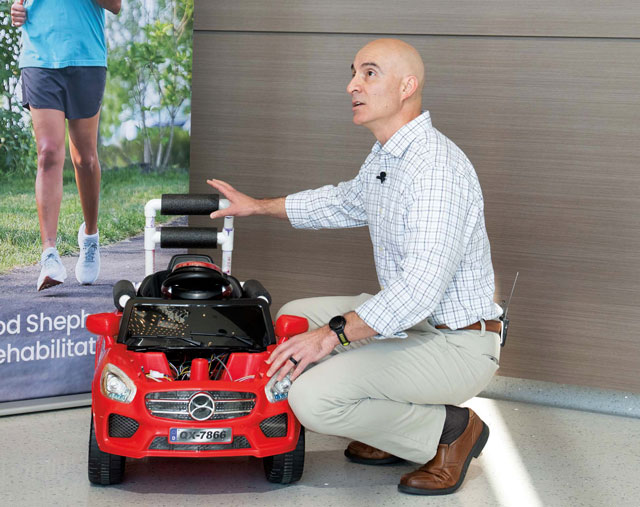
 Lehigh has formalized a partnership with Good Shepherd Rehabilitation to improve the lives of people living with disability. The rehabilitation network specializes in the treatment of spinal cord injury, brain injury, stroke, major multi-trauma, pulmonary disease, respiratory failure, musculoskeletal/orthopedics, and complex pediatric conditions.
The partnership, led by Lehigh’s College of Health (COH), creates new opportunities for engagement and collaboration across the university. COH and Rossin College faculty members have already partnered with Good Shepherd on multiple research projects.
“Growth of research and enhancing partnerships with regional and national organizations are important priorities within Lehigh’s Inspiring the Future Makers strategy,” says Nathan Urban, provost and senior vice president for academic affairs.
Good Shepherd Rehabilitation President and CEO Michael Spigel sees the partnership as an opportunity to turn research into practical solutions through new discoveries, techniques, and tools that make a difference in the lives of patients.
“This partnership is so exciting because it helps deeply integrate engineering, neuroscience, and data science expertise—all things Lehigh University excels at—directly into Good Shepherd’s programs and services for people with disabilities,” he says.
In August 2024, the institutions signed a Memorandum of Understanding outlining a 10-year vision that includes research collaborations, joint faculty appointments, and a seed program for new projects.
A milestone is the appointment of two joint faculty members, the first-of-its-kind hire for both institutions.
COH data scientist and motor control researcher Shirin Madarshahian studies how the brain and body control movement and uses data to improve clinical treatments for individuals with disability. Bioengineer Juan Aceros works on medical device solutions that enhance accessibility and independence for this population.
The partnership also advances Lehigh’s Center for Community-Driven Assistive Technologies, one of three new University Research Centers. CDAT aims to transform the lives of people with disabilities through interdisciplinary research and cutting-edge emerging and existing assistive technologies.
Even before the partnership was formalized, CDAT’s core faculty team engaged in discussion around shared space and models of collaboration with Good Shepherd.
“The synergy between Lehigh’s engineering and health colleges, combined with Good Shepherd’s clinical expertise, creates a powerful engine for innovation,” says Stephen P. DeWeerth, professor and the Lew and Sherry Hay Dean of Engineering. “It’s truly inspiring to witness the collaborative energy of our faculty, particularly the CDAT team. This partnership is a testament to their commitment to improving the lives of people with disabilities through innovation in technology.”
The partnership will allow Lehigh students to gain real-world training in rehabilitation and healthcare through internships and other opportunities at Good Shepherd. Early projects include a way-finding app that uses robotic mapping to improve indoor accessibility, wearable tech that helps people with dysphagia, and a community health needs assessment to understand the needs of people with autism and other neurodivergent conditions.