
 When the journal Engineering Structures named a Lehigh-led article one of its Best Papers of the Year for 2024, it wasn’t just an honor for a single study. It was recognition of decades of work that have positioned Lehigh as a global leader in structural simulation.
The winning paper, “Development of Multi-directional Real-Time Hybrid Simulation for Tall Buildings Subject to Multi-natural Hazards,” describes a framework for real-time hybrid simulation (RTHS) that makes it possible to capture how skyscrapers respond when earthquakes and strong winds strike together.
Tall buildings behave in unpredictable ways under natural hazards. Earthquakes and wind create non-linear, constantly shifting stresses that can’t be fully captured with conventional analysis. Hybrid simulation tackles that challenge by dividing a structural system into two subsystems: one modeled by a computer, the other tested physically in the lab. A simulation coordinator synchronizes the two in real time, producing a detailed picture of how the entire system reacts under changing conditions.
In this study, the team examined a 40-story building designed under California’s Tall Building Initiative guidelines. They combined earthquake records from the 1989 Loma Prieta quake with wind data generated at Florida International University’s “Wall of Wind,” and then ran a real-time hybrid simulation at Lehigh. The results confirmed that the method can reproduce the multi-directional demands on tall structures, capturing subtle interactions and failure points.
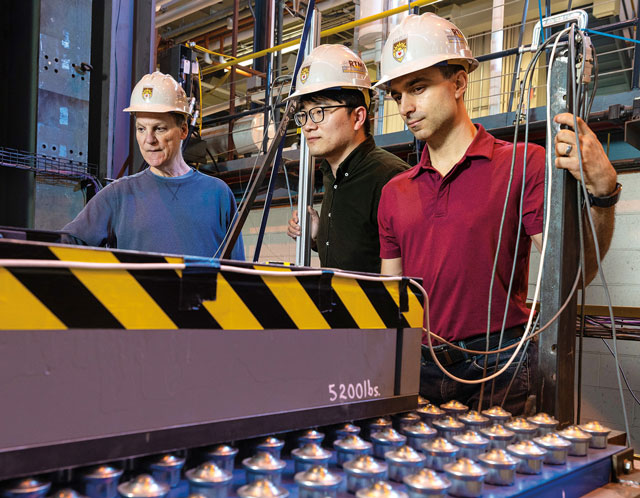
This level of testing is possible because of the capabilities at Lehigh’s Advanced Technology for Large Structural Systems (ATLSS) Engineering Research Center and the NSF-supported NHERI Lehigh Experimental Facility. Together, they provide the high-performance computing systems, dynamic servo-hydraulic actuators, and large-scale test beds required for sophisticated cyber-physical experiments.
“Our paper directly advances the core mission of the NSF NHERI Lehigh Experimental Facility and the ATLSS Center: to improve the sustainability and resilience of civil infrastructure,” says James M. Ricles, Bruce G. Johnston Professor of Structural Engineering and director of both facilities.
Ricles joined the faculty in 1992, and since then, Lehigh has steadily built the algorithms, hardware, and networks needed to support real-time hybrid simulation. What began as fundamental research two decades ago has evolved into an internationally recognized facility that anchors Lehigh’s leadership in structural resilience.
The award-winning project team includes then-PhD student Safwan Al-Subaihawi (now at Cal Poly San Luis Obispo); Spencer Quiel, an associate professor of structural engineering; and research scientist Thomas Marullo. The team’s work demonstrates not only the potential of the method itself, Ricles says, but also the value of the infrastructure developed at Lehigh to support it.