
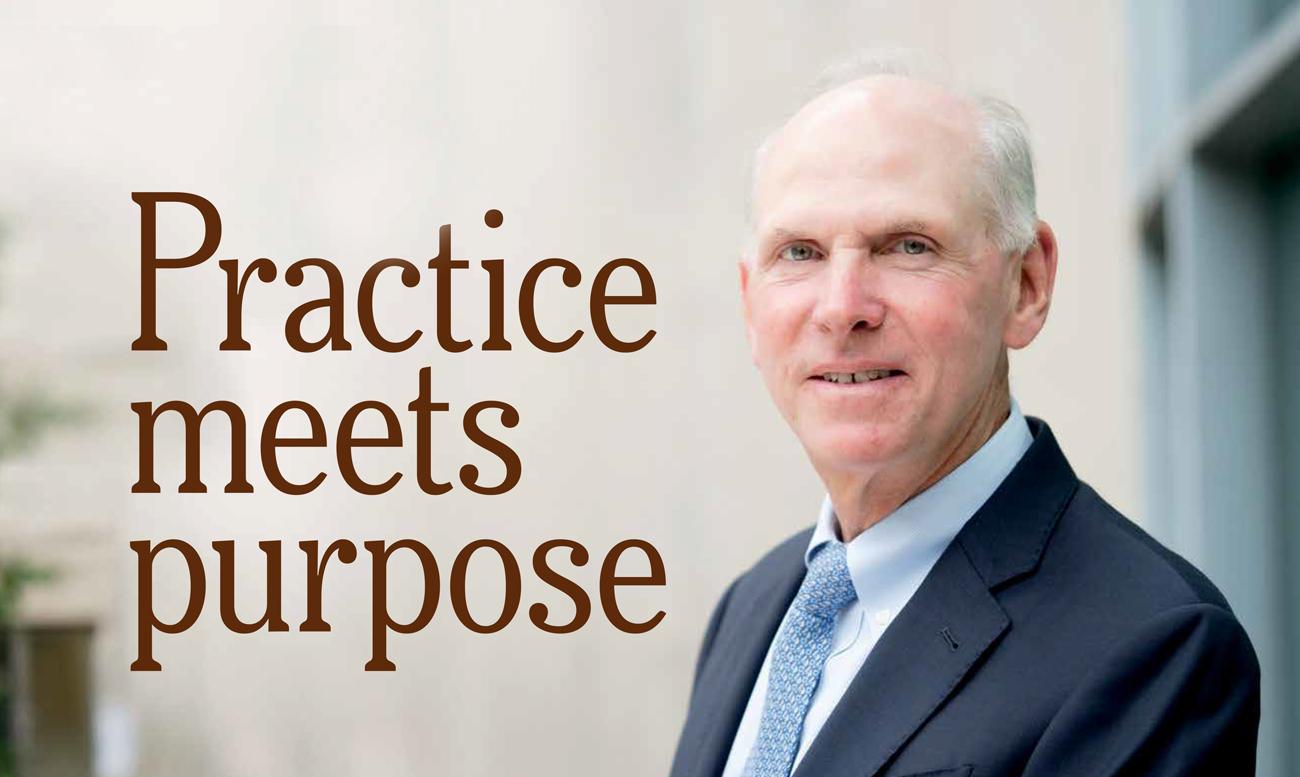
Andrew D. “Drew” Freed ’83 ’17P ’25P has long believed that engineering is about applying theory to real-world problems in ways that matter. As chairman and CEO of UTI Corporation, he and his team helped shape the emerging field of medical device development, producing some of the first minimally invasive surgical instruments for arthroscopy and designing intellectual property for a radiopaque stent visible under X-ray. These advances, as he puts it, “weren’t earth-shattering,” but they made a tangible difference for clinicians and patients alike.
That same belief has guided his philanthropy. Freed—who also served as CEO of Micro-Coax, Inc.; currently leads Freed Capital Partners, a boutique firm investing in the manufacturing of highly engineered products; and is a Lehigh Trustee—has endowed the David and Lorraine Freed Undergraduate Research Symposium, in honor of his parents, and created the Freed Family Robotics Design Studio in Wilbur Powerhouse. His two children are Lehigh Engineering alumni, and his giving supports initiatives that strengthen research and hands-on education, preparing graduates to bridge innovation with impact.
Q: What do students need most from their engineering education right now?
A: From my point of view, it’s all about having the facilities—and more specifically, the equipment and the capabilities—so they can build things and learn not only what to do, but what not to do. We need to return to fundamental engineering skills and to understanding how to apply those skills in a hands-on way. I think higher education has gotten away from that.
As an example, in my career, I’ve seen recent engineering graduates, hired from all over, walk through a tool and die shop and not know the difference between a mill and a lathe. You shouldn’t be able to get through engineering school as an undergraduate without knowing that difference.
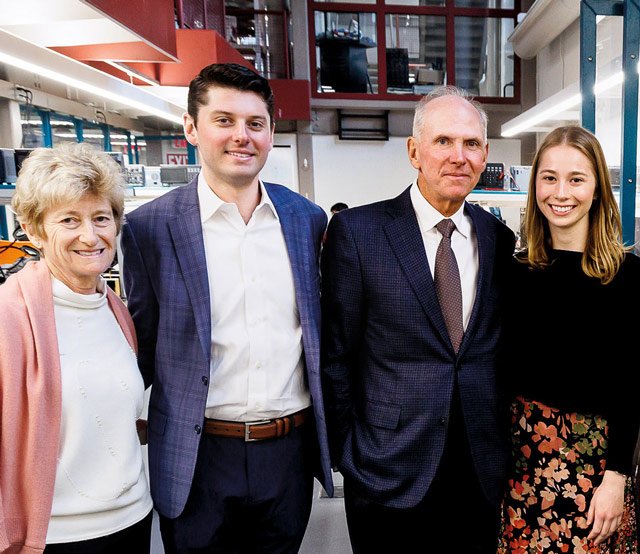 Q: The Robotics Design Studio is Lehigh’s newest Design Lab. What inspired you to support its creation?
A: We hired many engineers over my career, and the best were those who could combine theoretical knowledge with hands-on experience. I had been preaching that perspective to Dean [Steve] DeWeerth for a long ime, and he felt the same way. The robotics gift was an extension of previous efforts to help students understand how different pieces of equipment work, and how to combine classroom knowledge with hands-on experience so they can apply those skills in the real world. And that’s really what Wilbur Powerhouse is all about, right?
Now, through FYRE and the transformation of the first-year experience, eventually all engineering students will rotate through Wilbur. But I’ve already moved on from this. The real question is, what do we do next?
Q: In that case, what is next?
A: There’s a lot of work being done on the Mountaintop campus, where students are flying drones and taking the idea of fully autonomous vehicles to the next level. Advanced robotics is the next step in furthering undergraduate education and ensuring that when students graduate, they know how to use the equipment they’ll encounter in industry. The fundamental mechanics behind these technologies don’t change, but the automation that goes along with them changes a great deal. It’s important that our students have access to those technologies.
Q: What do you want students to gain from their experiences in the Robotics Studio?
A: An undergraduate engineering education should allow you to join industry and take off running. Back in the olden days, we had all kinds of training programs, and our new engineers would spend time in different business units. It would take them a while to get up to speed. Today, technologies are changing so quickly that we need young engineers to be on their game, adaptable to emerging technologies, and immediately productive. Those are the skills and mindsets that we’re instilling in the Robotics Studio.
Q: In what ways have you seen Lehigh evolve as a research university?
A: As an R1 research institution, we’ve hit the peak. We’ve come a long way, but we can’t rest on our laurels. Lehigh continues to invest in new faculty and emerging specialties so we can attract the research funding that will strengthen both our graduate and undergraduate academic programs.
Q: The Undergraduate Research Symposium recently marked its 20th year. How did you get involved?
A: The symposium was the brainchild of materials science and engineering professors Himanshu Jain and Wojciech Misiolek. They wanted more undergraduates to participate in fundamental research, which is critical for developing new ideas, inventions, and applications of technology. These all come from fundamental research. Throughout my career, we took interesting research and developed practical applications for it. The symposium needed funding to grow. My parents had recently passed, and education had been extremely important to them. I was the first in our family to go to college, so it was an easy decision to have them forever be the sponsors and champions of the Undergraduate Research Symposium.
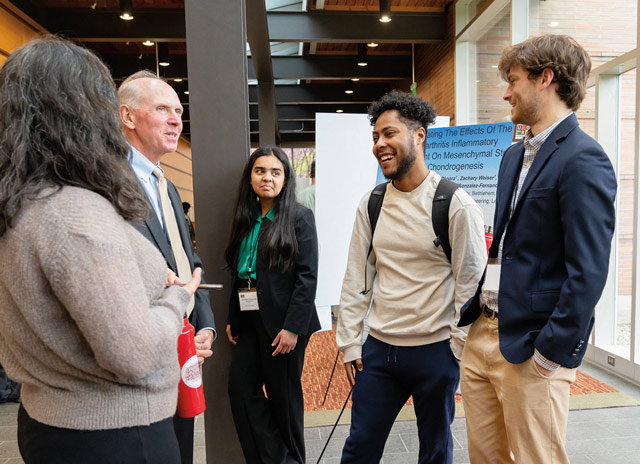 Q: What are the takeaways for symposium participants?
A: Focusing strictly on fundamental research gives students the opportunity to design novel experiments and approaches. In industry, if you’re not sure something will work, it’s wise to bring newer people onto the team. They don’t have blinders on and aren’t afraid of failure. More seasoned engineers often focus on why something won’t work instead of asking how we can make it work. It’s refreshing to see young engineers approaching problems this way.
At the symposium, the students present their research to a panel of very seasoned researchers. The judges ask difficult questions, and it’s fun to watch the students defend their work. Some even continue their projects through graduate school.
Q: Do you see philanthropy to Lehigh as an extension of your family values?
A: I do. Lehigh took a chance on me, and I’m forever appreciative of the education and experiences I had as an undergraduate studying metallurgy and materials engineering. I don’t consider myself a philanthropist, though. We’re just fortunate to be in a position to help people who need it—and it’s fun and rewarding. Nothing beats watching students use the tools you helped provide and seeing their excitement over their accomplishments.
With the problems in the world today, it’s easy to get down on humanity. But then I go into Wilbur Powerhouse, and the students show off their Mars rover project and explain how it works, how they redesigned the wheels...In that moment, I feel a sense of hope. I’m sure what’s going on in the world bothers them, too, but when they’re working on these projects, they’re engaged, thoughtful, and bright. It makes me think that if we work hard enough, maybe things will get better.
By funding initiatives like the Robotics Studio, we want to provide Lehigh students with the tools that can turn hope into an effective strategy to advance technology and humanity. The way the United States succeeds in the long run is by providing a high-quality education to people who really want it. We’re able to help with that, in a small way.