

In Lehigh’s Autonomous and Intelligent Robotics (AIR) Lab, researchers explore how autonomous systems can better collaborate with people and each other. This year, two AIR Lab–affiliated faculty members—Cristian-Ioan Vasile and David Saldaña—earned prestigious grants from the National Science Foundation’s Faculty Early Career Development (CAREER) program.
Vasile, an assistant professor of mechanical engineering and mechanics, is developing ways to assess and plan around robot capabilities, enabling teams of machines—such as self-driving vehicles, drones, and robotic assistants transforming industries from transportation and logistics to healthcare—to function safely and effectively in complex environments.
Even as advances in hardware and artificial intelligence allow these agents to perceive and reason more effectively, deploying them in dynamic, real-world settings—and getting them to do what we want—remains difficult.
“The overarching problem deals with robot capabilities,” says Vasile. “Complex interactions between new hardware and new software that comes from machine learning–based approaches create new problems regarding how to use these components, like how to assign them tasks.”
His NSF CAREER–funded research will develop structured methods for assessing the capabilities of learning-enabled agents and will use that information to improve the planning and coordination of robots working in teams, accounting for how performance varies depending on time, location, and situational context.
“It’s not just about whether a robot has a camera or an arm,” says Vasile. “We want to know if it can still operate in the dark, in a crowded space, or navigate a narrow corridor.”
His approach involves three main tasks: creating a formal framework to describe and learn an agent’s “capability profile”; designing planning methods that move beyond binary assumptions of capability; and detecting—and quickly recovering from—failures. Such dynamic reassessment is essential for safe, large-scale deployment of autonomous systems.
The ultimate goal, says Vasile, is to enable widespread use of robots that are both efficient and effective—not to replace humans, but to augment them.
“A lot of the jobs that robots could do are ones in which there are currently worker shortages, or that are dangerous or hazardous to human health,” he says. “In places where demographics are shifting and birth rates are declining, robots could potentially perform physical, strenuous work, which could free older adults to do more creative work.”
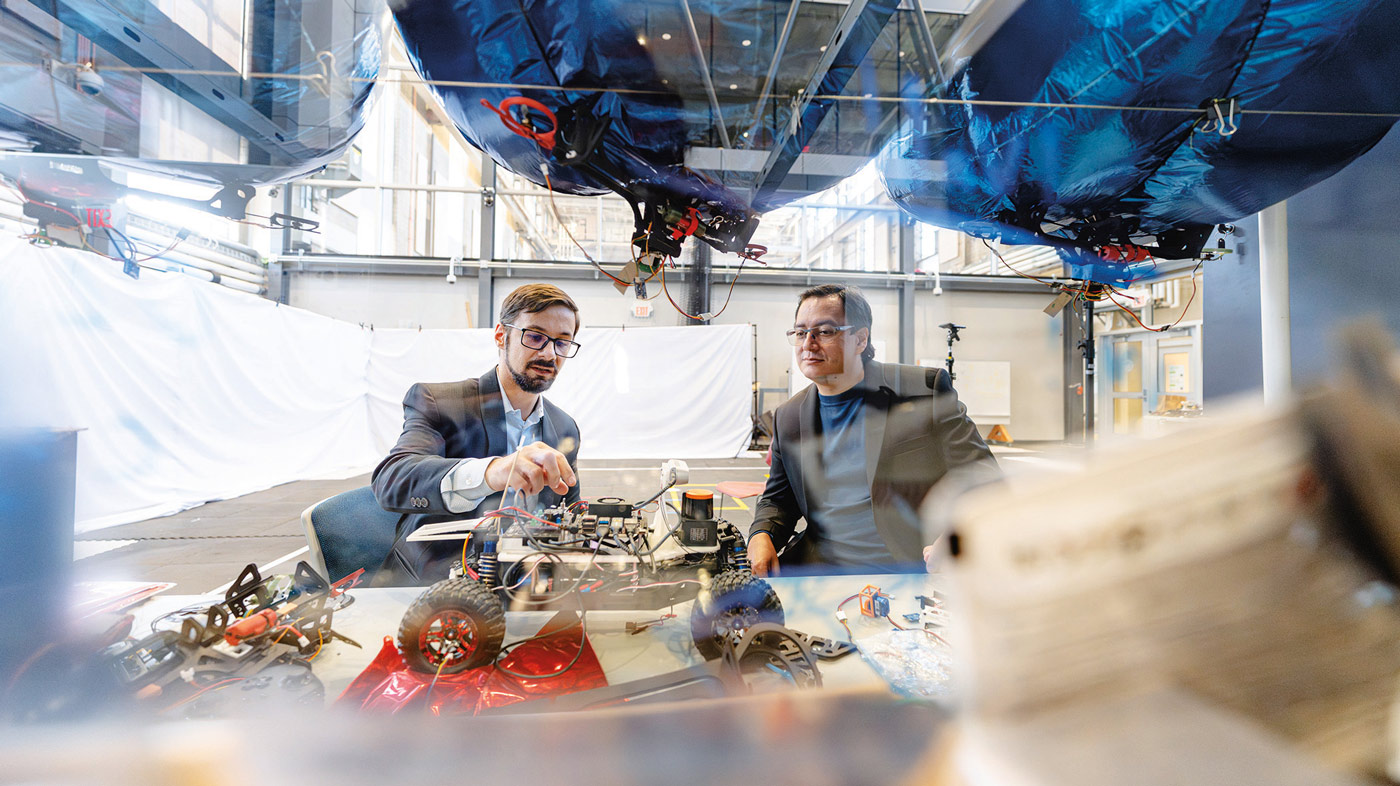 Creative thinking plays a key role in Saldaña’s NSF CAREER project. The assistant professor of computer science and engineering, who also leads the SwarmsLab, is taking inspiration from the natural world to design drones that can manipulate flexible objects.
“I was walking my dog and watching a squirrel jump from tree branch to tree branch,” he says. “I started thinking about how quickly the animal has to adapt to the properties of each branch and to the forces generated by their movement. How could we get robots, especially aerial robots, to adapt like that?”
Saldaña is exploring how to expand the capabilities of aerial robots so they can manipulate and transport flexible objects such as cables, rods, hoses, and plastic sheets. Potential applications include construction, disaster response, and industrial automation.
Currently, aerial robots are limited to manipulating rigid objects, like boxes, because the dynamic and unpredictable forces associated with flexible materials present unique challenges.
Saldaña and his team are developing a novel methodology that integrates control systems and reinforcement learning to maintain stability, enable rapid learning, and ensure time-critical recovery.
“This integration and the ability to learn quickly means that the robot won’t need to do something thousands of times before it can move one of these flexible objects,” he says. “The more pieces it moves, the more efficient it becomes.”
The project begins with an adaptive controller that ensures stability and provides real-time compensation for external forces without prior knowledge of an object’s material properties. The controller establishes a baseline for reinforcement learning, which enables aerial robots to explore and optimize control strategies through interaction. By integrating adaptive control with reinforcement learning, the framework combines the reliability of baseline stability with the agility and efficiency of learned strategies.
“This type of integration has never been done before,” says Saldaña, who also points to the potential human impact of the technology, especially in the construction of tall buildings.
In the future, drones could deliver and position cables and rods, he says, which could reduce costs and increase worker safety. Other applications might include assembling plastic sheeting over rooftops during hurricanes and manipulating fire hoses in emergencies.