
Bachelor of Science · Rossin College · Lehigh University
Bioengineering
Lehigh's highly interdisciplinary bioengineering program bridges rigorous training in engineering and the physical sciences with biology and bioengineering applications.
- DegreeB.S. in Bioengineering
- DepartmentBioengineering
- Tracks3: Biopharmaceutical Engineering, Biocomputational Engineering, Biomechanics and Biomaterials
- AccreditationABET (Engineering Accreditation Commission)

What is bioengineering at Lehigh?
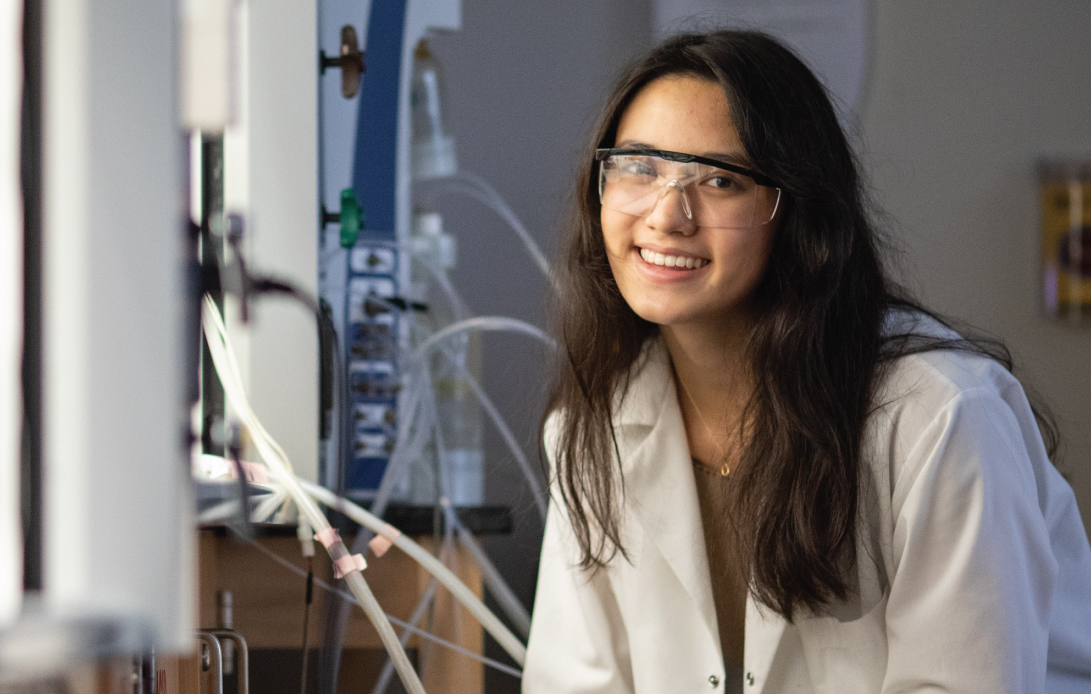
Bioengineering advances human health through scientific discovery and new biomedical technologies. Students design biomedical and diagnostic devices, develop platforms for tissue engineering and regenerative medicine, and create innovative therapeutics and drug delivery systems.
At Lehigh, students complement engineering and science courses with humanities, social sciences, and free electives, while exploring interests and passions beyond the classroom.
Is bioengineering right for you?
- You're fascinated by both engineering and biology.
- You're eager to solve problems in the areas of health care, medicine, and biotechnology, in emerging fields like biomedicine, biomaterials, wearable technology for health, and personalized medicine.
- You're deeply curious about tissue engineering and regenerative medicine, biopharmaceutical engineering, biocomputational engineering, and biomedical instrumentation.
- You're interested in designing and bringing to market medical devices, diagnostics, and systems for health care delivery and management.
Academic concentration
What bioengineering students study
Like every Lehigh engineering major, Bioengineering shares a core of engineering science and math, professional development and ethics, and project-based learning. Its required coursework puts its emphasis on biology and chemistry, with mechanical physics, data and computing, and electrical physics.
- Data and Computing
- Electrical Physics
- Mechanical Physics
- Biology and Chemistry
Bioengineering: emphasis on biology and chemistry, with mechanical physics, data and computing, and electrical physics
The bars are illustrative: they show the relative emphasis of each major's required coursework, drawn from the 2026-27 catalog.
Majors with the most similar emphasis: Chemical Engineering, Environmental Engineering, Materials Science and Engineering. Compare bioengineering and biomedical engineering, or find your match.
Combine bioengineering with another field
Integrated Business and Engineering students can choose Bioengineering as their engineering major, and IDEAS students have paired bioengineering with fields such as religion and molecular biology.
Choose a track
Bioengineering tracks
The B.S. in Bioengineering degree provides a structured curriculum comprised of three tracks.
Biopharmaceutical Engineering track
Biopharmaceutical Engineering is for students whose interests lie in genomics, proteomics, bioinformatics, recombinant DNA, protein engineering, bioprocessing, drug synthesis and delivery.
Biopharmaceutical Engineering track: emphasis on biology and chemistry, with mechanical physics, electrical physics, and data and computing
Courses in this track
- CHE 031 Material and Energy Balances of Chemical Processes
- BIOE 246 Bioengineering Thermodynamics
- BIOE 341 Biotechnology I
- BIOE 247 Biological Fluid Mechanics
- BIOE 343 Integrated Biotechnology Laboratory
- CHM 112 Organic Chemistry II
- BIOE 349 Metabolic Engineering
- MAT 033 Engineering Materials and Processes
Biocomputational Engineering track
The Biocomputational Engineering track covers education and research in the areas of bioinformatics, molecular modeling, signaling in biological systems, and machine learning.
Biocomputational Engineering track: emphasis on biology and chemistry, with data and computing, electrical physics, and mechanical physics
Courses in this track
- CSE 007 Introduction to Programming
- CSE 017 Programming and Data Structures
- BIOC 237 Introductory Molecular Modeling and Simulation
- BIOC 309 Bioengineering Applications in Machine Learning
- BIOE 312 Fundamentals of Biomedical Signals
- BIOS 115 Genetics
- BIOE 363 Numerical Methods for Scientists and Engineers
- PHY 380 Introduction to Computational Physics
Biomechanics and Biomaterials track
The Biomechanics and Biomaterials track encompasses applications of engineering principles to an understanding of biology and physiology, ranging from cells and tissues to organs and systems.
Biomechanics and Biomaterials track: emphasis on biology and chemistry and mechanical physics, with electrical physics and data and computing
Courses in this track
- MECH 003 Fundamentals of Engineering Mechanics
- BIOE 246 Bioengineering Thermodynamics
- MAT 033 Engineering Materials and Processes
- BIOE 025 Computer-aided Design for Bioengineers
- BIOE 247 Biological Fluid Mechanics
- BIOE 311 Introduction to Biomaterials
- BIOE 257 Biomechanics
- BIOE 357 Integrated Biostructural Mechanics Laboratory
Curriculum
Core bioengineering courses
Required in every track, from the 2026-27 Lehigh catalog.
| Course | Title | From the catalog |
|---|---|---|
| BIOS 041 | Introduction to Cellular and Molecular Biology | Basic building blocks and higher order structures required for cellular processes. |
| BIOS 042 | Introduction to Cellular and Molecular Biology Laboratory | Techniques and experiments related to the principal topics covered in BIOS 041 ; emphasis on experimental design and scientific communication. |
| BIOE 110 | Elements of Bioengineering | An introduction to the fields of biotechnology and biomedical engineering. |
| BIOE 210 | Introduction to Engineering Physiology | Human physiology for bioengineering students, with an emphasis on physiological processes and engineering principles. |
| CHM 031 | Chemical Equilibria in Aqueous Systems | An introduction to: intermolecular forces and their influence on physical properties and phase behavior; chemical kinetics; thermodynamics in chemical systems; and electrochemistry. |
| BIOE 225 | GMP Good manufacturing practice and regulatory affairs for bioengineers | Review of the principles of the Food and Drug Administration including its history, mission and applied regulations. |
| BIOE 211 | Capstone Design Project I | Students work on teams, integrating knowledge and skills acquired in their prior course work, to design practical solutions to real-world problems, typically in collaboration with industry, entrepreneurs, faculty, or campus departments. |
| CHM 110 | Organic Chemistry I | Systematic survey of the typical compounds of carbon, their classification, and general relations; study of synthetic reactions. |
| CHM 111 | Organic Chemistry Laboratory I | Preparation of pure organic compounds. |
| BIOE 212 | Capstone Design Project II | Students continue developing their solutions from BIOE 211 through prototype fabrication and testing, iteration, and failure mode analysis. |
| BIOE 226 | Ethics in Bioengineering Practice | Introduction to ethical principles and role of critical thinking in ethical decision-making. |
Four years at a glance
A typical four-year bioengineering schedule
The 2026-27 catalog's suggested sequence for each track. Your own schedule depends on AP or transfer credit and on choices you make with your advisor.
Biopharmaceutical Engineering track
| Year | Fall | Spring |
|---|---|---|
| First year |
|
|
| Second year |
|
|
| Third year |
|
|
| Fourth year |
|
|
Biocomputational Engineering track
| Year | Fall | Spring |
|---|---|---|
| First year |
|
|
| Second year |
|
|
| Third year |
|
|
| Fourth year |
|
|
Biomechanics and Biomaterials track
| Year | Fall | Spring |
|---|---|---|
| First year |
|
|
| Second year |
|
|
| Third year |
|
|
| Fourth year |
|
|
Source: Lehigh University catalog, 2026-27. Elective slots are filled from approved lists in the catalog.
Your first year
Starting bioengineering at Lehigh
Students begin their first year in the Rossin College without formally declaring a major. Most engineering students take the same courses in their first year. Bioengineering students take BIOS 041 and BIOS 42 (instead of HSS elective) in their spring semester.
FYRE, a novel first-year pathway now in its pilot phase, runs hands-on, seven-week modules across disciplines. Modules close to bioengineering include Human-Machine Interface and Design and Make Foundations.
Beyond the classroom
Research, design projects and bioengineering clubs
The program offers opportunities for experiential learning via extended research with faculty members, team-based and industry-sponsored design projects, and seminar courses.
- Biomedical Engineering Society (BMES): Lehigh's Biomedical Engineering Society (BMES) is a student-run organization aimed at providing students within the Department of Bioengineering opportunities to learn and grow both as individuals and collectively.
- LU e-NABLE: Students in Lehigh's Enabling the Future organization (LU e-NABLE) are collaborating with Ayúdame3D, a Spanish NGO which designs, manufactures and provides low cost, body-powered prosthetic arms, free of charge, to those in need around the globe.
- Rossin Junior Fellows: Rossin Junior Fellows are undergraduate students who serve as ambassadors for the P.C. Rossin College of Engineering and Applied Science.
Research across the college: the Rossin Research Scholars program pairs undergraduates with PhD mentors for a yearlong research project, and students present their work at the David and Lorraine Freed Undergraduate Research Symposium.
After Lehigh
Careers in bioengineering
Bioengineers who graduate from Lehigh University go on to work in established and emerging fields such as healthcare, biomedicine, pharmaceuticals, biomaterials and other biotechnology-related industries. Many develop and evaluate systems and devices that solve medical and health-related problems, such as artificial organs, prostheses, instrumentation, medical information systems and health management and care delivery systems.
Questions
Bioengineering at Lehigh: frequently asked questions
Does Lehigh have biomedical engineering?
Lehigh's undergraduate major in this field is the B.S. in Bioengineering. The Bioengineering Program is accredited by the Engineering Accreditation Commission of ABET under the commission's General Criteria and Program Criteria for Bioengineering and Biomedical and Similarly Named Engineering Programs.
What are the tracks in Lehigh's bioengineering major?
There are three: Biopharmaceutical Engineering, Biocomputational Engineering, and Biomechanics and Biomaterials. Biopharmaceutical Engineering is for students whose interests lie in genomics, proteomics, bioinformatics, recombinant DNA, protein engineering, bioprocessing, drug synthesis and delivery. The Biocomputational Engineering track covers education and research in the areas of bioinformatics, molecular modeling, signaling in biological systems, and machine learning. The Biomechanics and Biomaterials track encompasses applications of engineering principles to an understanding of biology and physiology, ranging from cells and tissues to organs and systems.
Is biocomputational engineering a separate major at Lehigh?
No. Biocomputational Engineering is one of the three tracks in the B.S. in Bioengineering. The Biocomputational Engineering track covers education and research in the areas of bioinformatics, molecular modeling, signaling in biological systems, and machine learning.
Is Lehigh's bioengineering program accredited?
Yes. The Bioengineering Program is accredited by the Engineering Accreditation Commission of ABET under the commission's General Criteria and Program Criteria for Bioengineering and Biomedical and Similarly Named Engineering Programs.
What do bioengineering students take in their first year?
Most engineering students take the same courses in their first year. Bioengineering students take BIOS 041 and BIOS 42 (instead of HSS elective) in their spring semester.
Can I combine bioengineering with business or the arts at Lehigh?
Yes. Bioengineering is one of the engineering majors open to Integrated Business and Engineering (IBE) students. In IDEAS, students have combined bioengineering with religion or with molecular biology.
What can bioengineering students do outside the classroom?
The program offers opportunities for experiential learning via extended research with faculty members, team-based and industry-sponsored design projects, and seminar courses. Student organizations include the Biomedical Engineering Society (BMES) and LU e-NABLE.
Where do Lehigh bioengineering graduates work?
Bioengineers who graduate from Lehigh University go on to work in established and emerging fields such as healthcare, biomedicine, pharmaceuticals, biomaterials and other biotechnology-related industries. Many develop and evaluate systems and devices that solve medical and health-related problems, such as artificial organs, prostheses, instrumentation, medical information systems and health management and care delivery systems.
Contact
Questions about bioengineering?
Department of Bioengineering
Sinclair Lab
7 Asa Drive, Suite 205
Bethlehem, PA 18015