
Master’s program · Rossin College of Engineering
Master of Engineering in Technical Entrepreneurship
The Master of Engineering in Technical Entrepreneurship at Lehigh University is a full-time, cohort-based degree that takes you through the whole path from an idea to a launched venture.
- Credits30
- Typical length11 months
- DeliveryOn campus
- Degree awardedMaster of Engineering
- GRENeither accepted nor reviewed
On this page
Overview
What the Master of Engineering in Technical Entrepreneurship is
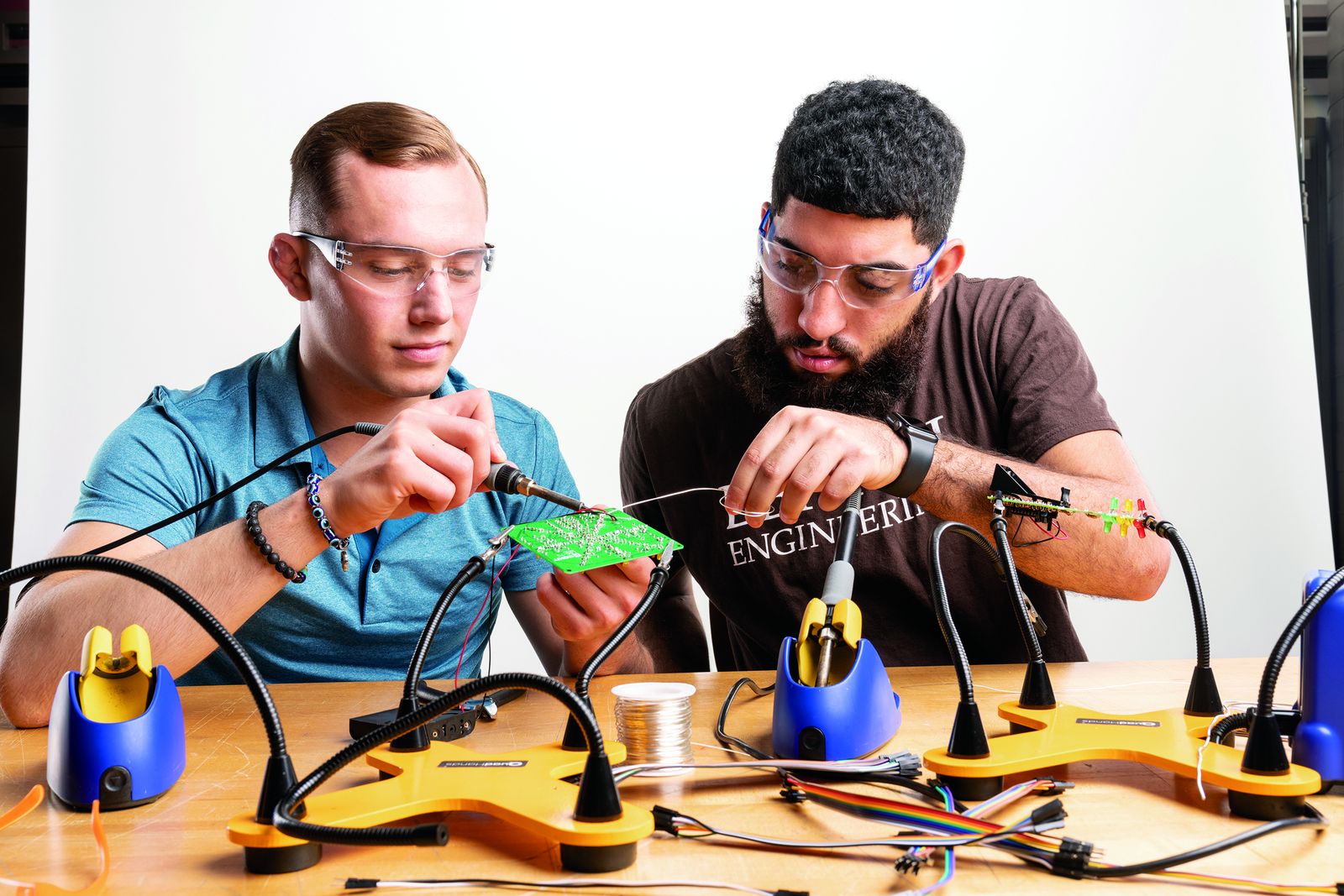
The program teaches by doing, making and launching. You work with a dedicated faculty in a dedicated maker space that keeps your intellectual property secure, so ideas can become prototypes and prototypes can become ventures without leaving the program.
Students from any undergraduate major are encouraged to apply, provided they bring curiosity and an entrepreneurial mindset. Businesses from young startups to Fortune 500 companies want creative, innovative people who can lead and manage product development teams, and graduates are prepared for complex product development roles in both large and small companies.
A 30-credit degree, typically 11 months of full-time study, delivered on campus.
Disciplines
An interdisciplinary program
This degree is not owned by a single department. It draws faculty and coursework from 8 departments across the Rossin College.
- Department of Bioengineering
- Department of Chemical and Biomolecular Engineering
- Department of Civil and Environmental Engineering
- Department of Computer Science and Engineering
- Department of Electrical and Computer Engineering
- Department of Industrial and Systems Engineering
- Department of Materials Science and Engineering
- Department of Mechanical Engineering and Mechanics
Curriculum
What you study
The degree requires 30 graduate credits, and every course is required. They fall into three groups: skill building, process courses and project courses.
- Skill building. Creativity and Systematic Innovation Methods (TE 301, 3 credits), Methods in Prototyping, Modeling and Testing (TE 303, 3 credits) and Intellectual Property (IP) Creation and Management (TE 407, 2 credits).
- Process courses. Two Integrated Product Development process courses (TE 401 and TE 402) and two Entrepreneurial Startup process courses (TE 403 and TE 404), at 3 credits each.
- Project courses. Technical Entrepreneurship Projects 1 (TE 400, 1 credit), Entrepreneurial Startup Projects-2 (TE 406, 3 credits), and Integrated Product Development Projects-1 and Projects-2 (TE 461 and TE 462, 3 credits each).
- Thesis and exam. Neither a thesis nor a comprehensive exam is required.
- Course-level rules. At least 24 credits must be at the 300 and 400 level, with at least 18 of them at the 400 level. At least 18 credits must be in the major field, with at least 15 of them at the 400 level. You need a B- or better in at least 18 credits of your program and in all 300-level courses in the major field, and no course graded below C- counts toward the degree.
- Courses that do not count. Courses with an ESLP or EAPC subject code, doctoral-only 400-level courses (ENGR 441 and ENGR 499), ENGR 492 and ENGR 496 Summer Work Experience cannot be applied to the degree.
| Code | Course | What it covers |
|---|---|---|
| TE 301 | Creativity and Systematic Innovation Methods | Creativity and systematic innovation methods for engineers. |
| TE 303 | Methods in Prototyping, Modeling and Testing | Prototyping, breadboarding, fabrication, testing methods. |
| TE 407 | Intellectual Property (IP) Creation and Management | Patents, copyrights, trademarks, and trade secrets. |
| TE 401 | Integrated Product Development (IPD) Process-1 | Interdisciplinary product design and development process. |
| TE 402 | Integrated Product Development (IPD) Process-2 | Manufacturing, marketing launch, and customer support. |
| TE 403 | Entrepreneurial Startup Process-1 | Feasibility analysis and new venture business models. |
| TE 404 | Entrepreneurial Startup Process-2 | Marketing, sales strategy, and venture team mobilization. |
| TE 400 | Technical Entrepreneurship Projects 1 | Customer discovery for target technologies and markets. |
| TE 406 | Entrepreneurial Startup Projects-2 | Business plan and investor pitch for company launch. |
| TE 461 | Integrated Product Development (IPD) Projects-1 | Technical and economic feasibility study of new products. |
| TE 462 | Integrated Product Development (IPD) Projects-2 | Detailed design, fabrication, and testing of prototypes. |
The Lehigh University Course Catalog is the official source for degree requirements, and requirements can change from year to year. Confirm your own plan against the catalog listing below and with your academic advisor.
Careers
Where graduates work
Technical entrepreneurship alumni build products, lead teams and start companies.
Our alumni work in information technology, manufacturing, construction, life sciences, finance, consulting and education. Many hold executive and management roles, and many work as engineers. Typical titles include founder or co-founder, chief executive, project engineer, project manager, business development manager, senior software engineer and head of research and development.
Employers where our alumni most often work include:
- EY
- Movable Ink
- Jazwares
- Soltech (Manufacturing)
- Elevate Construction Partnership
- destination mono
- Microsoft
- Salesforce
Alumni also work at Dmg Mori Usa, Montefiore Medical Center, Sterne, Kessler, Goldstein & Fox, STO Building Group, Northampton Community College, Wayfair and China Gold International Resources.
Based on current employers of Lehigh technical entrepreneurship alumni who graduated between 2003 and 2025. Class of 2025 master’s graduates across the Rossin College averaged $100,000 in starting salary.
Tuition and funding
What it costs, and what help is available
Base tuition for this 30-credit degree is $75,635, reflecting the summer-start accelerated cycle.
- Qualified applicants are automatically considered for merit scholarships as high as 20% of tuition, with no separate application required.
- International students are considered on the same basis as domestic applicants.
How to apply
What a complete application needs
- Academic record
A bachelor’s degree, or the equivalent from a foreign institution, by the time you enroll, in any undergraduate major. A GPA of at least 2.75 on a 4.0 scale is preferred, and international GPAs are evaluated against that standard. A trend of strengthening grades in your final semesters is taken into account. You will also submit official transcripts, a personal statement, a resume, and letters of recommendation.
- Holistic review
The graduate program director reviews each application as a whole, in consultation with program faculty.
- GRE
GRE scores are neither accepted nor reviewed.
- English proficiency
International applicants submit a TOEFL iBT, IELTS, Duolingo, Cambridge English or Pearson Test of English score that meets the minimums in the table below.
- Application fee
$50, non-refundable.
- Deadline
June 15 for the summer start. The program enrolls one cohort a year, so summer is the only start term.
| Test | Overall | Speaking | Writing | Reading | Listening |
|---|---|---|---|---|---|
| TOEFL iBT | 81 | 22 | 20 | 20 | 16 |
| IELTS | 6.5 | 6.5 | 6.0 | 6.5 | 6.0 |
| Duolingo | 125 | 125 | 120 | 125 | 110 |
| Cambridge English | 176 | 176 | 169 | 176 | 169 |
| Pearson Test of English | 68 | 53 or above on each band | |||
FAQ
Frequently asked questions
What is the Master of Engineering in Technical Entrepreneurship at Lehigh?
It is a full-time, 30-credit professional master’s degree in which students learn the path from idea to venture by doing, making and launching. It draws on a dedicated faculty and a dedicated maker space that keeps intellectual property secure.
How many credits is the Master of Engineering in Technical Entrepreneurship?
30 credits, all in required Technical Entrepreneurship courses: skill building, process courses and project courses.
How long does the Master of Engineering in Technical Entrepreneurship take to complete?
The program takes eleven months of full-time study.
Do I have to write a thesis or take a comprehensive exam?
No. Neither is required.
What courses will I take?
Skill building courses in creativity and innovation methods, prototyping, modeling and testing, and intellectual property; process courses in integrated product development and the entrepreneurial startup; and project courses in both. The full list appears in the curriculum section above.
Do I need an engineering degree to apply?
No. Students from any undergraduate major are encouraged to apply. What matters is an entrepreneurial mindset and curiosity about building products and ventures.
When does the program start?
It starts in the summer, and summer is the only start term. The application deadline is June 15.
What are the admission requirements?
A bachelor’s degree, or the equivalent from a foreign institution, by the time you enroll. A GPA of at least 2.75 on a 4.0 scale is preferred, with consideration for a trend of strengthening grades in your final semesters. Applications are reviewed as a whole by the graduate program director in consultation with program faculty.
Is the GRE required for the Master of Engineering in Technical Entrepreneurship?
GRE scores are neither accepted nor reviewed for any Rossin College graduate program.
What English proficiency scores do international applicants need?
Minimum overall scores are 81 on the TOEFL iBT, 6.5 on the IELTS, 125 on Duolingo, 176 on Cambridge English, and 68 on the Pearson Test of English. Each test also has minimum speaking, writing, reading and listening scores, listed in the application requirements section above.
When are applications due?
June 15, for the summer start.
How is the program delivered?
On campus. Consult the program contact for the current term-by-term format.
What does it cost, and is funding available?
Base tuition is $75,635 for the 30-credit degree, reflecting the accelerated summer-start cycle. Qualified applicants are automatically considered for merit scholarships as high as 20% of tuition, with no separate application required. International students are considered on the same basis as domestic applicants.
Which department offers this program?
It is interdisciplinary, drawing on 8 departments across the Rossin College rather than sitting in one: Bioengineering, Chemical and Biomolecular Engineering, Civil and Environmental Engineering, Computer Science and Engineering, Electrical and Computer Engineering, Industrial and Systems Engineering, Materials Science and Engineering, and Mechanical Engineering and Mechanics.
What do graduates earn?
Class of 2025 master’s graduates across the Rossin College averaged $100,000 in starting salary.
How do I apply?
Apply through Lehigh’s graduate application. A complete application includes transcripts, a personal statement, a resume, letters of recommendation, English-proficiency scores where applicable, and a $50 application fee. The deadline is June 15 for the summer start.
Contact
Talk to the program
P.C. Rossin College of Engineering and Applied Science
The Technical Entrepreneurship curriculum »
General inquiries go to engineering@lehigh.edu.