
Master’s program · Rossin College of Engineering
Master of Science in Materials Science and Engineering
The MS in Materials Science and Engineering at Lehigh University develops advanced expertise in designing, synthesizing, characterizing and discovering new materials.
- Credits30
- Typical length1.5–2 years
- DeliveryOn campus
- Degree awardedMaster of Science
- GRENeither accepted nor reviewed
On this page
Overview
What the Master of Science in Materials Science and Engineering is
The program brings experimental, computational and data-driven methods together around one idea: a material’s processing determines its structure, its structure determines its properties, and its properties determine how it performs. You learn to work across that chain, in coursework and, if you choose, in hands-on research with faculty.
The aim is engineers who think critically and broadly, take on complex grand challenges, and help drive sustainable and ethical technological innovation. Graduates are prepared for advanced roles in industry, research environments and the global professional landscape, and the program works closely with industry.
A 30-credit degree, typically 1.5–2 years of full-time study, delivered on campus.
Research areas
Research aimed at health, sustainability and discovery
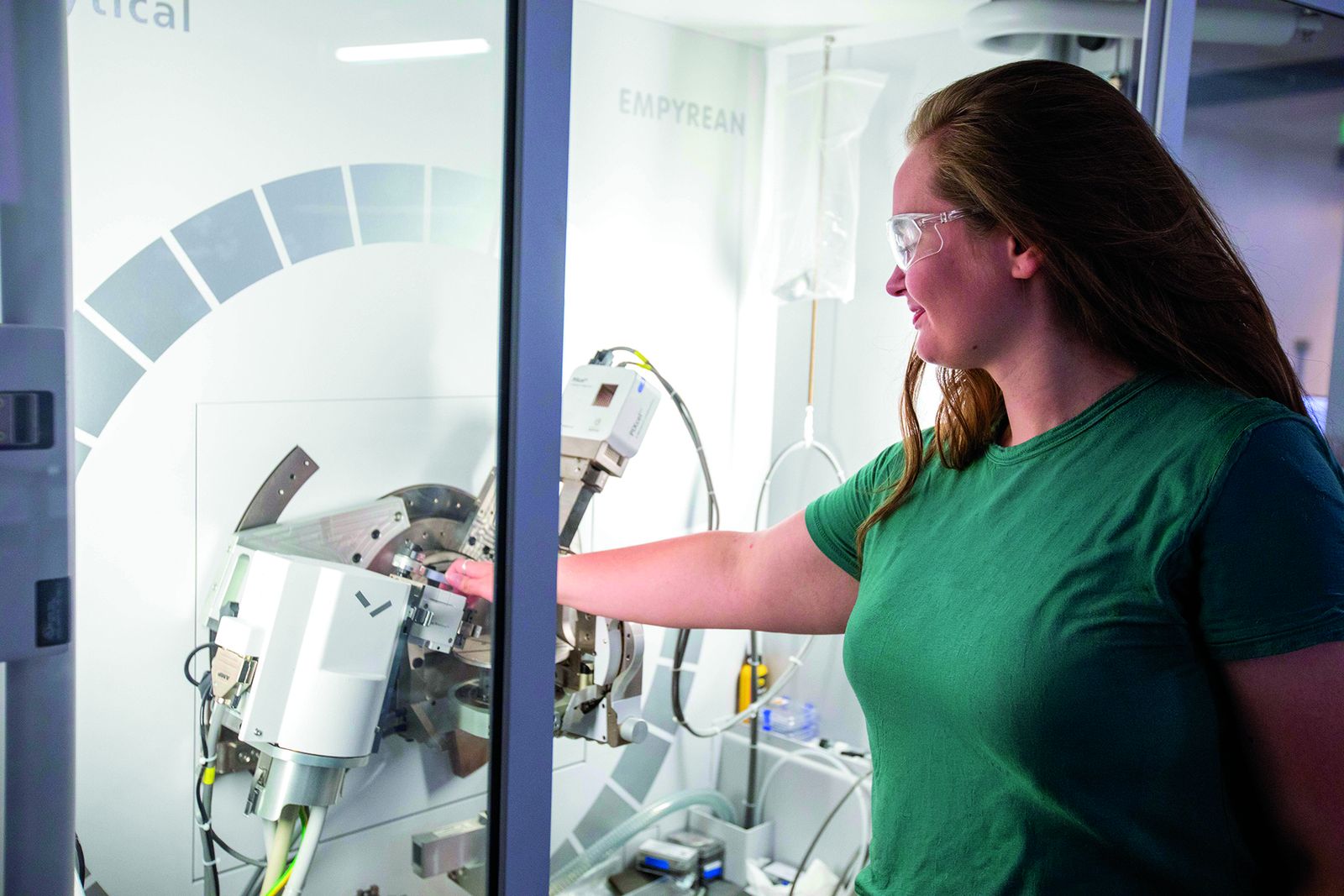
Across its three research areas, the department’s faculty and students take on large, complex problems: better materials for medicine and health, manufacturing and energy technologies that are more sustainable, and faster ways to see and understand what materials are made of. Master’s students can take part through electives, projects and thesis or project research.
Materials for Advancing Human Health
Advances in medicine often depend on materials that can interact safely and effectively with the body. Work in this area designs and studies materials for health and biomedical applications.
Sustainable Materials and Manufacturing
Energy, electronics and manufacturing all face pressure to use resources more responsibly. This area develops materials and processing approaches that support sustainable technological innovation.
Advanced Characterization Using Machine Learning
Characterizing a material can generate more data than people can interpret unaided. This area combines advanced characterization with machine learning so that structure and properties can be understood and new materials discovered more quickly.
Curriculum
What you study
The degree requires 30 graduate credits in three groups: a 10-credit required core, 8 credits of materials electives and research, and 12 credits of free electives.
- Group 1, required core, 10 credits. Thermodynamics (MAT 401), Structure/Property Relations (MAT 403) and Kinetics (MAT 405).
- Group 2, materials electives and research, 8 credits. MAT courses at the 300 and 400 level, with at least 5 credits at the 400 level. You can include 3 to 6 credits of thesis research (MAT 490) or project research (MAT 460) here. A thesis is not required, and there is no comprehensive exam.
- Group 3, free electives, 12 credits. Courses at the 300 or 400 level from MAT, excluding MAT 460 and MAT 490, or from another department with advisor approval. Some 400-level courses may be needed to meet the degree’s overall 400-level requirement.
- Departmental seminar. In-person, full-time master’s students enroll in the 0-credit Materials Science and Engineering Seminar (MAT 451) every fall and spring semester.
- Course-level rules. At least 24 credits must be at the 300 and 400 level, with 18 of them at the 400 level, and research or thesis registration can count toward that 400-level total. At least 18 credits must be in the major field, 15 of them at the 400 level. You need a B- or better in at least 18 credits of your program and in all 300-level courses in the major field, and no course graded below C- counts toward the degree. Advisor approval is required for electives, including MAT courses and those from other departments.
- Research and project supervision. Faculty availability depends on specialty and current advising commitments, so if you want to pursue a thesis or project, contact faculty in your area of interest during or before your first semester.
- Exclusions. Courses with an ESLP or EAPC subject code, undergraduate-only 300-level courses, and the doctoral-only courses ENGR 441, ENGR 499, ENGR 492 (Summer Research) and ENGR 496 (Summer Work Experience) cannot count toward the degree.
| Code | Course | What it covers |
|---|---|---|
| MAT 401 | Thermodynamics | Thermodynamics of materials processes. |
| MAT 403 | Structure/Property Relations | Structure of materials and relationship to properties. |
| MAT 405 | Kinetics | Diffusion, nucleation and growth kinetics. |
The Lehigh University Course Catalog is the official source for degree requirements, and requirements can change from year to year. Confirm your own plan against the catalog listing and with your academic advisor.
Careers
Where graduates work
Materials science and engineering alumni work wherever new materials make new products possible.
Our alumni work in manufacturing, energy and natural resources, life sciences, defense and space, electronics and information technology, national laboratories and universities. Typical roles include materials engineer, metallurgical engineer, process engineer, research scientist, product development manager and technical manager, and some alumni move into finance, sales and executive roles.
Employers where our alumni most often work include:
- RTX (Raytheon)
- ExxonMobil
- Sandia National Laboratories
- Brookhaven National Laboratory
- Merck
- Thermo Fisher Scientific
- Apple
- IBM
Alumni also work at Johnson & Johnson, GKN Hoeganaes, Medtronic, Oak Ridge National Laboratory, Saint-Gobain, Vision Equipment and Corning.
Based on current employers of Lehigh materials science and engineering alumni who graduated between 1996 and 2025. Class of 2025 master’s graduates across the Rossin College averaged $100,000 in starting salary.
Tuition and funding
What it costs, and what help is available
Base tuition for this 30-credit degree is $52,050.
- Qualified applicants are automatically considered for merit scholarships as high as 20% of tuition, with no separate application required.
- International students are considered on the same basis as domestic applicants.
How to apply
What a complete application needs
- Academic record
A bachelor’s degree, or the equivalent from a foreign institution, in materials science and engineering or a related engineering or science discipline by the time you enroll. A GPA of 3.0 or higher on a 4.0 scale is typically expected. Applicants below 3.0 may be considered if the application includes significant documented research accomplishments, relevant industrial experience or compelling extraordinary circumstances.
- Holistic review
The materials science and engineering graduate director reviews each application as a whole, in consultation with the department’s graduate committee.
- GRE
GRE scores are neither accepted nor reviewed.
- English proficiency
International applicants follow the University’s graduate guidelines for language requirements. The College’s minimum scores for each accepted test are in the table below.
- Application fee
$50, non-refundable.
- Deadlines
December 15 for a spring start, May 15 for a summer start, and July 15 for a fall start.
| Test | Overall | Speaking | Writing | Reading | Listening |
|---|---|---|---|---|---|
| TOEFL iBT | 81 | 22 | 20 | 20 | 16 |
| IELTS | 6.5 | 6.5 | 6.0 | 6.5 | 6.0 |
| Duolingo | 125 | 125 | 120 | 125 | 110 |
| Cambridge English | 176 | 176 | 169 | 176 | 169 |
| Pearson Test of English | 68 | 53 or above on each band | |||
FAQ
Frequently asked questions
What is the MS in Materials Science and Engineering at Lehigh?
It is a 30-credit master’s degree that builds advanced expertise in the design, selection, synthesis, characterization and discovery of materials, using experimental, computational and data-driven methods and the processing, structure, properties and performance framework.
How many credits is the MS in Materials Science and Engineering?
30 credits: a 10-credit required core, 8 credits of materials electives and research, and 12 credits of free electives.
How long does the MS in Materials Science and Engineering take to complete?
The program typically takes 1.5 to 2 years. Faster completion can be achieved through academic planning with your advisor.
Do I have to write a thesis or take a comprehensive exam?
No. Neither is required. If you want research experience, you can include 3 to 6 credits of thesis research or project research in the materials electives and research group.
What courses make up the required core?
Thermodynamics (MAT 401), Structure/Property Relations (MAT 403) and Kinetics (MAT 405), for 10 credits in all.
Is there a seminar requirement?
In-person, full-time master’s students enroll in the 0-credit Materials Science and Engineering Seminar (MAT 451) every fall and spring semester.
What are the admission requirements?
A bachelor’s degree, or the equivalent from a foreign institution, in materials science and engineering or a related engineering or science discipline by the time you enroll. A GPA of 3.0 or higher on a 4.0 scale is typically expected, and applicants below 3.0 may be considered with documented research accomplishments, relevant industrial experience or compelling extraordinary circumstances. Applications are reviewed as a whole.
Is the GRE required for the MS in Materials Science and Engineering?
No. GRE scores are neither accepted nor reviewed.
What English proficiency scores do international applicants need?
International applicants follow the University’s graduate guidelines for language requirements. The College’s minimum overall scores are 81 on the TOEFL iBT, 6.5 on the IELTS, 125 on Duolingo, 176 on Cambridge English, and 68 on the Pearson Test of English, with minimum band scores listed in the application requirements section above.
When are applications due?
December 15 for a spring start, May 15 for a summer start, and July 15 for a fall start.
How is the program delivered?
On campus. Consult the program contact for the current term-by-term format.
What does it cost, and is funding available?
Base tuition is $52,050 for the 30-credit degree. Qualified applicants are automatically considered for merit scholarships as high as 20% of tuition, with no separate application required. International students are considered on the same basis as domestic applicants.
Which department offers this program?
The Department of Materials Science and Engineering.
What do graduates earn?
Class of 2025 master’s graduates across the Rossin College averaged $100,000 in starting salary.
How do I apply?
Apply through Lehigh’s graduate application. A complete application includes transcripts, English-proficiency scores where applicable, and a $50 application fee. Deadlines are December 15 for a spring start, May 15 for a summer start, and July 15 for a fall start.
What elective courses can I choose from?
Electives are chosen with your advisor. Courses students can choose from include Solidification, Current Topics in Materials, Metal Forming Processes, Mechanical Behavior of Ceramic Solids, Optical Properties of Materials, Advanced Transmission Electron Microscopy, Advanced Scanning Electron Microscopy and Glass Science, among others. The Lehigh course catalog carries the full list.
Contact
Talk to the program
Department of Materials Science and Engineering
Whitaker Laboratory, 5 East Packer Avenue, Bethlehem, PA 18015
Department of Materials Science and Engineering »
General inquiries go to engineering@lehigh.edu.