
Master’s program · Rossin College of Engineering
Master of Science in Structural Engineering
Lehigh University’s master’s degrees in Structural Engineering give engineers a firm grounding in how structural members behave, along with a wide choice of electives from within the department and across the university.
- Credits30
- Typical length1.5–2 years
- DeliveryOn campus, hybrid or fully online
- Degree awardedMaster of Science or Master of Engineering
- GRENeither accepted nor reviewed

On this page
Overview
What the Master of Science in Structural Engineering is
The MS fits students who want flexibility. After one required course on structural members and a choice among structural dynamics, structural analysis and the finite element method, most of the degree is technical electives, so you can pursue the topics that interest you most and add courses from other departments. If you want research experience, up to 3 credits can go to thesis or project-based work.
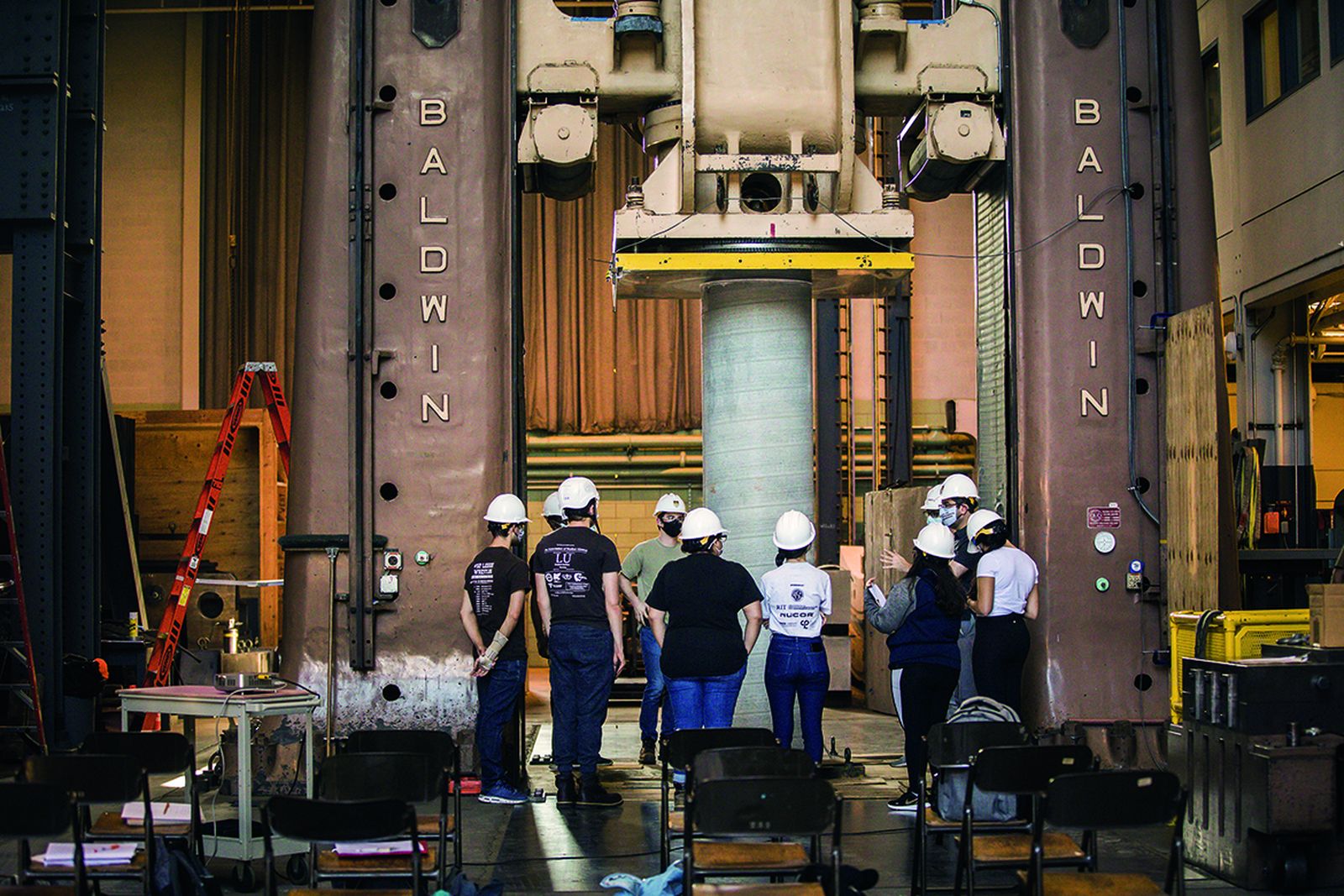
The M.Eng. suits students ready to practice. Its design sequence builds toward a final design project, and a structural behavior laboratory rounds out the core. Throughout the program you have the chance to interact with industry supporters and alumni.
A 30-credit degree, typically 1.5–2 years of full-time study, delivered on campus, hybrid or fully online.
Research areas
Research on the built and natural environment
Across these four areas, the department’s faculty and students tackle some of the largest and most complex challenges facing communities: safe and durable infrastructure, stable foundations, dependable water supplies and a clean environment. Master’s students can draw on this work through their electives and, in the MS, the research option.
Structural Engineering
Buildings, bridges and other structures must carry their loads safely for decades while using materials responsibly. Work in this area studies how structures behave and how to design, evaluate and strengthen them.
Geotechnical Engineering
Every structure rests on soil or rock, and ground conditions shape its safety and its cost. This area studies the behavior of earth materials and how foundations and other ground-supported works respond to loads and changing conditions.
Water Resources Engineering
Floods, droughts and growing demand strain water supplies and the infrastructure that moves and stores water. This area studies how water moves through natural and built systems and how to manage it.
Environmental Engineering
Clean air, water and soil underpin public health. Work in this area develops engineered ways to understand, prevent and remedy contamination.
Curriculum
What you study
Both degrees require 30 graduate credits and build on CEE 404, Mechanics and Behavior of Structural Members, plus a choice of core electives. They differ in what follows: the MS leaves most of the degree to technical electives, while the M.Eng. adds a design sequence and a laboratory.
- MS core, 3 credits. CEE 404, Mechanics and Behavior of Structural Members.
- M.Eng. core, 15 credits. CEE 404, Mechanics and Behavior of Structural Members, together with the three-course design sequence of Design Project I, II and III (CEE 416, CEE 417 and CEE 418), which ends in a final design project, and Structural Behavior Laboratory (CEE 419).
- Core electives, 6 to 9 credits (both degrees). Choose at least two of Structural Dynamics (CEE 352), Structural Analysis II (CEE 359) and Finite Element Method in Structural Engineering (CEE 366). Taking all three is recommended.
- MS technical electives, 18 to 21 credits. Six to seven courses at the 300 or 400 level in CEE or CAT, or, with permission, in other departments. They must include five 400-level CEE or CAT courses.
- M.Eng. technical electives, 6 to 9 credits. Two to three courses at the 300 or 400 level in CEE or CAT, or, with permission, in other departments. They must include one 400-level CEE or CAT course.
- MS research option. Up to 3 credits of thesis or project-based research, through CEE 491 Thesis, CEE 480 Independent Study or CEE 481 MS or MEng Project. The normal effort for these courses is 3 credits, and more may be assigned for more extensive work. No more than 6 credits in total from these three courses can count toward the degree.
- Thesis and exams. Neither degree requires a thesis or a comprehensive exam.
- Course-level rules. At least 24 credits must be at the 300 and 400 level, with at least 18 of them at the 400 level, and MS research or thesis registration counts toward that 400-level total. At least 18 credits must be in your major field, with at least 15 of them at the 400 level. You need a B- or better in at least 18 credits of your program and in every 300-level course in your major field, and no course graded below C- counts toward the degree. Courses with an ESLP subject code, doctoral-only 400-level courses, ENGR 492 and ENGR 496 cannot be counted.
| Code | Course | What it covers |
|---|---|---|
| CEE 404 | Mechanics and Behavior of Structural Members | Behavior of structural members; elasticity. |
| CEE 419 | Structural Behavior Laboratory | Laboratory study of structural behavior. |
The Lehigh University Course Catalog is the official source for degree requirements, and requirements can change from year to year. Confirm your own plan against the catalog listing below and with your academic advisor.
Careers
Where graduates work
Structural engineering alumni design, build and look after the structures communities rely on.
Lehigh structural engineering alumni work most often in engineering firms, followed by construction, services, consulting, education and information technology. Typical roles include structural engineer, project engineer, senior bridge engineer, structural designer and consulting engineer. Many alumni later advance to project manager, principal, vice president or professor.
Employers where our alumni most often work include:
- Thornton Tomasetti
- AECOM
- Simpson Gumpertz & Heger
- WSP
- Walter P Moore
- Wiss, Janney, Elstner Associates
- HNTB
- Kiewit
Alumni also work at OConnell, Stantec, HDR, Jacobs, McLaren Engineering Group, DeSimone Consulting Engineering and KL&A Engineers and Builders.
Based on current employers of Lehigh structural engineering alumni who graduated between 1997 and 2025. Class of 2025 master’s graduates across the Rossin College averaged $100,000 in starting salary.
Tuition and funding
What it costs, and what help is available
Base tuition for this 30-credit degree is $52,050.
- Qualified applicants are automatically considered for merit scholarships as high as 20% of tuition, with no separate application required.
- International students are considered on the same basis as domestic applicants.
How to apply
What a complete application needs
- Academic record
A bachelor’s degree, or the equivalent from a foreign institution, by the time you enroll. A GPA of at least 3.0 on a 4.0 scale is preferred, and international GPAs are evaluated against that standard. A trend of strengthening grades in your final semesters is taken into account. You will also submit official transcripts, a personal statement, a resume, and letters of recommendation.
- GRE
GRE scores are neither accepted nor reviewed.
- English proficiency
International applicants submit a TOEFL iBT, IELTS, Duolingo, Cambridge English or Pearson Test of English score that meets the minimums in the table below.
- Application fee
$50, non-refundable.
- Deadlines
December 15 for a spring start, May 15 for a summer start, and July 15 for a fall start.
| Test | Overall | Speaking | Writing | Reading | Listening |
|---|---|---|---|---|---|
| TOEFL iBT | 81 | 22 | 20 | 20 | 16 |
| IELTS | 6.5 | 6.5 | 6.0 | 6.5 | 6.0 |
| Duolingo | 125 | 125 | 120 | 125 | 110 |
| Cambridge English | 176 | 176 | 169 | 176 | 169 |
| Pearson Test of English | 68 | 53 or above on each band | |||
FAQ
Frequently asked questions
What are the MS and M.Eng. in Structural Engineering at Lehigh?
They are two 30-credit master’s degrees in structural engineering. Both start from a required core in how structural members behave, with access to a broad portfolio of electives from the department and from other departments. The M.Eng. stresses engineering applications and design, and it is built around a three-course design sequence that ends in a final design project.
How do the MS and the M.Eng. differ?
The MS requires 3 credits of core coursework and then 18 to 21 credits of technical electives, with an optional research component. The M.Eng. requires 15 credits of core coursework, including the design sequence and a structural behavior laboratory, and 6 to 9 credits of technical electives.
How many credits are the degrees, and how long do they take?
Each degree is 30 credits and typically takes 1.5 to 2 years. Faster completion may be possible through academic planning, and M.Eng. students can also start in the second summer session.
Do I have to write a thesis or take a comprehensive exam?
No. Neither degree requires a thesis or a comprehensive exam. MS students who want research experience can put up to 3 credits toward a thesis or a project.
What courses make up the core?
Every student takes CEE 404, Mechanics and Behavior of Structural Members, and chooses at least two core electives from Structural Dynamics (CEE 352), Structural Analysis II (CEE 359) and Finite Element Method in Structural Engineering (CEE 366). Taking all three electives is recommended. M.Eng. students also take the design sequence (CEE 416, CEE 417 and CEE 418) and Structural Behavior Laboratory (CEE 419).
What is the M.Eng. design sequence?
It is a three-course sequence, Design Project I, II and III, that results in a final design project and complements the core courses in structural engineering. Throughout the program, students have the opportunity to interact with industry supporters and alumni.
What are the admission requirements?
A bachelor’s degree, or the equivalent from a foreign institution, by the time you enroll. A GPA of at least 3.0 on a 4.0 scale is preferred, with consideration for a trend of strengthening grades in your final semesters.
Is the GRE required for the Master of Science in Structural Engineering?
GRE scores are neither accepted nor reviewed for any Rossin College graduate program.
What English proficiency scores do international applicants need?
Minimum overall scores are 81 on the TOEFL iBT, 6.5 on the IELTS, 125 on Duolingo, 176 on Cambridge English, and 68 on the Pearson Test of English. Each test also has minimum speaking, writing, reading and listening scores, listed in the application requirements section above.
When are applications due?
December 15 for a spring start, May 15 for a summer start, and July 15 for a fall start.
How is the program delivered?
On campus, hybrid or fully online. Consult the program contact for the current term-by-term format.
What does it cost, and is funding available?
Base tuition is $52,050 for the 30-credit degree. Qualified applicants are automatically considered for merit scholarships as high as 20% of tuition, with no separate application required. International students are considered on the same basis as domestic applicants.
Which department offers this program?
The Department of Civil and Environmental Engineering.
What do graduates earn?
Class of 2025 master’s graduates across the Rossin College averaged $100,000 in starting salary.
How do I apply?
Apply through Lehigh’s graduate application. A complete application includes transcripts, a personal statement, a resume, letters of recommendation, English-proficiency scores where applicable, and a $50 application fee. Deadlines are December 15 for a spring start, May 15 for a summer start, and July 15 for a fall start.
What elective courses can I choose from?
Electives are chosen with your advisor. Courses students can choose from include Structural Dynamics, Structural Analysis II and Finite Element Method in Structural Engineering. The Lehigh course catalog carries the full list.
Contact
Talk to the program
Department of Civil and Environmental Engineering
Fritz Engineering Laboratory, 13 East Packer Avenue, Bethlehem, PA 18015-3176
Department of Civil and Environmental Engineering »
General inquiries go to engineering@lehigh.edu.