
To the uninitiated, a video of a rocket that never leaves the earth can feel anticlimactic. But for the students behind it, the static fire of Bowie—a liquid bi-propellant rocket—was a turning point. The test confirmed that the Lehigh University Rocketry Association (LURA), a student-founded-and-run club, had moved beyond early experimentation into the kind of systems-level engineering used in industry.
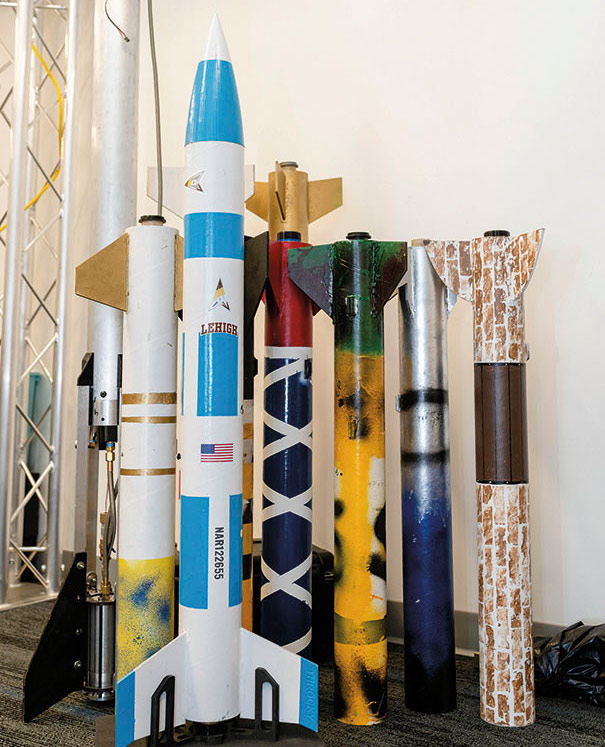 “We were looking for a seven-second burn time, and that’s what we got,” says LURA’s president, Keegan Gagnon ’26, a newly graduated mechanical engineer who is now a graduate student in Lehigh’s MS-AERO program. “Compared with solid fuel, which can be purchased as a cartridge, there’s more plumbing, more electronics, and more moving parts to liquid fuel, since you have to build the entire propellant system yourself. Not a lot of universities are working with it, but liquid fuel is what SpaceX and NASA use for their rockets, and we wanted to build something that reflects the industry. The next step is to launch it.”
Bowie is one of several recent advances by a club still in its formative years. Gagnon, who worked with model rockets as a child, started LURA during his sophomore year after realizing how companies such as SpaceX were driving demand for aerospace engineers—and after learning that Lehigh had a distinct advantage in the field.
“I had no idea we had an astronaut as a professor on campus,” says Gagnon. “After learning about Terry Hart, and all the amazing classes he taught, I started the club.”
It wasn’t easy launching a club that works with explosive materials, but today LURA has over 40 members from a range of majors. Its purpose is twofold, says Gagnon: to expose students—from across engineering disciplines and beyond—to rocketry and aerospace, and to push the boundaries of collegiate research and development in those areas.
“We intend to work on systems that mirror industry practice, so when students go to these companies, they’re already familiar with the technology,” he says. “We want everyone to know that Lehigh University can compete as a serious rocketry program.”
To that end, the next test for Bowie will take place midsemester in Maryland. The goal is to reach 5,000–6,000 feet. At that point, a small parachute, or drogue, will deploy and slow the rocket’s descent. Once it reaches approximately 1,500 feet, a larger parachute will deploy and carry it safely to the ground. The flight will mark the club’s first-ever launch of a liquid-fueled rocket.
Meanwhile, the team is also preparing Talon, their 14-foot-long, 8-inch-diameter solid fuel rocket, for the 2026 Experimental Sounding Rocket Association’s International Rocket Engineering Competition (IREC) in Texas. The annual event is the world’s largest collegiate rocketry competition, and teams must apply for selection. This year’s IREC will host 186 teams from around the globe.
“Talon has been our main project for the year, and the plan is to compete for the world championship in the 10,000-foot category,” says Gagnon.
At IREC, winning can take many forms. For the altitude category, the overall winner is the team that gets as close to 10,000 feet as possible, but teams are also evaluated on the quality of their design reports, the accuracy of their simulations compared with actual flight data, and the complexity of their payload. LURA’s payload is a robotic dog named Laika.
“The point of the competition is to be innovative,” says Joshua Kraus ’27, who is concentrating on aerospace engineering and behavioral psychology in Lehigh’s Integrated Degree in Engineering, Arts and Sciences (IDEAS) program and serves as lead engineer on Talon’s payload. “We weren’t looking to build the safest option, which is usually a CubeSat—a miniature, inexpensive satellite. It’s straightforward: a box you send up and bring back down. But that’s not our way. We’re the first rocket lab at Lehigh, and we wanted to go in with a bang.”
The payload team has been developing Laika—named after the dog who flew aboard the Soviet Union’s Sputnik 2—since last summer. The goal is for Laika to be released at 2,000 feet, parachute back to Earth, and, upon landing, release itself from its restraints. From there, it will stand up, walk around, and perform its scientific mission: taking photos of the terrain with an optical camera, collecting temperature readings with a thermal camera, and using Time-of-Flight (ToF) LiDAR—which measures distance using laser pulses—to navigate.
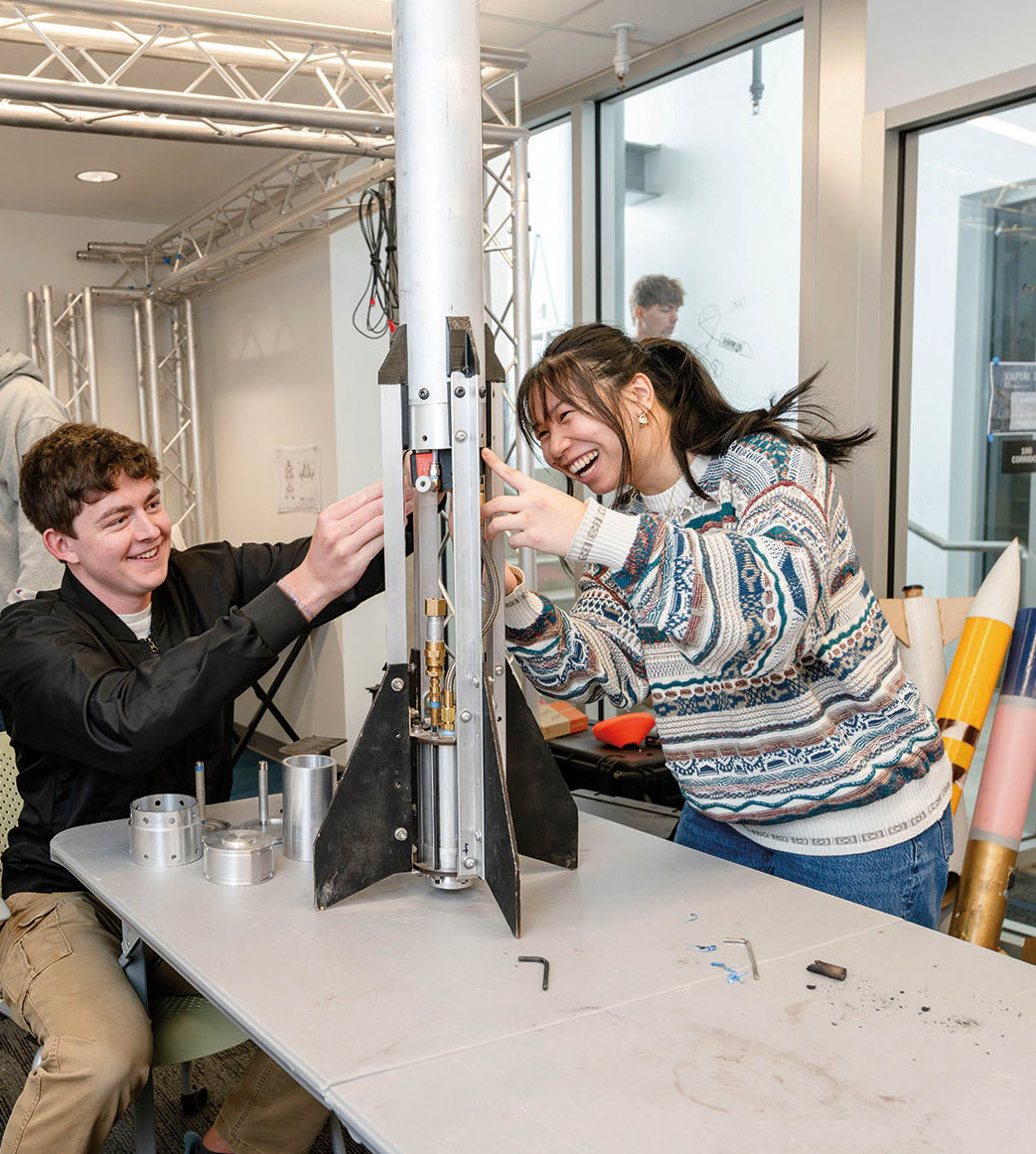 “It’s an interesting concept because most robotic exploration is done with wheels,” says Kraus. “But that technology is becoming arcane. In the future, the way that robots move and act will look closer to how humans or animals move. With Laika, we wanted to demonstrate that technology. It’s harder to do, but the challenge is the point.”
Embracing such challenges isn’t just about winning competitions. LURA provides students with a unique opportunity to encounter many of the situations they will face as working engineers—experiences both Gagnon and Kraus, along with other club members, have successfully leveraged in interviews.
“I was able to walk through the different problems we faced and how we worked through them,” says Gagnon, who will be working as an aerospace engineer at Northrop Grumman after completing his master’s degree. “Everything from budgetary and regulatory issues to the fact that we initially didn’t have lab space and were working out of the back of my car for a while. It was on a much smaller scale, but those experiences made clear how we were able to execute a vision. We went from spending half a semester talking about what the club could become to being one of the biggest engineering clubs on campus and competing at the largest event in collegiate rocketry.”
For Kraus, who will be interning with SpaceX in California this summer, LURA marked his first experience with engineering being a deeply collaborative effort. Previously, he’d thought of engineering as largely a solo endeavor—studying, working, and building on his own. As a member of LURA, he is constantly surrounded by peers with different skill sets and strengths, and he’s struck by how much more inspired and productive he feels as part of a team.
“Learning how to operate in a team environment and trust other engineers was huge, and I became a significantly better team player,” he says. “Being able to demonstrate that mindset to these space companies is incredibly valuable. LURA taught me how to be an engineer among engineers.”