
When propulsion systems fail, it’s often because structural materials reach their breaking point—cracking, deforming, or degrading under heat and stress. Extending those limits is central to the research of Natasha Vermaak (pictured), an associate professor of mechanical engineering and mechanics. Vermaak seeks to develop materials and structures capable of powering next-generation engines for satellites, orbital vehicles, and other high-demand space applications.
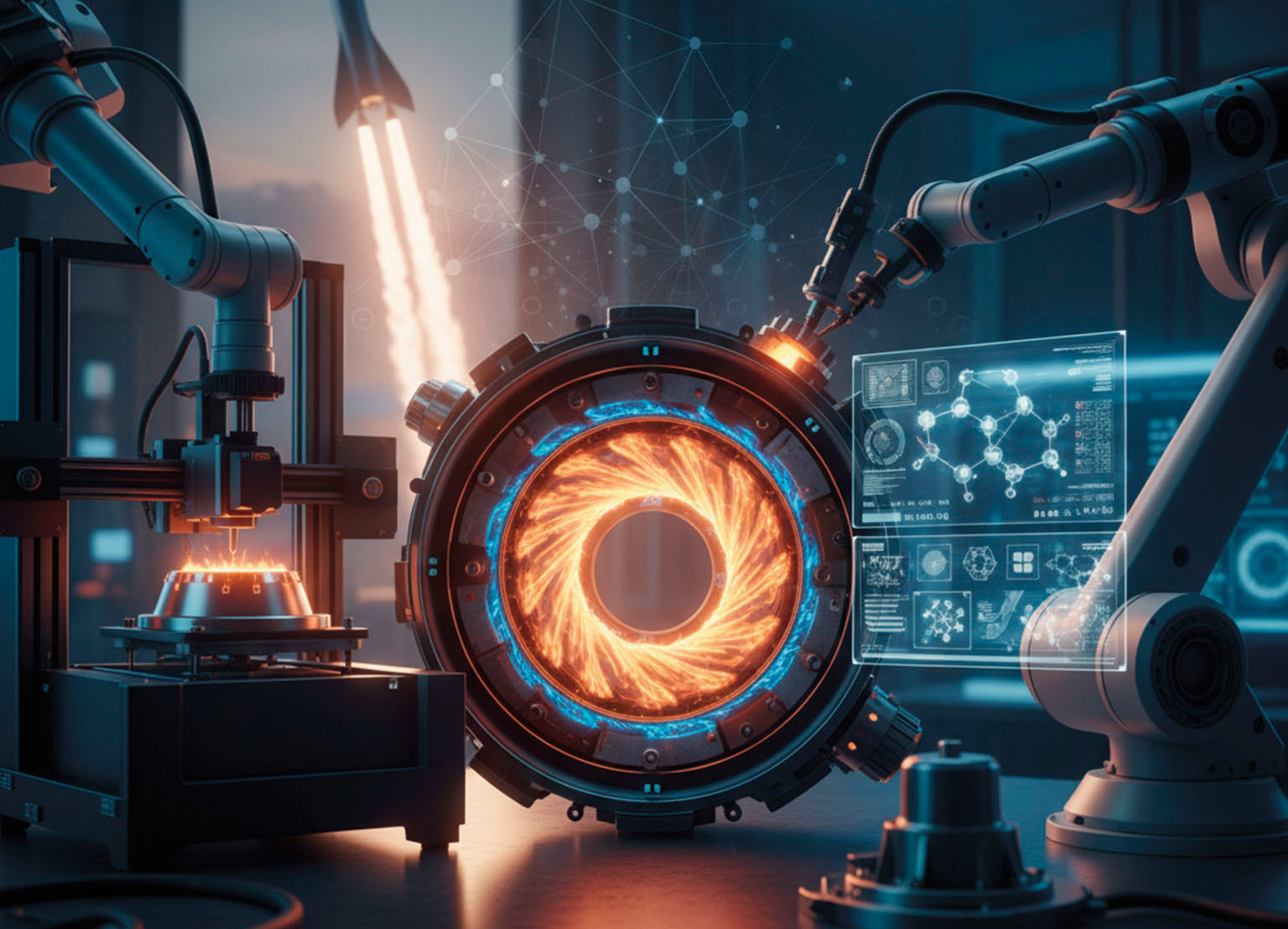
One of her current projects explores a particularly unforgiving environment: the rotating detonation engine (RDE). Unlike conventional engines, which rely on deflagration-based combustion, these engines sustain a continuous detonation wave traveling at thousands of meters per second. The design promises dramatic gains in efficiency and thrust, but it also exposes components to rapidly fluctuating thermal and mechanical loads. Although the RDE concept has advanced quickly, materials capable of withstanding these extreme conditions have not.
 Vermaak leads a multi-institutional team—with researchers at Carnegie Mellon University; the University of California, Irvine; and the Air Force Research Laboratory; and industry partners—investigating structural materials systems engineered for this harsh regime. By combining experiments, high-fidelity simulations, and data-driven tools—including AI and machine learning—the team aims to understand how alloy composition and microstructure influence damage and failure under detonation-driven loading, ultimately guiding the design of materials that can keep pace with propulsion innovation.
“This is an exciting opportunity to identify breakthrough materials capabilities that may spur advancements in propulsion systems of the future,” she says.
Another focus of Vermaak’s work is a collaboration supported by the Defense Advanced Research Projects Agency (DARPA), which addresses turbomachinery components in jet and rocket engines. The project challenges the long-standing “one part, one material” paradigm by exploring additively manufactured components in which material properties vary across a single part. Using bladed disks as a test case, the team, led by MIT, is developing AI-enabled design tools to optimize geometry, composition, and performance for each location, while considering material criticality.
Together, these projects illustrate a consistent theme in Vermaak’s research: questioning traditional assumptions about how aerospace materials and structures are designed, and expanding the range of conditions in which advanced propulsion systems can safely operate. By bridging mechanics, design, and materials science with computational and experimental tools, her work is helping to define the limits—and possibilities—for the future of flight.