
Women’s health challenges often go underexplored, but Lehigh bioengineers are bringing new tools and perspectives to the field. Their work spans tissue regeneration, wearable technology, and in vitro modeling, opening avenues to better understand conditions that affect women’s daily lives and long-term well-being.
Dhruv Seshadri
Wearable Insights
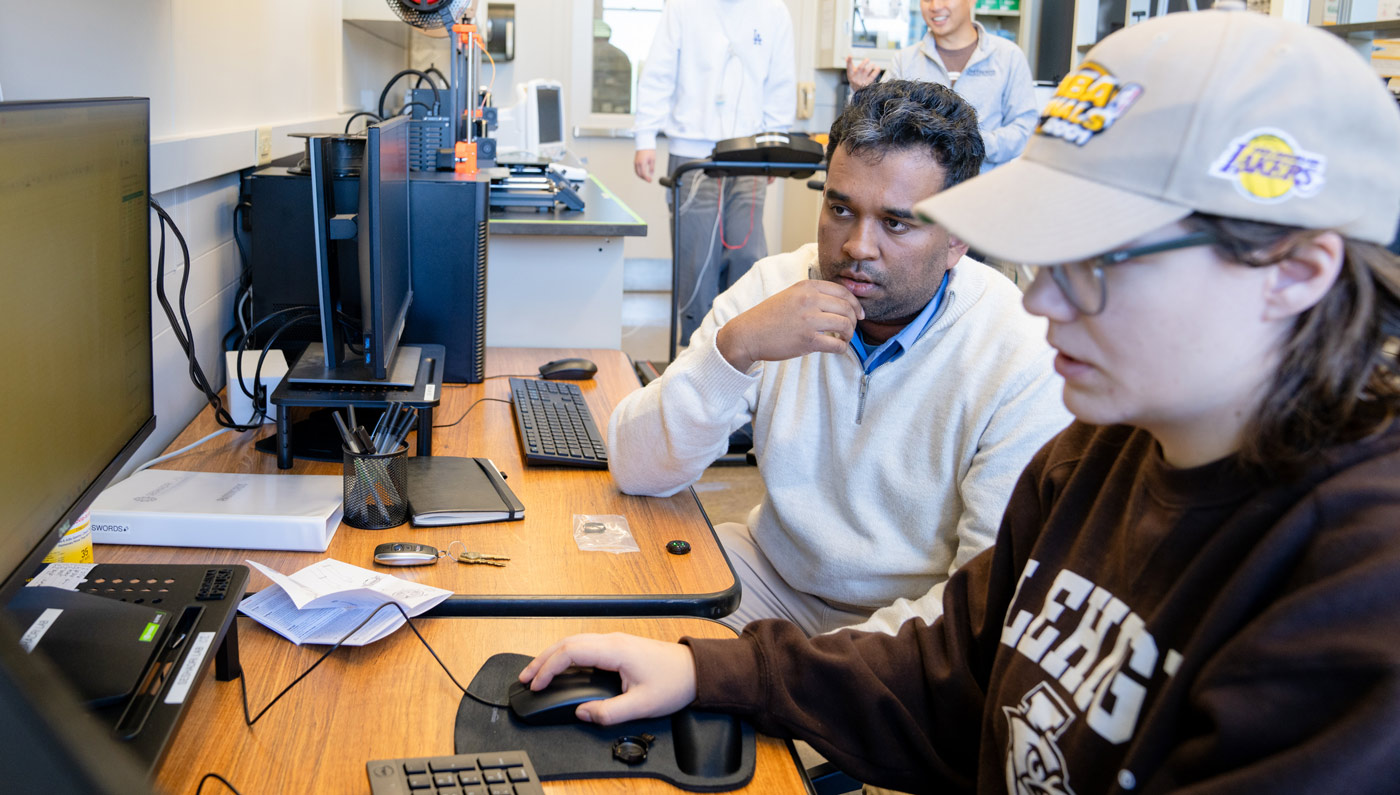
Wearable technology can play a significant role in addressing women’s health, particularly when it comes to understanding the physiological effects of their menstrual cycles. Dhruv Seshadri (pictured above), an assistant professor of bioengineering, and his team have partnered with Ultrahuman, an India-based company that calls itself “the world’s most comprehensive self-quantification platform,” on two projects addressing areas of unmet need relating to women’s health.
The first uses the company’s wearable tech to understand how female athletes respond to training, and how factors such as the menstrual cycle may affect recovery and injury risk.
“There’s a significant need for objective data that can ultimately be used for training optimization protocols to mitigate injuries, especially given that female athletes are two to eight times more likely to tear their anterior cruciate ligament compared with their male counterparts,” says Seshadri. “To date, very little is known about the effect of menstrual cycles on injury.”
To that end, Seshadri and his team, in collaboration with Ultrahuman, have equipped 13 female athletes with Ultrahuman’s Ring AIR. Sensors in the device, which is worn on the index finger, gather data on sleep, heart rate, movement, skin temperature, and more. The data is collected longitudinally to help researchers identify trends, especially in relation to menstrual cycles. Lehigh researchers will analyze the data, generate models, and provide actionable insights into how athletes are responding—or not—to their training.
The team is working closely with coaches, providing concise, data-driven feedback to guide training decisions. For instance, data derived from an athlete under the dual stresses of midterms and heavy training may reveal disrupted sleep and elevated metrics such as resting heart rate that, in combination, can increase chances of soft-tissue injury. In that case, the coach may decrease the player’s training intensity and/or direct them toward more rehab.
“We want to normalize conversations around women’s health and give athletes data to articulate and support their subjective experiences,” says Hayley Whitney ’24, a PhD student in Seshadri’s lab who leads the project. “We also want to give trainers and coaches the tools to support every aspect of the athlete.”
Seshadri also emphasizes leveling the playing field in sports science. “A lot of research has focused on professional or elite athletes. We want to make this technology and data accessible and meaningful for everyone.”
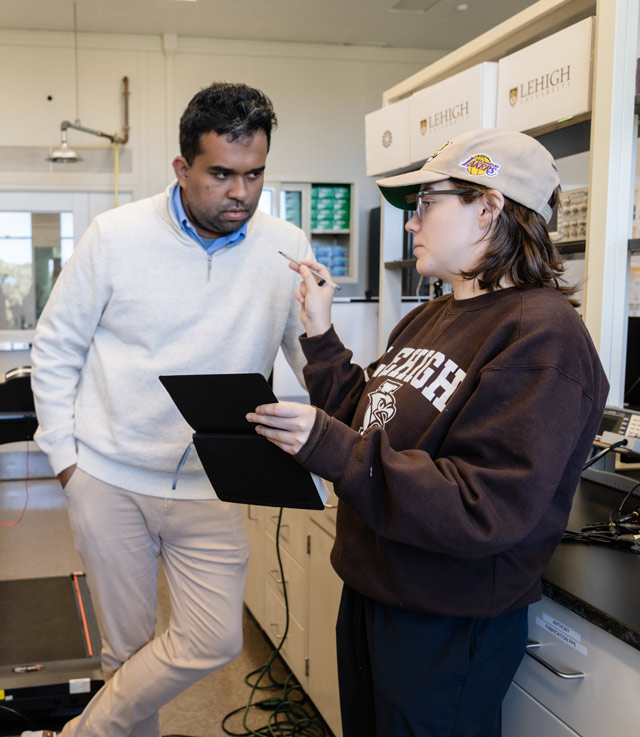 In the second project, Seshadri and his team are leading a women’s health initiative in South India that blends research, education, and service to address long-held taboos around menstrual hygiene and maternal care.
With support from Lehigh’s Office of International Affairs, and again in partnership with Ultrahuman, the study aims to empower young women through education and data-driven health tools. The research component targets college students and young healthcare workers—many of whom have never participated in formal research—and uses the Ring AIR to track vitals and menstrual cycles. The 22 participants will wear the ring continuously for nine months, and Seshadri’s team will collect and analyze the data and educate the participants on what the results mean for their health.
“Wearable technologies have the potential to revolutionize women’s health by offering continuous, real-time monitoring and enabling early intervention,” says Rupa Ravi, a global and women’s health consultant for the Seshadri Lab. “In maternal and pregnancy monitoring, these devices can track critical indicators such as blood sugar levels in gestational diabetes and blood pressure in hypertensive disorders, providing valuable data that can drive timely interventions and significantly improve outcomes. Beyond maternal health, wearables also empower individuals to track menstrual cycles, manage pain, and monitor symptoms related to gynecological conditions. This real-time, personalized care is especially critical in remote and low-resource settings, where healthcare access is often limited and burdened by significant barriers.”
For the education component, Seshadri and Ravi co-taught a course titled Global Health and Bioengineering for Empowering Women’s Health, which reached more than 80 individuals across two cities in South India. The sessions covered menstrual health and education, wearable technology, and the bioengineering program at Lehigh. Ravi recently presented this work at the FIGO World Congress of Gynecology and Obstetrics in South Africa.
“We wanted to assess the knowledge gaps in this field,” Seshadri says. “We collected a robust data set to identify critical path elements in women’s health, where engineering can help bridge the gap with current healthcare challenges. Our goal is to ultimately develop low-cost, scalable, and equitable technologies to advance women’s health.”
The third arm of the project focused on direct service—delivering menstrual kits that included reusable, biodegradable pads and wipes and iron-rich sweets to impoverished tribal communities facing limited access to resources, cultural stigmas, and domestic violence.
“We wanted to better understand their living conditions and thoughts on menstrual hygiene and education,” he says. “We also learned that they’re very interested in using wearable tech and partnering with us to develop tools that could potentially help them.”
The ultimate goal, he says, is to scale the entire initiative to all of India and use it as a way to break taboos around menstruation, while developing wearables that can have a measurable impact on women’s lives.
In 2026, Seshadri plans to launch a new course focused on the nexus of sustainability, equitable innovation, and digital health in collaboration with enterprise software company KGiSL in Coimbatore, India. His aim is to ensure that his lab’s work stays closely aligned with the United Nations’ sustainable development goals and is translated into practical solutions that improve patient outcomes.
“I went into academia to help people,” says Seshadri. “And more than ever, the world needs this type of meaningful partnership between industry and higher education.”
 Taneka Jones
3D Modeling
She calls herself a “tissue architect.”
Taneka Jones (pictured) is a research assistant professor in the Department of Bioengineering, and a tissue engineer by training. She is also adept at forming the kinds of partnerships that help translate groundbreaking research into real-world medical practice. It’s an ability she developed as a medical science liaison where she worked with clinicians and other stakeholders to identify problems that could be addressed through industry innovation.
“Lehigh may not have a hospital directly affiliated with it,” she says, “but the university is extremely interested in building capacity and building capability. External partnerships will enhance our ability to support clinical translation.”
Jones recently received grant funding to help gynecologists at the University of Michigan Medical Center, in collaboration with Erica Marsh, MD, a professor of obstetrics and gynecology at U-M Medical School, develop in vitro models to study uterine pathology.
“Doctors will send us both healthy and diseased uterine tissues that have been extracted from patients of different ages,” she says. “With my biofabrication expertise, I’ll use these tissues to create tissue mimics, or 3D models, that we can then use to identify new therapies to target extracellular matrix disease as it relates to the uterus.” (The extra-cellular matrix refers to the non-cellular tissues that support a healthy tissue environment.)
One of the conditions the team is addressing is fibroids. These noncancerous growths inside the uterus can cause symptoms such as pain and heavy bleeding that can significantly degrade quality of life, and all women are at risk. Fibroids can be surgically removed, but they often grow back. Currently, a hysterectomy is the only definitive treatment.
“We don’t have a good grasp on fibroid development, and so we don’t understand why they recur,” says Jones. “There’s a gap between what’s happening at the tissue level, and what clinicians understand. I’ll be using these tissues to study various time points in a woman’s reproductive lifespan, and to build better in vitro models that will allow for earlier interventions so that a hysterectomy is no longer considered the gold standard for treatment.”

Anand Ramamurthi
Elastic Matrix Repair
Pelvic organ prolapse (POP) is a disorder that primarily affects older women who have experienced multiple vaginal childbirths.
Repeated vaginal deliveries can cause the muscles and connective tissue that hold the pelvic organs—the vagina, bladder, uterus, urethra, and rectum—to weaken, causing one or more of the organs to drop out of position and bulge or extrude outside the body.
“There’s a breakdown and loss of the elastic matrix that contributes to tissue elasticity, similar to how a rubber band can stretch and recoil,” says Anand Ramamurthi (pictured), professor and chair of the Department of Bioengineering. “In adults, those elastic fibers aren’t regenerated or repaired because most of what exists in the body is produced just before or just after a woman is born.”
The disorder affects approximately three to 11 percent of all women, according to the Cleveland Clinic. Although a history of multiple vaginal deliveries is the primary risk factor, others include being overweight, having connective tissue disease, and having a family history of the disease.
In addition to causing emotional stress and a degradation in quality of life, POP creates significant discomfort and pain, says Ramamurthi. “For some women in the early stages, specific exercises, called Kegel exercises, that strengthen pelvic floor muscles can help. But for those in more advanced stages, surgery is the only option.”
The problem with surgery, he says, is that the mesh traditionally used to hold the organs in place is made of polypropylene materials that stimulate fibrotic thickening, or scarring, that causes pain. The FDA has since banned those polymer-based meshes, and surgeons must now rely on tissue grafts taken from the patient. However, these grafts can lead to complications, including infection, urinary retention, graft-related incontinence, pain, and recurrence of prolapse.
“So there are very few options for them,” says Ramamurthi. “We want to develop a nonsurgical solution that could be applied in the early stages of POP to delay the disorder’s onset and/or its progression. If we’re successful in doing that, we believe that in the future, our treatment could be applied to reduce the severity of POP in patients at a more advanced stage.”
Ramamurthi and his team, which includes Margot Damaser, a biomedical engineering researcher at the Cleveland Clinic, recently received an approximately $3.2 million, five-year grant from the National Institutes of Child Health and Development, with approximately half of the total funding going to Lehigh.
The team will explore a three-phase research methodology. In the first, they will use cell cultures to investigate therapies that could inhibit the breakdown of the elastic matrix.
“We’ve developed nanoparticles that can be used to deliver a drug called doxycycline, which inhibits the enzymes that cause the breakdown of tissue structures,” he says. “We’ve previously shown that when we deliver this drug at very small doses, it not only has anti-degradative effects, but it also regenerates the elastic matrix, which is a novel finding.”
The nanoparticles themselves, Ramamurthi says, are also modified to inhibit degradative enzymes and stimulate elastic matrix production, and so act synergistically with the drug. The team will test the nanoparticles in cell cultures of non-epithelial vaginal cells from patients who underwent POP surgery.
“The purpose of the first phase is to discover novel molecular targets for therapy,” he says. “We want to identify what target proteins the drugs are acting on, and if there are other targets we’re not yet aware of.”
 In the second stage of the research, the team will test the nanoparticles on surgically extracted tissues in a long-term culture to determine if the nanoparticles improve tissue health. In the third phase, they will evaluate the treatment in vivo.
“We’ll be using a cutting-edge mouse model,” he says. “The mice are missing a specific gene, called Loxl1, which means they lack the protein required for crosslinking elastin precursor molecules into a structural matrix in adult tissues. The mouse model is unique in that mice lacking Loxl1 spontaneously develop POP after multiple vaginal births in a manner that closely evokes the clinical condition. We will deliver the nanoparticles into the vaginal wall, and we want to know: Do the nanoparticles stay in place? Do they release the drug? Where does the drug go? Does the condition improve? We will essentially be looking at how the tissue structure improves across time.”
If successful, such a nonsurgical intervention could prevent or even reverse the matrix degradation that leads to POP, reduce the severity of its later stages, and potentially help younger women with POP who want to have more children.
“Despite the prevalence of POP, it’s a disease without mainstream visibility,” says Ramamurthi. “There are only a few research groups focusing on it, and even fewer looking into regenerative therapies. Our lab’s expertise lies in regenerative therapies for elastic matrix assembly and we’ve been collaborating with the Damaser Lab for 10 years. What we’re proposing here is an extremely high level of innovation—a nonsurgical therapeutic that could reverse the pathophysiology of disease. There are very few groups in the world capable of doing this.”