
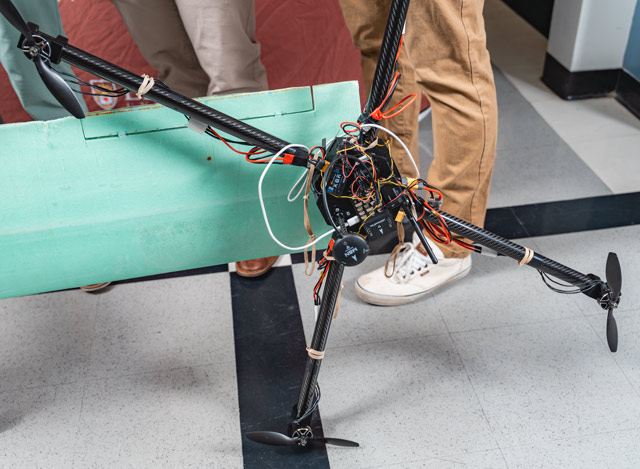
A team of seniors advised by Ebru Demir, an assistant professor of mechanical engineering and mechanics, will soon present their drone design to NASA representatives. It’s designed for vertical takeoff, horizontal flight, and capturing aerial images to create geomaps of a given area. Potential uses include search-and-rescue in difficult terrain or providing reconnaissance to inform military operations.
The students are part of the Interdisciplinary Capstone Design experience, a two-semester industry simulation that runs from the spring of their junior year through their senior fall semester. It’s one of several capstone options offered across the college.
While FYRE, the new First-Year Rossin Experience, will introduce hands-on learning at the start of the undergraduate journey, capstone serves as its pinnacle, giving upper-level students the opportunity to apply those design-and-build skills in industry-driven projects.
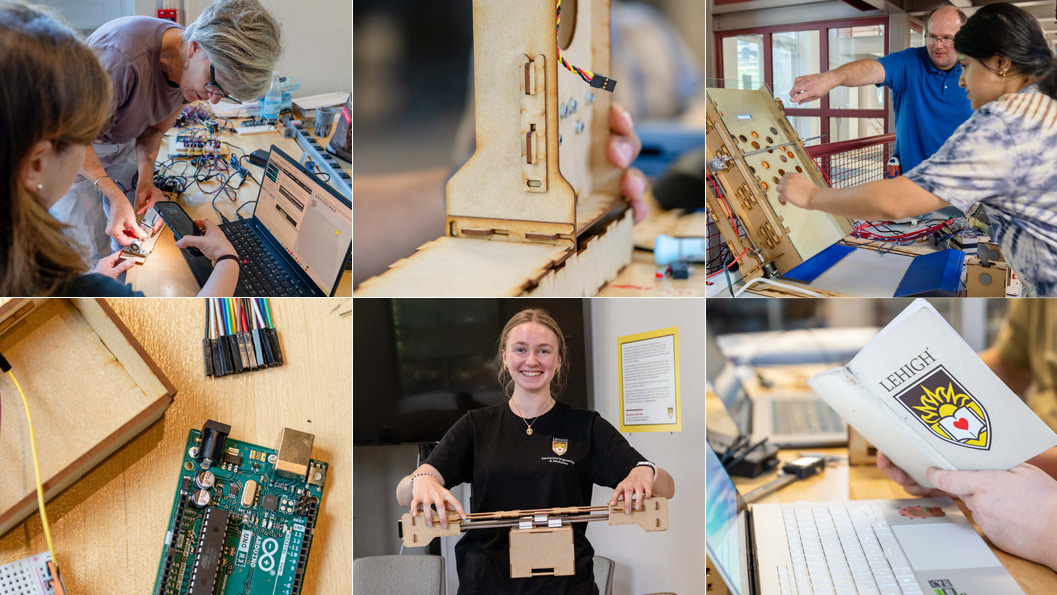
Interdisciplinary Capstone Design spans three departments: mechanical engineering and mechanics (MEM), materials science and engineering, and bioengineering. Undergraduates work in small teams on real-world projects sponsored by roughly 30 external industry partners. In the first semester, students focus on conceptual design—understanding the problem, gathering stakeholder input, developing project management and communication skills, and building prototypes. In the second, they fabricate and test solutions. Through it all, they collaborate with industry and academic advisors, manage budgets, and work across disciplines.
 “The problems industry faces are interdisciplinary and require multiple areas of expertise,” says program director Emrah Bayrak, an assistant professor in the MEM department. “Students need to learn how to work with people from different backgrounds because that’s what they’ll be required to do in their jobs. This capstone experience reflects and prepares them for that reality.”
This model of preparation began 30 years ago with the Integrated Product Development (IPD) program. At the time, engineering design was standard in engineering curricula, but such programs typically stayed within academia and addressed academic questions, says Sabrina Jedlicka, Lehigh’s deputy provost for graduate education. Jedlicka, who is also an associate professor of bioengineering and materials science and engineering, led the effort to grow IPD into a campus-wide, interdisciplinary capstone design program following the retirement of its longtime director, MEM professor John Ochs, in 2018.
“IPD filled a gap in engineering training,” she says. “It embraced an interdisciplinary mindset and was driven by real-world projects with outside mentors guiding students on work that mattered to their organizations. IPD served as a model for many subsequent programs.”
Over the past three decades, IPD has grown, evolved, changed names, and spawned numerous success stories in terms of university facilities, programs, and student-led startups: The Baker Institute for Entrepreneurship, Creativity and Innovation; the Innovation Lab at Wilbur Powerhouse; the master’s program in Technical Entrepreneurship; and startups such as EcoTech Marine (aquarium equipment), With Meraki Co. (probiotics for vaginal health), and Tick Mitt (a reusable, tick-removing glove) all have roots that can be traced to the program.
“So many innovative ideas and ventures have come out of the Interdisciplinary Capstone Design program,” says Jedlicka. “Students are leaving Lehigh with an understanding not only of the technical skills that they need to be able to do their job, but also of the business acumen and process skills needed to create things that people want with limited waste. That is the definition of a future maker.”
The NASA drone team, which is also mentored by Terry Hart, a teaching full professor of mechanical engineering and mechanics and a former astronaut—will graduate with a wide range of skills and experiences to draw on immediately.
“The stakes are high because many of our partners rely on Lehigh for solutions,” says Bayrak. “They expect our students to deliver something that works—just like in the real world. When these students interview for jobs, they constantly reference their capstone experience. They’re starting their careers with confidence.”
Beyond supplying valuable experience to students, he says, “Interdisciplinary Capstone Design provides added value to our industry partners by strengthening the student recruitment pipeline, as many companies participate specifically to develop relationships with Lehigh and recruit our students.”